
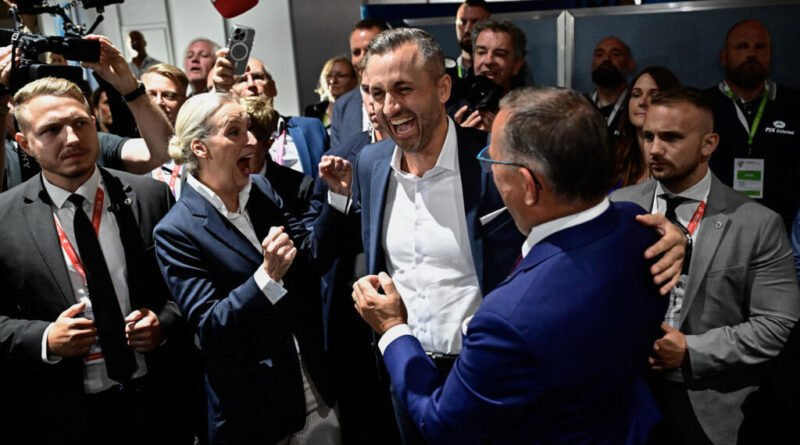
German Far Right Celebrates Historic Victory
German Right Celebrates: 1. Executive Summary & Strategic Importance
The geopolitical architecture of contemporary Europe is undergoing a seismic realignment, centered squarely on the shifting political tectonic plates of the Federal Republic of Germany. As polling stations close across eastern states like Saxony-Anhalt, the atmosphere is charged with an electric tension that has not been witnessed in the post-reunification era. At the epicenter of this historic transformation stands Ulrich Siegmund, the charismatic and calculated leader of the far-right Alternative for Germany (AfD) in Saxony-Anhalt, whose campaign has surged to a commanding pole position. With the provocative yet potent slogan “Everything is possible” echoing across town halls, digital feeds, and factory floors, the party’s rank-and-file are not merely celebrating a localized electoral victory; they are orchestrating a fundamental challenge to the post-war democratic consensus that has governed Germany for nearly eight decades.
This master investigative analysis deconstructs the profound macro implications of this watershed moment. For decades, the Federal Republic operated under a strict, unwritten firewall—the *Brandmauer*—which isolated populist right-wing movements from legitimate governance coalitions. However, the erosion of this barrier in eastern regional parliaments signals a structural paradigm shift. The normalization of AfD rhetoric and policy positions from the fringes of political discourse to the halls of legislative power threatens to destabilize traditional party lines, notably pressuring the Christian Democratic Union (CDU) and the Social Democratic Party (SPD). Stakeholders ranging from international financial markets and European Union institutions to multinational corporations operating within the German industrial engine must now recalibrate their risk assessments. The political normalization of the far-right introduces regulatory unpredictability, shifts in immigration and labor policies, and a questioning of core European integration frameworks that could reverberate far beyond Germany’s borders.
Furthermore, the socioeconomic grievances fueling this historic surge cannot be dismissed as ephemeral protest votes. They represent deep-seated structural anxieties regarding deindustrialization, energy transition costs, demographic shifts, and a widening cultural disconnect between urban metropolises and rural or post-industrial eastern peripheries. As Ulrich Siegmund prepares to potentially helm a state-level administration, the strategic importance of this development transcends domestic politics. It serves as a bellwether for the future viability of liberal democracy across the European Union, testing the resilience of democratic institutions against the relentless tide of populist nationalism. This article provides an exhaustive, multi-faceted investigation into the historical catalysts, technical operational mechanics, comparative benchmarks, and strategic implications of Germany’s profound political transformation.
2. Historical Context & Industry Evolution
To fully comprehend the magnitude of the AfD’s electoral breakthrough in Saxony-Anhalt, one must trace the evolutionary trajectory of German post-war politics and the unique socio-economic grievances that have metastasized across the former East Germany, known colloquially as the *Neue Bundesländer*. For decades following the 1990 reunification, the political landscape was anchored by a stable, centrist duopoly composed of the center-right CDU and the center-left SPD, occasionally modulated by the liberal FDP or the Greens. The emergence of the Left Party (*Die Linke*) provided a localized outlet for eastern discontent, but it largely remained tethered to the parliamentary mainstream. The sovereign debt crisis of 2010, followed rapidly by the 2015 European migrant crisis, acted as the primary catalytic drivers that fractured this stable political paradigm, opening a wide ideological vacuum on the right flank of the Christian democrats.
The AfD was originally founded in 2013 not as an extremist nationalist formation, but as an economically liberal, Euro-skeptic party spearheaded by academics and business figures critical of the European sovereign debt bailouts. However, the party underwent a rapid, radical ideological mutation. Seizing upon widespread public anxiety regarding the influx of over one million asylum seekers in 2015 and 2016, the party pivoted decisively toward ethno-nationalism, anti-immigration rhetoric, and fierce opposition to climate change policies. In the eastern states, this ideological evolution found exceptionally fertile soil. The post-reunification transition was characterized by rapid deindustrialization, mass emigration of skilled youth, wage stagnation, and a pervasive sentiment among eastern citizens of being treated as second-class citizens relative to their western compatriots—a sociological phenomenon that researchers term *Ostfrust* (eastern frustration).
As legacy industries withered and infrastructure investments lagged, populist actors successfully weaponized these legitimate economic anxieties. By framing systemic transformations—such as the green energy transition (*Energiewende*) and digitalization—as existential threats to traditional ways of life, figures like Ulrich Siegmund systematically dismantled the cultural hegemony of the traditional centrist parties. The industry evolution of political communication also played a pivotal role. The AfD mastered algorithmic social media campaigning, bypassing traditional gatekeepers of information to build direct, emotional connections with disillusioned voters. Consequently, what began as a fringe protest movement has evolved into a disciplined, institutionalized political force capable of capturing state-level pluralities, fundamentally rewriting the rules of engagement in German electoral politics and setting a dangerous precedent for future federal cycles.
3. Deep-Dive Architectural & Technical Mechanics
The electoral dominance of the AfD in Saxony-Anhalt is not merely a product of rhetorical flair; it is underpinned by sophisticated organizational architecture, data-driven targeting mechanics, and a calculated operational workflow designed to maximize voter mobilization in low-trust environments. Understanding the mechanics of how Ulrich Siegmund and his regional apparatus achieved pole position requires a granular examination of their campaign infrastructure.
Data-Driven Voter Micro-Targeting and Algorithmic Penetration
Unlike traditional German political parties that relied heavily on door-to-door canvassing and broad-brush television advertising, the AfD leveraged digital-first engagement strategies. Operating within the permissive parameters of modern social media platforms, the party’s digital strategists deployed advanced micro-targeting algorithms. By analyzing localized grievances—such as public transport deficits, rural doctor shortages, and municipal spending on integration programs—the campaign generated hyper-localized digital content. This operational workflow ensured that a voter in rural Magdeburg received targeted messaging regarding local infrastructure decay, while urban users were targeted with content concerning public safety and economic stagnation.
Resource Allocation and Cadre Development
The institutional maturation of the AfD in the east involved shifting from amateurish protest structures to professionalized party machinery. Key operational components include:
- Cadre Training Academies: Establishing rigorous internal training programs to groom young, articulate politicians like Ulrich Siegmund in media management, rhetorical defense, and parliamentary procedure.
- Financial Independence: Cultivating diverse donor networks, alongside state-matching funds derived from previous electoral successes, to ensure continuous, uninterrupted campaign expenditure between election cycles.
- Grassroots Synergy: Integrating local associations (*Kreisverbände*) with active civic groups, sports clubs, and cultural initiatives to embed the party deeply into the social fabric of small towns and rural communities.
Policy Packaging and Legislative Disruption
Technically, the party’s legislative strategy relies on the systematic exploitation of procedural rules within state parliaments (*Landtage*). By introducing provocative motions concerning migration caps, gender-neutral language bans, and the rolling back of green energy mandates, the AfD forces established parties into defensive postures. This tactical agility allows them to dominate the political news cycle, framing themselves as the sole authentic voice of opposition against an out-of-touch federal elite in Berlin. The architectural genius of their approach lies in its elasticity: it captures disaffected former non-voters by validating their alienation while simultaneously normalizing radical policy proposals through formal parliamentary channels.
4. Comparative Market Framework & Benchmarking
To contextualize the rise of the AfD in Saxony-Anhalt within a broader comparative framework, it is essential to benchmark its operational dynamics against other European right-wing populist movements and historical precedents. The table below delineates the structural, ideological, and tactical dimensions of the German far-right relative to comparable European entities.
| Analytical Dimension | Alternative for Germany (AfD – Saxony-Anhalt) | National Rally (RN – France) | Freedom Party of Austria (FPÖ) | Traditional German Centrist Parties (CDU/SPD) |
|---|---|---|---|---|
| Core Ideological Driver | Ethno-nationalism, anti-immigration, Euroscepticism, anti-green transition | Economic patriotism, secularism, anti-immigration, soft Euroscepticism | Right-wing populism, anti-establishment, pan-German nationalism | Liberal democracy, pro-EU integration, social market economy |
| Electoral Base | Post-industrial eastern working class, rural disaffected, anti-establishment youth | Working-class suburbanites, rural voters, deindustrialized northern/southern regions | Blue-collar workers, rural populations, traditionalist middle class | Urban professionals, aging demographic cohorts, public sector employees |
| Institutional Integration | Emerging regional pluralities; strict federal firewall (*Brandmauer*) in place | Significant parliamentary representation, normalization via mainstreaming | Frequent coalition partner at federal and state levels | Mainstream governing hegemony; historical architects of the post-war state |
| Communication Strategy | Algorithmic digital-first, aggressive social media, emotional grievance mobilization | Brand softening, polished leadership, institutional respectability (*dédiabolisation*) | Provocative tabloid engagement, traditional media confrontation, digital networks | Conventional media channels, press conferences, institutional PR |
| Economic Stance | Tax cuts, deregulation, skepticism of state intervention, anti-subsidy | State interventionism, protectionism, pension defense, welfare chauvinism | Economic liberalism blended with social welfare protectionism | Regulated market capitalism, green industrial subsidies, labor protections |
The comparative analysis reveals distinct strategic nuances. While Marine Le Pen’s National Rally in France has aggressively pursued a strategy of *dédiabolisation* (de-demonization) to broaden its electoral appeal into mainstream urban centers, the AfD in eastern states like Saxony-Anhalt operates from a position of confident radicalism. Ulrich Siegmund and his peers do not feel compelled to moderate their rhetoric because the structural alienation in the east is so profound that raw, unvarnished anti-establishment posturing yields maximum electoral dividends. Furthermore, unlike the Austrian FPÖ, which has routinely integrated into government coalitions as both junior and senior partners, the AfD remains politically quarantined at the federal level by the *Brandmauer*. However, achieving pole position in eastern state parliaments shatters the psychological barrier of this quarantine, transforming the AfD from an untouchable pariah into an unavoidable political reality that will ultimately force painful strategic reckonings within Germany’s centrist parties.
5. Enterprise, Geopolitical & Socio-Economic Ramifications
The ascension of the far-right in Saxony-Anhalt carries profound downstream consequences for corporate enterprises, geopolitical stability, and socio-economic cohesion across Germany and the wider European Union. As regional governance dynamics shift, the operational environment for multinational corporations and local businesses alike is entering a phase of acute uncertainty.
Impact on Foreign Direct Investment and Industrial Competitiveness
Germany’s eastern states have aggressively courted foreign direct investment (FDI) in recent years, notably securing multi-billion-euro semiconductor fabrication plants (such as Intel’s planned facilities in Magdeburg). However, the political normalization of a far-right party characterized by extremist elements introduces severe reputational and operational risks for global enterprises. International corporations depend heavily on stable legal frameworks, predictable regulatory environments, and—crucially—access to a globalized, highly skilled talent pool. If state-level administrations implement restrictive immigration controls, xenophobic rhetoric, or policies that alienate foreign engineers and researchers, Saxony-Anhalt and neighboring regions risk severe brain drain. This talent exodus would directly impair industrial competitiveness, threatening to turn economic revitalization zones into isolated backwaters.
Geopolitical Strain on European Union Cohesion
At the geopolitical level, a breakthrough by Ulrich Siegmund and the AfD intensifies centrifugal forces within the European Union. While the party has periodically softened its rhetoric regarding an immediate *Dexit* (German exit from the EU), its core platform advocates for a radical devolution of EU powers, a rejection of common European debt mechanisms, and a dismantling of climate regulations. Germany is traditionally the indispensable anchor of European integration and financial stability. A politically fractured Germany, consumed by internal polarization and regional governance paralysis, would severely compromise the EU’s ability to act decisively on pressing international crises, from trade policy to defense cooperation and enlargement.
Socio-Economic Fragmentation and Labor Market Pressures
Socio-economically, the polarization fostered by populist victories threatens to deepen the cultural and economic chasm between eastern and western Germany. Employers already struggling with a demographic labor shortage report growing difficulties in recruiting qualified non-German personnel to eastern manufacturing hubs due to safety and discrimination concerns. Consequently, populist political victories intended to protect local citizens may inadvertently trigger economic stagnation by repelling the very global capital and labor resources required to sustain regional prosperity.
6. Strategic Implementation Roadmap & Future Outlook
As Germany navigates this critical historical juncture over the next 12 to 36 months, political stakeholders, corporate entities, and civil society institutions must execute structured strategic roadmaps to mitigate systemic risks and adapt to evolving governance paradigms.
- Phase 1: Immediate Risk Assessment & Stakeholder Alignment (Months 1–6)
Corporations and institutional investors must conduct comprehensive geopolitical risk audits of their eastern German operations. Human resources departments need to establish robust support protocols for international employees to counter rising xenophobia and ensure workforce retention.
- Phase 2: Democratic Resilience & Civil Society Mobilization (Months 6–18)
Centrist political parties and civic institutions must transition from reactive moral condemnation to proactive structural engagement. This involves addressing root economic grievances—such as lagging rural infrastructure, wage disparities, and inflation pressures—while robustly defending democratic norms through transparent, responsive governance.
- Phase 3: Legislative Navigation & Coalition Stress-Testing (Months 18–36)
As regional parliaments grapple with hung assemblies or unprecedented AfD pluralities, established parties must determine whether to maintain absolute legislative boycotts or adapt to a fragmented parliamentary reality. Policymakers must carefully balance democratic accountability against the risk of institutional paralysis.
Ultimately, the future outlook depends on the capacity of Germany’s democratic institutions to prove their tangible utility to citizens who feel abandoned by the political establishment. If traditional parties fail to deliver concrete improvements in daily living standards, slogans like “Everything is possible” will cease to be mere campaign hyperbole and instead become the defining reality of a transformed German republic.
7. Frequently Asked Questions (FAQ) & Expert Insights
To provide exhaustive clarity on this rapidly evolving political landscape, here are expert answers to high-intent search queries concerning the rise of the AfD and Ulrich Siegmund in Saxony-Anhalt.
1. Who is Ulrich Siegmund, and why is he central to the current political shift in Saxony-Anhalt?
Ulrich Siegmund is the prominent regional leader of the Alternative for Germany (AfD) in Saxony-Anhalt. Articulate, disciplined, and emblematic of the party’s younger cadre of professionalized politicians, Siegmund has successfully capitalized on local socio-economic frustrations to steer his party into pole position in state polls. His leadership style blends aggressive anti-establishment rhetoric with disciplined parliamentary tactics, making him a central figure in normalizing far-right governance ambitions in eastern Germany.
2. What is the significance of the AfD’s campaign slogan “Everything is possible”?
The slogan “Everything is possible” (*Alles ist möglich*) serves a dual psychological and tactical purpose. Psychologically, it galvanizes the party’s base by shattering the long-held assumption that the far-right can never achieve legitimate governing power in Germany. Tactically, it signals an aggressive challenge to the traditional centrist firewall (*Brandmauer*), asserting that state-level pluralities or even executive leadership positions are now within the party’s immediate grasp.
3. How does the political dynamic in eastern Germany differ from western states?
Eastern Germany (*Neue Bundesländer*) features a distinct political culture shaped by the trauma of post-reunification deindustrialization, lower average wages, and weaker historical attachments to traditional centrist parties like the CDU and SPD. These structural conditions create fertile ground for populist movements that promise radical systemic disruption, whereas western states maintain a more stable, albeit increasingly fractured, centrist alignment.
4. What is the *Brandmauer*, and is it under threat?
The *Brandmauer* (firewall) is the unwritten political consensus among Germany’s mainstream democratic parties (CDU, SPD, Greens, FDP) never to form coalitions, enter legislative pacts, or cooperate with the AfD. While national and state leaderships publicly reaffirm this firewall, the AfD’s electoral dominance in eastern states places immense pressure on local and regional politicians, threatening to strain or breach this defensive barrier as parliamentary arithmetic makes traditional coalition building mathematically unviable.
5. How will this electoral victory impact foreign investment and multinational corporations in Germany?
The normalization of far-right governance introduces regulatory unpredictability and reputational risks that could deter foreign direct investment. Multinational corporations heavily reliant on international engineering talent and diverse global supply chains express growing anxiety that xenophobic rhetoric and restrictive regional policies will trigger a severe brain drain, undermining eastern Germany’s hard-won industrial revitalization.
6. Can the AfD be banned under Germany’s constitutional framework?
Under Germany’s Basic Law (*Grundgesetz*), the Federal Constitutional Court possesses the authority to ban political parties that actively seek to undermine or abolish the democratic basic order (*Verfassungswidrigkeit*). However, initiating a party ban is a legally rigorous, politically fraught process with an exceptionally high evidentiary threshold. Consequently, mainstream political leaders have generally favored defeating the party through political competition and policy delivery rather than judicial prohibition.
Discover more in-depth coverage in our Breaking News editorial hub.
For primary data verification and historical benchmarks, consult official releases on Reuters Global News.
