
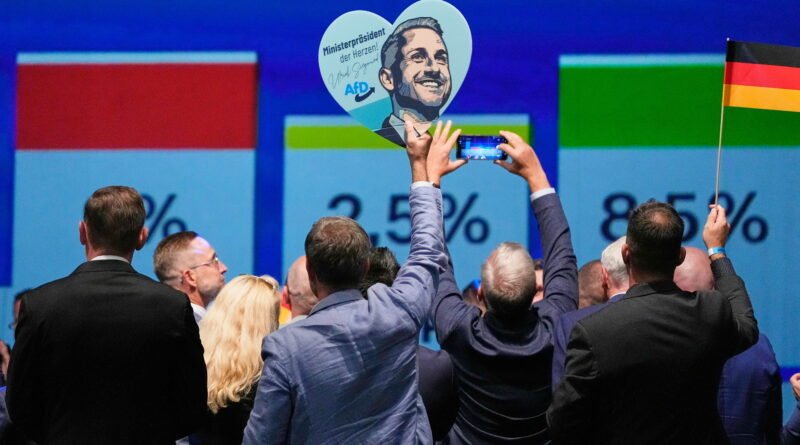
Far Right Surges Ahead in Key German Regional Vote
right surges ahead: 1. Executive Summary & Strategic Importance
The recent tectonic shifts in Germany’s political landscape, underscored by commanding exit polls suggesting a profound victory for the far-right Alternative for Germany (AfD) in a vital regional election, mark a watershed moment in post-World War II European political history. As initial projections flashed across newsrooms and parliamentary monitors, the sheer scale of voter realignment captured the attention of international markets, geopolitical strategists, and constitutional watchdogs alike. For decades, the Federal Republic of Germany operated under a deeply entrenched democratic consensus—a centrist, firewall-enforced stability designed explicitly to prevent the resurgence of radical extremist movements that precipitated the catastrophes of the mid-20th century. However, this foundational architecture is now facing its most rigorous stress test to date.
At the center of this seismic event is the AfD, a party that has systematically evolved from an anti-euro academic protest movement into a hardened, populist-nationalist force capitalizing on public anxieties surrounding immigration, economic stagnation, inflation, and the rapid, often disruptive green energy transition. The exit polls, corroborated by early precinct returns, indicate that the party has secured a historic plurality, outperforming both traditional center-right Christian Democrats and the center-left establishment parties currently heading federal coalitions. This development is not merely an isolated regional anomaly; it functions as a glaring barometer of deep-seated systemic discontent sweeping across Europe’s economic powerhouse. The core stakeholders in this unfolding drama include federal lawmakers in Berlin grappling with declining approval ratings, regional business leaders worried about labor retention and foreign investment, European Union technocrats monitoring the erosion of liberal democratic norms, and millions of German citizens whose views on national identity and global integration are fracturing along ideological lines.
The macro implications of this electoral outcome extend far beyond regional governance. While winning a plurality of the popular vote is a symbolic and legislative triumph for the AfD, the immediate operational reality is defined by the so-called Brandmauer—the informal, unyielding firewall maintained by all mainstream democratic parties pledging never to form a coalition or enter into government partnerships with the far right. Consequently, even with an imposing lead, the party faces a formidable path toward executive power, raising complex questions about legislative gridlock, minority governance, and the potential normalization of previously unpalatable political configurations. This analysis provides an exhaustive, multi-dimensional investigative breakdown of the historic drivers, operational mechanics, market repercussions, and strategic futures defining Germany’s unprecedented political crossroad.
2. Historical Context & Industry Evolution
To fully comprehend the gravity of the recent regional election results, one must trace the historical trajectory of Germany’s post-war political ecosystem. Founded on the ashes of the Weimar Republic’s collapse and the horrors of Nazi totalitarianism, the Basic Law (Grundgesetz) of 1949 established a “defensive democracy” (streitbare Demokratie). This institutional framework was purposely engineered with structural tripwires—such as proportional representation with a five-percent electoral threshold, a powerful constitutional court, and strict limits on anti-constitutional rhetoric—to insulate the young republic from extremist subversion. For over half a century, this system fostered a remarkably stable two-plus-party dominance anchored by the Christian Democratic Union/Christian Social Union (CDU/CSU) and the Social Democratic Party (SPD), occasionally modulated by the liberal Free Democratic Party (FDP) or, more recently, Alliance 90/The Greens.
The paradigm shift began in earnest in the wake of the 2015 European migrant crisis, when Chancellor Angela Merkel’s government welcomed over one million asylum seekers, predominantly from conflict zones in the Middle East. This singular policy decision ruptured the post-reunification consensus, creating an immediate political vacuum on the right flank of the CDU. Sensing profound public anxiety regarding border security, cultural assimilation, and strained social services, a coalition of conservative academics, economists, and disillusioned politicians founded the Alternative for Germany. Initially focused on Eurozone bailout criticisms, the party rapidly pivoted toward virulent anti-immigration rhetoric, national sovereignty, and skepticism toward mainstream media.
Over the subsequent decade, the AfD evolved from a fringe intellectual club into a professionally managed political machine, steadily institutionalizing its electoral footprint, particularly across the eastern states (the former German Democratic Republic). The socio-economic realities of eastern Germany—characterized by lower average wages, a pervasive sentiment of being treated as second-class citizens relative to western states, rapid demographic aging, and a weaker generational attachment to western-style party allegiances—provided fertile ground for populist agitation. Successive federal governments failed to bridge this structural gap, fueling a deep-seated grievance economy. When compounded by the post-pandemic inflationary spike, the energy crisis triggered by the disruption of Russian natural gas supplies, and the sweeping mandates of the green transition, public trust in traditional political leadership evaporated. The current electoral breakthrough is thus the culmination of a ten-year evolutionary process wherein systemic grievances were successfully harnessed and weaponized against the post-war institutional elite.
3. Deep-Dive Architectural & Technical Mechanics
Electoral Architecture and Proportional Representation Mechanics
Germany’s regional and federal electoral systems are marvels of procedural complexity, designed to balance direct constituency representation with broad proportional fairness. In state-level elections, voters typically cast two votes: the first vote (Erststimme) for a direct local candidate in a single-member constituency, and the second vote (Zweitstimme) for a party list. It is this second vote that dictates the ultimate balance of power in the state parliament (Landtag). The recent exit polls indicate that the AfD achieved historic highs in both metrics, capturing direct mandates in numerous rural strongholds while commanding an unprecedented share of the list vote. This dual-track success strips away the argument that the party’s rise is merely a protest vote cast on second ballots, proving instead that a significant percentage of the electorate actively endorses the party’s direct local representatives.
The Mechanics of the “Firewall” (Brandmauer) and Coalition Building
The core structural mechanism preventing the AfD from translating electoral plurality into executive power is the Brandmauer. In a parliamentary democracy, passing legislation and forming a government requires either an absolute majority (50% plus one seat) or a stable coalition of parties capable of commanding that majority. Historically, German state governments have been formed through two- or three-party coalitions (e.g., SPD, Greens, and FDP, or CDU and SPD). However, because every mainstream democratic party has committed to an absolute blockade against cooperating with the AfD, the mathematical threshold for coalition formation shifts dramatically. Even if the AfD secures 35% to 40% of the vote, the remaining parties must band together in awkward, ideologically diverse “grand coalitions” or minority arrangements to outnumber the far-right bloc. This dynamic creates acute legislative fragility, where governance becomes an exercise in defensive coalition management rather than proactive policymaking.
Information Warfare, Digital Amplification, and Grassroots Mobilization
From an operational standpoint, the AfD’s electoral dominance is underpinned by a sophisticated, highly optimized digital communication strategy. While legacy media outlets maintain a critical distance from the party, the AfD has bypassed traditional gatekeepers by dominating alternative digital channels. Utilizing platforms like TikTok, Telegram, and YouTube, the party’s communications apparatus deploys short-form, emotionally resonant video content that targets economic anxiety and cultural displacement with surgical precision. Algorithmic amplification rewards this high-engagement, polarizing content, allowing the party to outpace mainstream rivals in digital reach among young voters. Furthermore, the party’s ground game in eastern municipalities relies on hyper-local community integration—sponsoring local sports clubs, organizing citizens’ forums, and positioning themselves as the sole defenders of neglected rural infrastructure against distant, urban elites.
4. Comparative Market Framework & Benchmarking
To understand the systemic impact of Germany’s political shift, it is essential to benchmark the current populist surge against historical European trends and alternative governance paradigms. The following matrix contrasts the current German political landscape with comparable historical and international models:
| Analytical Dimension | Traditional Post-War German Consensus | Current Regional AfD Surge | Comparative European Model (e.g., Italy/Meloni) | Weimar Republic Parallels (1930s) |
|---|---|---|---|---|
| Core Ideological Driver | Pro-European federalism, centrist compromise, social market economy. | Nationalist protectionism, anti-immigration, Euroscepticism, anti-establishment. | National conservatism, pragmatic engagement with EU fiscal rules, sovereignism. | Totalitarian radicalism, violent overthrow of democratic institutions, hyper-nationalism. |
| Institutional Resilience | High; protected by constitutional court and defensive democracy safeguards. | Stressed; tested by normalization in regional parliaments and municipal bodies. | Moderate; tested through executive leadership and institutional adaptation. | Extremely weak; systemic collapse, structural subversion of the judiciary. |
| Coalition Dynamics | Stable, predictable centrist coalitions (CDU/SPD, SPD/Greens/FDP). | Paralyzed by the Brandmauer; forcing unnatural multi-party defensive alliances. | Cohesive right-wing coalitions led by dominant populist-conservative figures. | Unstable minority cabinets, emergency decrees under Article 48. |
| Economic & Business Impact | Predictable regulatory environment, strong labor-capital cooperation. | Increased policy uncertainty, investor hesitation, skilled labor flight concerns. | Pragmatic market reassurance post-election to calm bond yields and EU regulators. | Catastrophic economic collapse, capital flight, hyperinflation, protectionist trade wars. |
The comparative matrix reveals crucial strategic insights. Unlike the Weimar Republic, where democratic institutions were inherently fragile and actively hollowed out from within by violent paramilitary factions, modern Germany possesses a robust constitutional bedrock that successfully resists systemic subversion. However, the contemporary scenario diverges sharply from the traditional post-war consensus. The inability to form natural governing majorities without engaging in ideological contortions creates chronic political instability. When benchmarked against Mediterranean models like Italy under Giorgia Meloni—where populist movements moderated certain radical edges upon entering executive office to maintain sovereign debt stability—the German AfD remains uniquely isolated due to the absolute nature of the domestic firewall. This isolation prevents a smooth transition into pragmatic governance, potentially trapping regional parliaments in permanent cycles of obstruction and legislative paralysis.
5. Enterprise, Geopolitical & Socio-Economic Ramifications
Impact on Regional Enterprise and Foreign Direct Investment
The commercial implications of a dominant far-right party in key industrial regions cannot be overstated. Germany’s economic model relies heavily on a globally integrated supply chain, high-tech manufacturing, and a steady influx of international skilled labor. However, the rise of xenophobic nationalist rhetoric creates an immediate talent-retention crisis. Multinational corporations and regional Mittelstand enterprises heavily depend on foreign engineers, software developers, and medical professionals. When exit polls signal a hostile political climate toward non-native populations, international talent naturally redirects toward more welcoming European tech and industrial hubs, exacerbating Germany’s already acute labor shortages. Furthermore, foreign direct investment (FDI) thrives on political predictability; the prospect of prolonged legislative gridlock and potential civil unrest introduces risk premiums that deter capital allocation in the affected eastern states.
Geopolitical Shockwaves Across the European Union and NATO
From a geopolitical perspective, the solidification of a powerful far-right bloc in Germany sends shockwaves through the European Union and NATO alliances. As the undisputed economic engine of the EU, Germany has historically served as the primary guarantor of continental stability, fiscal discipline, and institutional cohesion. The rise of a party openly critical of EU integration, skeptical of financial aid packages to member states, and ambiguous in its stance on the war in Ukraine threatens to fracture European unity. Brussels technocrats now face the daunting prospect of a paralyzed Berlin, unable to project decisive leadership on critical transnational issues such as defense procurement, enlargement policy, and climate legislation. Moreover, the AfD’s stated positions on loosening sanctions against Russia and questioning trans-Atlantic security commitments alarms Washington and NATO headquarters, complicating Western deterrence strategies in Eastern Europe.
Socio-Economic Polarization and Public Trust Erosion
Domestically, the socio-economic fabric of Germany is experiencing an accelerating cultural polarization. Urban centers, populated largely by younger, university-educated, cosmopolitan demographics, are diverging sharply from rural and peri-urban districts where working-class voters feel abandoned by metropolitan elites. This urban-rural divide manifests as an empathy deficit, where each side views the other’s political choices not merely as a disagreement over policy, but as an existential threat to society. The erosion of trust in public broadcasting, mainstream journalism, and democratic institutions creates parallel information ecosystems, making rational, evidence-based public discourse increasingly difficult to achieve.
6. Strategic Implementation Roadmap & Future Outlook
As Germany navigates this historic inflection point over the next 12 to 36 months, political leaders, institutional guardians, and business stakeholders must execute a disciplined strategic roadmap to safeguard democratic stability while addressing the root causes of public discontent. The following phased framework outlines critical milestones and risk mitigation strategies:
- Immediate Crisis Stabilization (Months 1–6): Mainstream parties must manage the immediate fallout of the regional election by constructing stable, pragmatic minority or multi-party governing coalitions that respect the Brandmauer while demonstrating immediate responsiveness to local economic grievances. Simultaneously, regional chambers of commerce must launch targeted campaigns reassuring international investors of legal and contractual security.
- Structural Economic and Social Intervention (Months 6–18): Federal and state governments must pivot from reactive rhetoric to proactive socio-economic reform. This includes targeted investments in eastern infrastructure, vocational training programs to cushion the green energy transition, and sensible reforms to administrative bureaucracy that alleviate cost-of-living pressures on middle- and lower-income families.
- Communication and Civic Engagement Overhaul (Months 18–36): Institutions must rebuild public trust by decentralizing political engagement, creating transparent town-hall forums that directly address voter anxieties regarding immigration and integration without resorting to polarized rhetoric. Concurrently, digital literacy initiatives must be scaled across educational systems to counter disinformation and algorithmic radicalization.
The long-term outlook remains delicately balanced. If mainstream parties treat the election results merely as an aberration to be ignored or suppressed through administrative blockades, populist sentiment will likely metastasize further, threatening federal stability in upcoming national cycles. Conversely, if the establishment utilizes this electoral shock as a catalyst for genuine administrative reform and empathetic listening, Germany’s defensive democracy can successfully weather this unprecedented stress test and emerge with a renewed, more resilient civic consensus.
7. Frequently Asked Questions (FAQ) & Expert Insights
1. What do the recent exit polls in Germany signify for the country’s political landscape?
The exit polls indicate a historic breakthrough for the far-right Alternative for Germany (AfD) in a key regional election, securing a commanding plurality of the vote. This signals a profound shift in voter sentiment, driven by deep-seated public anxieties regarding immigration, inflation, economic stagnation, and the socio-economic impact of the green energy transition, particularly across eastern German states.
2. Can the AfD form a state government following this election victory?
Despite winning a plurality, the AfD faces a near-insurmountable barrier known as the Brandmauer (firewall). All mainstream democratic parties have maintained a strict, unyielding pledge never to form coalitions or enter into governing partnerships with the far right. Consequently, other parties must unite in complex, multi-party coalitions to achieve an absolute majority, keeping the AfD out of executive power for now.
3. Why is the AfD particularly successful in eastern German states?
The eastern states (the former GDR) possess unique socio-economic characteristics that foster populist sentiment. These include lower average wages, historical grievances regarding reunification, rapid demographic aging, and a weaker institutional attachment to traditional western-style political parties. These structural vulnerabilities made eastern voters more receptive to anti-establishment and nationalist messaging during times of crisis.
4. How does Germany’s “defensive democracy” framework respond to extremist political parties?
Rooted in the 1949 Basic Law, Germany’s “defensive democracy” (streitbare Demokratie) incorporates constitutional safeguards designed to prevent extremist movements from subverting democratic institutions from within. While the system protects freedom of speech and political organization, it empowers constitutional watchdogs and judicial bodies to monitor, restrict, or ban organizations proven to harbor active anti-constitutional agendas.
5. What are the economic and international implications of this political shift?
Economically, the rise of the far right introduces policy uncertainty, complicating skilled labor retention and foreign direct investment in affected regions. Geopolitically, a fractured or paralyzed political landscape in Berlin worries European Union and NATO partners, as Germany’s traditional role as a pillar of continental stability and pro-European integration faces internal political headwinds.
6. How are mainstream German parties planning to counter the rise of the populist far right?
Mainstream parties are pursuing a dual strategy: maintaining strict legislative isolation of the AfD via the firewall, while simultaneously attempting to address the underlying economic and social grievances of disgruntled voters through targeted infrastructure investments, inflation relief, and more pragmatic approaches to immigration and energy policy.
Discover more in-depth coverage in our Breaking News editorial hub.
For primary data verification and historical benchmarks, consult official releases on Reuters Global News.
