
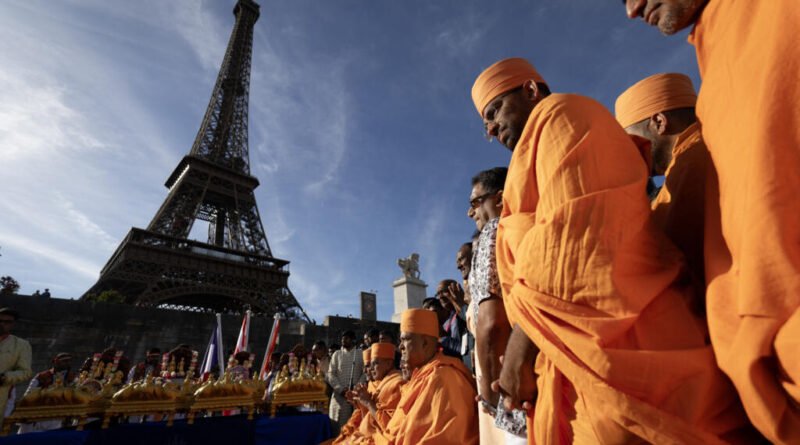
Eiffel Tower Shut by Strike Over Womens Exclusion
Eiffel Tower shut: 1. Executive Summary & Strategic Importance
The sudden and disruptive closure of the Eiffel Tower on Monday—triggered by a walkout and strike organized by unionized staff—serves as a watershed moment at the intersection of international diplomacy, labor rights, and corporate ethics. The immediate catalyst for the industrial action was the exclusion of female employees from participating in or facilitating a private visit by a high-ranking Hindu delegation. According to statements released by SETE (Société d’Exploitation de la Tour Eiffel), the monument’s operational managing body, the visiting delegation had explicitly requested that the tour be structured in a manner that restricted or entirely minimized direct operational interactions with female staff members. In response to this concession to external cultural or religious demands, the monument’s workforce downed tools, citing egregious violations of French labor laws, fundamental gender equality principles, and the core constitutional tenets of the French Republic.
This event transcends a localized labor dispute or a brief tourism bottleneck; it exposes profound systemic vulnerabilities within international hospitality, cultural institutions, and public diplomacy. As global tourism rebounds and high-net-worth delegations, foreign dignitaries, and religious groups increasingly demand customized, culturally insulated access to premier world heritage sites, destination management companies and public operators face an impossible ethical and legal triage. The incident forces a critical re-evaluation of how global landmarks navigate the delicate fault lines between cross-cultural accommodation, international protocol, and domestic labor standards. When foreign visitor expectations directly collide with local legal frameworks mandating absolute non-discrimination and gender parity, organizations are forced to make immediate, high-stakes operational choices that carry immense reputational, legal, and financial fallout.
From an investigative and macroeconomic standpoint, the strike underscores the immense leverage held by frontline operational staff in safeguarding institutional values against top-down managerial compromises. SETE’s initial compliance with the delegation’s restrictive scheduling and staffing requests—ostensibly designed to secure high-level diplomatic goodwill or lucrative private booking revenue—highlights a dangerous corporate blind spot. Management failed to anticipate that internal stakeholders would fiercely reject any operational compromise that sidelines female workers. This master article will deconstruct the anatomy of the crisis, examining the historical trajectory of labor activism at the Iron Lady, the operational mechanics of managing private VIP delegations, the comparative legal frameworks governing workplace discrimination across international jurisdictions, and the long-term strategic adjustments required to insulate cultural assets from similar ideological flashpoints in the future.
2. Historical Context & Industry Evolution
To fully grasp the gravity of the Eiffel Tower strike, one must examine the deep-rooted history of labor militancy and egalitarian ideology that defines modern France, and by extension, its most iconic national monument. Constructed for the 1889 World’s Fair, the Eiffel Tower has long since evolved from an architectural engineering marvel into a potent ideological symbol of the French Republic (*La République française*). Its operations are deeply intertwined with the sociopolitical fabric of France, where labor unions (*syndicats*) wield immense cultural and institutional power, particularly within state-owned or municipal enterprises. Strikes at the Eiffel Tower are historically frequent, often erupting over wage disputes, pension reforms, maintenance backlogs, or crowd management safety concerns. However, a strike explicitly provoked by an ideological or religious clash over gender-based exclusion represents an unprecedented chapter in the monument’s operational history.
Historically, the global tourism and hospitality industry has operated under an unwritten maxim: “the customer is always right,” a philosophy that historically pressured service staff to accommodate eccentric, culturally specific, or even discriminatory preferences of high-spending clientele. In earlier eras of mass tourism, local sensitivities were frequently subjugated to the financial imperatives of attracting foreign capital and high-tier diplomatic tourism. Tour operators routinely indulged private delegations, corporate titans, and foreign officials by curating bespoke environments tailored to their exact social, religious, or political comfort zones. This could include private buyouts, cordoned-off sectors, and strict demographic curations of support staff.
However, the past decade has witnessed a seismic shift in the socio-cultural landscape of Western employment. Catalyzed by social movements championing intersectional feminism, workplace equity, and aggressive enforcement of anti-discrimination statutes, the tolerance for institutionalized exclusion has evaporated. Employees across the hospitality, tourism, and heritage sectors are no longer willing to accept professional sideline roles to appease foreign traditionalist customs. When external diplomatic protocols attempt to override domestic civil rights protections, a systemic friction occurs. The Eiffel Tower strike is not an isolated anomaly, but rather the logical culmination of this ongoing paradigm shift. It signals to international tourism boards, cultural ministries, and venue operators worldwide that the era of bending local employment standards to satisfy regressive foreign preferences is officially over.
3. Deep-Dive Architectural & Technical Mechanics
Operational Protocols for VIP and State Delegations
Managing high-security, high-profile delegations at a global landmark like the Eiffel Tower requires a complex, multi-layered operational workflow. Typically, foreign heads of state, royal families, or religious councils coordinate their visits months in advance through the Ministry of Foreign Affairs, the Préfecture de Police, and SETE’s specialized VIP concierge division. These workflows involve rigorous security sweeps, crowd control planning, and custom logistical scheduling to ensure minimal disruption to the millions of annual public tourists while guaranteeing maximum security and comfort for the visiting party.
The technical breakdown of these visits usually encompasses:
- Pre-Visit Security Vetting: Coordination with intelligence agencies and diplomatic security details to establish restricted zones and elevator reservations.
- Staff Allocation Algorithms: Rostering systems that assign bilingual guides, security personnel, elevator operators, and technical staff based on seniority, availability, and specific security clearances.
- Spatial Zoning: Temporary partitioning of the tower’s esplanade, first floor, second floor, and the summit to isolate the private party from the general ticketing public.
In the specific instance that sparked the strike, the operational protocol failed at the staff allocation and human resources tier. Management attempted to manually override standard rostering procedures to accommodate the visiting Hindu delegation’s request for gender-segregated interactions. By actively reassigning female employees away from the delegation’s path, management crossed a critical operational boundary, converting a routine logistical accommodation into a systemic violation of internal labor protocols.
The Anatomy of a Flash Strike and Workforce Mobilization
When frontline employees identified the discriminatory staffing adjustments, the mobilization pipeline activated with extraordinary speed. Union representatives from major French labor confederations—such as the CGT (Confédération Générale du Travail) and FO (Force Ouvrière)—utilized established communication channels to alert members across all operational departments, including ticket sales, elevator operations, security, and maintenance.
The technical execution of the strike involved:
- Emergency General Assembly: Staff convened on-site to verify the operational directives given by management regarding the delegation’s visit.
- Legal Notice & Work Stoppage: Invoking French labor rights regarding sudden modifications to working conditions that contravene non-discrimination clauses, workers voted unanimously to walk off the job.
- Facility Shutdown Sequence: To ensure public safety and secure the monument, technical staff initiated emergency lockdown protocols, halting elevators, closing entry gates, and evacuating the public esplanade in coordination with local law enforcement.
Economic and Logistical Impact Metrics
A sudden, unscheduled closure of the Eiffel Tower produces immediate, measurable shockwaves throughout Paris’s tourism economy. The logistical fallout can be quantified through several operational vectors:
- Ticket Revenue Loss: Immediate cancellation and refund processing for tens of thousands of pre-booked time-slot ticket holders.
- Ancillary Economic Damage: Revenue contraction for surrounding restaurants, gift shops, tour operators, and river cruise lines that rely on the Eiffel Tower’s gravitational tourist pull.
- Reputational Cost: Immediate negative global media coverage damaging the brand equity of Paris as an inclusive, premier travel destination.
4. Comparative Market Framework & Benchmarking
To contextualize how global cultural institutions handle competing demands between international diplomacy, religious accommodation, and domestic labor laws, we must examine comparative benchmarks across different jurisdictions. The following table contrasts the Eiffel Tower’s operational framework with other global landmarks and sectors.
| Institution / Sector | Primary Jurisdiction | Approach to VIP / Religious Accommodation | Labor & Anti-Discrimination Enforcement | Crisis Vulnerability Index |
|---|---|---|---|---|
| The Eiffel Tower (SETE) | France (EU) | Historically accommodating, recently subjected to intense union pushback over external demands. | Strict French labor code (*Code du Travail*) and constitutional equality mandates. | High (High union density, immediate strike risk). |
| The Vatican Museums | Vatican City / Italy | Sovereign religious entity with bespoke dress codes and visitor behavioral protocols applied uniformly. | Governed by Vatican employment law and Canon law, distinct from secular EU norms. | Low (Clear, codified religious exemptions and internal rules). |
| The Louvre Museum | France (EU) | Frequent host to state delegations; maintains strict separation between private viewings and public rights. | Rigid adherence to French public service employment standards and equality laws. | Medium-High (Frequent flash strikes by unionized museum staff). |
| Burj Khalifa / Emaar Hospitality | United Arab Emirates | Highly adaptive to ultra-VIP and international delegation preferences, integrating custom luxury protocols. | Regional labor laws with strong emphasis on hospitality service delivery and client satisfaction. | Low (Low tolerance for unauthorized labor strikes; service-first culture). |
The comparative analysis reveals a stark dichotomy in how global institutions manage these crises. In hyper-regulated, unionized environments like France, managerial attempts to bend rules for international elites inevitably trigger severe institutional friction. Unlike private luxury developments in the Gulf or sovereign religious enclaves like the Vatican—where institutional mandates align directly with specific cultural or religious hierarchies—publicly owned secular landmarks in Western Europe operate in a socio-political fishbowl. Any deviation from foundational egalitarian principles is immediately flagged, litigated, and resisted by empowered workforce syndicates.
Furthermore, the benchmarking highlights the unique vulnerability of public tourism infrastructure. While private venues can quietly reassign staff without union oversight or public scrutiny, public monuments like the Eiffel Tower are legally bound to uphold public service obligations (*service public*). When management attempts to privatize or alter public access norms to flatter foreign dignitaries, it breaches the social contract between the monument, its workers, and the citizenry. This structural reality mandates that future visitor management strategies must prioritize internal legal compliance and employee dignity over external diplomatic appeasement.
5. Enterprise, Geopolitical & Socio-Economic Ramifications
Impact on International Diplomacy and Tourism Boards
The strike sends a sobering signal to foreign ministries, diplomatic corps, and international tourism boards. For decades, high-level delegations have operated under the assumption that financial power or diplomatic status can buy bespoke behavioral accommodations anywhere in the world. The Eiffel Tower incident proves that in modern Western democracies, employee rights and public equality laws supersede diplomatic soft-power requests. Foreign delegations visiting European capitals must now recognize that cultural expectations regarding gender segregation or caste-based exclusions cannot be legally or operationally enforced on foreign soil.
Regulatory and Legal Pressures on Cultural Operators
For executive management teams running major historical and cultural venues, the incident exposes severe liability risks. Under European Union directives and domestic labor statutes, knowingly reassigning employees based on gender to satisfy a third party’s discriminatory request exposes the employer to catastrophic legal action. Employees subjected to such reassignments have robust grounds for lawsuits alleging workplace discrimination, harassment, and constructive dismissal. Consequently, risk mitigation committees within cultural institutions are currently rewriting their operating charters to explicitly bar management from accepting any visitor condition that violates non-discrimination statutes.
Socio-Economic Fallout for the Paris Hospitality Ecosystem
The broader economic ripples of the strike demonstrate how hyper-connected urban tourism ecosystems are vulnerable to sudden micro-disruptions. When the Iron Lady closes unexpectedly, the shockwave is felt instantly across the Parisian service economy:
- Hotels experience sudden waves of guest complaints and trip cancellations.
- High-end restaurants and cafes in the 7th arrondissement see immediate revenue drops from stranded tourists.
- Tour operators face administrative bottlenecks managing rescheduled itineraries and refund requests.
This economic fragility underscores why maintaining stable, transparent labor relations is not merely an HR objective, but an essential pillar of macroeconomic stability for tourism-dependent metropolitan areas.
6. Strategic Implementation Roadmap & Future Outlook
To prevent recurring crises and insulate global landmarks from the clash between international tourism demands and domestic labor laws, executive leadership teams must execute a comprehensive 12-to-36-month strategic overhaul. The following roadmap outlines the critical phases required to achieve operational resilience:
- Phase 1: Immediate Policy Codification (Months 1–6)
- Draft and publish an unyielding “Zero-Discrimination Charter” governing all private visits, state delegations, and VIP bookings.
- Establish clear, non-negotiable red lines prohibiting any external visitor request that dictates the gender, race, religion, or ethnicity of assigned operational staff.
- Phase 2: Stakeholder Alignment & Union Consultation (Months 6–12)
- Establish a joint oversight committee comprising management, HR representatives, and recognized labor union delegates to review all major incoming state visit protocols.
- Implement transparent booking notification workflows so that staff are fully briefed on VIP itineraries without compromising workplace rights.
- Phase 3: Technological & Operational Upgrade (Months 12–24)
- Deploy automated, randomized staff rostering software for VIP tours to eliminate managerial discretion in staff assignments.
- Develop robust crisis communication protocols to manage public and media messaging transparently in the event of industrial disputes.
- Phase 4: Global Industry Benchmarking & Advocacy (Months 24–36)
- Partner with international tourism bodies (such as the UNWTO) to establish standardized global guidelines for balancing cultural tourism with local civil rights compliance.
- Publish annual transparency reports detailing private delegation management and compliance with labor equity metrics.
7. Frequently Asked Questions (FAQ) & Expert Insights
Why did the Eiffel Tower staff go on strike?
The strike was initiated by unionized staff in protest against management’s decision to exclude female employees from participating in or servicing a private visit by a visiting Hindu delegation. The delegation had requested limited interactions with women, and management’s compliance with this request triggered fierce internal backlash over gender discrimination and violations of French labor law.
Is it legal for cultural sites to accommodate visitor requests for gender segregation?
In France and across the European Union, strict anti-discrimination laws (*Code du Travail*) and constitutional principles of gender equality make it illegal for employers to relegate or exclude employees based on gender to satisfy third-party preferences. Complying with such requests exposes employers to severe legal liability for workplace discrimination.
What impact does an Eiffel Tower closure have on the local economy?
A sudden closure halts ticket sales for tens of thousands of visitors and inflicts immediate financial losses on surrounding hotels, restaurants, tour operators, and retail businesses that depend on the monument’s continuous foot traffic.
How do unions exercise such power over a major monument like the Eiffel Tower?
France has a robust tradition of labor activism, and union density remains high in public and municipal enterprises. Syndicates possess legal rights to call flash strikes when working conditions or fundamental labor principles are compromised, effectively shutting down operations until management negotiates.
How can management prevent similar incidents during future state visits?
Operators must institute ironclad non-discrimination charters that explicitly reject any foreign delegation request that curtails employee rights based on gender, race, or religion. Transparent communication and union consultation prior to VIP visits are essential to eliminating operational blind spots.
What broader message does this strike send to the global tourism industry?
The incident signals a definitive end to the era where foreign money or diplomatic pressure could force service staff to accept discriminatory treatment. Global institutions are now on notice that workforce equity and local civil rights take absolute precedence over external cultural accommodations.
Discover more in-depth coverage in our Breaking News editorial hub.
For primary data verification and historical benchmarks, consult official releases on Reuters Global News.
