
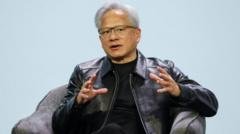
Nvidia Jensen Huang Investigation: Inside the Security Crisis
A sudden shockwave has hit Silicon Valley‘s most valuable enterprise. The board of directors at Nvidia has officially initiated an independent Nvidia Jensen Huang investigation after public disclosures revealed the legendary chief executive engaged in an extramarital affair with a businesswoman suspected by federal authorities of being a covert operative for Beijing. The fallout was immediate. Wall Street shuddered, Capitol Hill launched an inquiry, and the tech sector was left grappling with an uneasy question: Did America’s silicon backbone suffer an unsanctioned breach?
The Nvidia Jensen Huang investigation is an independent board inquiry triggered by reports that the chief executive engaged in an extramarital affair with an alleged Chinese intelligence operative. The probe assesses whether proprietary microchip architecture, strategic AI roadmaps, or national security safeguards were compromised amid heightened Washington-Beijing technology trade tensions.<\/p>
- Board Inquiry Launched: Nvidia's board has commissioned an independent review following admissions by CEO Jensen Huang regarding an affair with a suspected Chinese spy.
- Counterintelligence Scope: Federal intelligence unmasking linked Huang to Alice Huang, a executive associated with Singapore-based data firm Megaspeed.
- Congressional Subpoena Pressure: Three House Republican committee leaders have summoned Huang to testify on corporate espionage defenses and foreign infiltration risks.
- High-Stakes Valuation: At a market valuation of $4.5 trillion, Nvidia's dominance in AI hardware makes any executive vulnerability an existential geopolitical issue.
The headline reads like a cold-war thriller, yet the reality unfolds in the cold light of boardroom governance and geopolitical tension. Jensen Huang, the workaholic architect behind Nvidia’s meteoric rise to a $4.5 trillion valuation, broke his silence with a blunt admission. He owned up to the personal betrayal of his family, expressed deep regret to shareholders, and pledged complete cooperation with external legal counsel retained by the board. Yet personal contrition does little to settle the nerve-wracking security questions currently reverberating through Washington.
Silicon Diplomacy Meets Counterintelligence
For more than three decades, Jensen Huang stood as an untouchable figure in computing history. He pulled Nvidia back from the brink of bankruptcy in the late 1990s, bet the entire company on graphics processing units (GPUs), and single-handedly built the hardware bedrock that powers OpenAI, Meta, and Google. But high stakes attract high-level espionage. According to reports first broken by The New York Times, federal counterintelligence operations had been quietly tracking an individual named Alice Huang—also known in regulatory filings as Huang Le. She is not related to the Nvidia chief executive.
Alice Huang’s business endeavors placed her at the nexus of global compute infrastructure. As a key figure linked to Megaspeed, a Singapore-based data center enterprise handling massive high-performance hardware deployments, her movements drew the scrutiny of US intelligence agencies. Standard surveillance of foreign targets eventually picked up intercepted communications with an unidentified American citizen. Federal investigators executed an official “unmasking” procedure to reveal the identity behind the transcript: Nvidia’s own founder.
“The issue of foreign infiltration and access to cutting-edge US technology is core to the investigative work of our committees. When executive relationships cross paths with foreign intelligence targets, national security demands absolute transparency.” — Joint Statement, House Committee Leaders
The revelatory unmasking instantly converted a private indiscretion into a major concern regarding AI chip national security. Federal intelligence officers have not publicly detailed what specific technical files, hardware roadmaps, or strategic silicon allocations were discussed, if any. What remains clear is that foreign adversary apparatuses view access to executive leadership as the ultimate vector for intelligence gathering.
The Singapore Connection and Megaspeed’s Defense
Understandably, the international footprint of the scandal has drawn intense scrutiny toward Southeast Asia’s data center ecosystem. Singapore has evolved into a premier operational node for advanced computing clusters, serving as a critical bridge between Western technology developers and Asian enterprise markets. Megaspeed sits directly in the center of this web, operating massive facilities designed to house thousands of interconnected GPUs.
When federal authorities highlighted Alice Huang’s connections, Megaspeed moved swiftly to insulate its core operations. Corporate representatives confirmed that external legal advisers were retained to review internal practices, auditing every contract and communication associated with her tenure. Company spokespersons reiterated that current leadership takes counterespionage protocols seriously and intends to cooperate fully with regulatory inquiries. Despite those assurances, foreign intelligence analysts point out that human-targeted operations often bypass digital firewalls entirely.
Consider the structural exposure. Nvidia does not merely sell silicon chips off a shelf; it designs custom interconnect architectures, develops proprietary CUDA software libraries, and orchestrates global compute delivery schedules. Access to high-level strategic planning allows foreign state actors to map out supply chain bottlenecks, anticipate hardware export bans, or engineer unauthorized cloud-sourcing workarounds. The threat of a Chinese counterintelligence probe aimed at the top of the AI hardware supply chain is no longer theoretical—it is an active operational risk.
Capitol Hill Responds: Congressional Subpoenas and Protocol Reviews
Washington moved fast. Within days of the public revelation, three prominent House Republican committee chairs dispatched a bipartisan letter to Nvidia’s headquarters in Santa Clara. The directive was unambiguous: Jensen Huang must appear before lawmakers to explain the company’s executive counterespionage controls, internal security auditing, and handling of potential foreign intelligence approaches.
Key Concerns Outlined by Lawmakers:
- Executive Counterintelligence Oversight: Whether Nvidia maintains mandatory counterespionage reporting protocols for senior officers holding sensitive national technology assets.
- Export Control Integrity: The potential exposure of architectural specifications for restricted semiconductors, such as the H200 and Blackwell architecture platforms.
- Data Center Infrastructure Access: The vetting process applied to foreign data center partners, third-party hosting firms, and regional compute distributors in Southeast Asia.
- Board Disclosure Timelines: The precise timeline detailing when Nvidia’s board was first alerted by federal law enforcement regarding the unmasking event.
Lawmakers view Nvidia not merely as a publicly traded commercial entity, but as a critical national asset. Semiconductors represent the definitive geopolitical battleground of the 21st century. Over the past several years, the US Department of Commerce has imposed rigorous export controls restricting the shipment of high-end graphics processors to China, aiming to prevent foreign military modernization through advanced artificial intelligence capabilities.
Nvidia has had to continuously re-engineer its product lineups to comply with strict performance-density caps. When Washington restricted the sale of its flagship A100 and H100 systems, Nvidia created tailored variants like the H200 to navigate regulatory thresholds. The balance between maintaining multi-billion-dollar commercial revenues in Asia and protecting national trade secrets remains delicate. A breach at the executive level threatens to dismantle that equilibrium entirely.
Quantifying the Risk: Silicon Vulnerabilities & Geopolitical Trade Control
To contextualize the operational magnitude of this crisis, examine how Nvidia’s hardware architecture intersects with global regulatory regimes and counterespionage targets:
| Semiconductor Asset | Strategic Importance | Export Control Status | Espionage Vulnerability Vector |
|---|---|---|---|
| Blackwell Architecture | Next-generation AI training and inference engine powering frontier models. | Strictly restricted from non-licensed export to foreign adversary states. | Architectural blueprints, packaging techniques, yield optimization data. |
| H200 Tensor Core | High-bandwidth memory accelerator critical for enterprise deep learning. | Subject to conditional export licensing and performance caps. | Supply chain allocation schedules, firm-level firmware modifications. |
| CUDA Ecosystem | Proprietary software layer binding software developers to Nvidia silicon. | Globally accessible software stack with proprietary core drivers. | Source code commits, zero-day software exploit discovery. |
| Megaspeed Enterprise Nodes | Third-party Singapore compute clusters serving enterprise clients. | Monitored under regional transshipment compliance frameworks. | Physical hardware access, unauthorized remote cloud provisioning. |
Corporate Governance Under Fire
While Washington focuses on national security, Wall Street is scrutinizing Nvidia corporate governance. Independent board members find themselves in a precarious position. On one hand, Jensen Huang is widely acknowledged as an irreplaceable visionary—a leader who personally oversaw the technical pivots that yielded unprecedented market dominance. On the other, sound corporate risk management dictates that no single individual, regardless of stature, can operate above basic security oversight.
Nvidia’s board issued a direct statement attempting to reassure skittish institutional investors. Directors emphasized that an exhaustive internal review has found no initial evidence suggesting proprietary corporate secrets or national security parameters were compromised. However, governance experts point out that preliminary assessments often evolve as forensic accountants, cybersecurity auditors, and intelligence liaisons comb through private servers, encrypted messaging logs, and financial records.
“When a founder CEO exercises total operational control, standard corporate checks and balances can falter. Boards must prove that executive protocols apply equally to the corner office, especially when national security assets are involved.” — Corporate Risk Analyst, Bloomberg Intelligence
Institutional shareholders are quietly calculating the operational risks. The microchip giant recently posted record-breaking revenues of $215 billion, driven by insatiable demand for generative AI hardware. Yet, stock volatility spiked as news of the independent inquiry circulated. Investors dislike uncertainty, and an active federal counterintelligence probe involving a key founder introduces an unpredictable variable into an otherwise stellar growth narrative.
The Human Factor: A Perfectionist’s Misstep
To those who have tracked Jensen Huang’s career over three decades, the scandal presents a stark paradox. Huang is famous for an uncompromising work ethic. He favors simple leather jackets over executive suits, works late hours, and demands meticulous operational execution from his vice presidents. His leadership style built an environment where failure was not tolerated and execution was everything.
That personal discipline makes the public admission of personal unfaithfulness all the more jarring. “I was unfaithful to my wife. My actions hurt her and our children. There is no excuse for what I did. I am deeply sorry,” Huang stated in his public apology. He acknowledged falling short of the standards expected by Nvidia’s employees, board members, and global shareholders. He reiterated his commitment to America’s national interest, writing, “I love our country and our company. I am committed to protecting Nvidia and supporting America’s national security.”
Public figures in tech often weather personal scandals. However, when a personal lapse intersects with a targeted human intelligence operation, personal privacy vanishes. Counterintelligence doctrine has long identified executive relationships, emotional vulnerabilities, and personal indiscretions as primary entry points for foreign recruitment or intelligence exploitation. Intelligence officers refer to this strategy as targeted cultivation. Whether Alice Huang’s interactions with Jensen Huang constituted an active espionage campaign or an uncoordinated relationship remains the core subject of the ongoing investigation.
Political Reactions and Washington’s Dilemma
The controversy arrives during an already complex political environment. Former President Donald Trump offered an intriguing perspective when questioned by reporters regarding the investigation into the Nvidia chief. While affirming that he had not spoken directly with Huang since the news broke, Trump offered a nuanced defense of the executive’s track record while acknowledging the unpredictable nature of high-stakes corporate leadership.
“I just know he’s a fine person, but you never know what’s going on,” Trump noted, adding that Huang had “done an amazing job for our country.”
Trump’s comments illustrate the core dilemma confronting policymakers in Washington. The US government relies heavily on domestic tech champions like Nvidia, AMD, and Intel to maintain an undisputed lead in global computing power. Crippling or sidelining the leadership of America’s primary hardware innovator could inadvertently stall domestic AI infrastructure deployment, handing a strategic advantage to foreign competitors.
Yet, leniency carries its own severe risks. If federal authorities allow high-profile technology executives to bypass standard security protocols, it signals to foreign intelligence services that top-tier corporate targets represent soft targets for intelligence gathering. Managing this balance requires surgical precision from both the Department of Justice and Nvidia’s independent board investigators.
Mitigating Semiconductor Supply Chain Risk
Beyond the immediate headlines, the incident highlights broader systemic vulnerabilities across the global tech hardware sector. Managing modern semiconductor supply chain risk requires monitoring human access points just as rigorously as digital software environments. Microchip production involves intricate global networks: silicon wafers manufactured in Taiwan, high-bandwidth memory produced in South Korea, system assembly conducted across Asia, and final data center deployment scattered across global cloud hubs.
Critical Vulnerabilities in the Tech Supply Chain:
- Executive Access Vectors: Unrestricted visibility into multi-year architectural roadmaps and high-level foundry capacity allocations.
- Third-Party System Integrators: Overseas assembly plants and regional data hosting vendors that bypass strict physical security controls.
- Software Driver Infrastructure: Proprietary firmware code updates that could be altered to introduce low-level hardware bugs or unauthorized access channels.
- Unsanctioned Compute Reselling: Gray-market channels that route restricted hardware through intermediary entities in non-aligned jurisdictions.
Nvidia’s board probe will inevitably force every major technology firm in Silicon Valley to audit their executive counterespionage policies. Mandatory travel disclosures, enhanced communications monitoring, and independent background checks for foreign infrastructure partners are likely to become standard corporate mandates across the hardware ecosystem.
The Path Ahead for Nvidia
The coming months will test the resilience of Nvidia’s institutional framework. The independent investigation led by outside legal counsel will complete its audit of executive communications, device logs, and strategic disclosures. Concurrently, Jensen Huang must prepare to address congressional leaders directly on Capitol Hill, reassuring lawmakers that Nvidia’s security posture remains completely uncompromised.
Nvidia has navigated near-fatal corporate crises before. It survived brutal graphics card price wars, technical design flaws, and volatile crypto-mining boom-and-bust cycles. But an investigation involving executive intelligence unmasking, foreign espionage allegations, and congressional oversight represents an entirely different class of challenge. For Jensen Huang and the board he built, the ultimate test is no longer just manufacturing the world’s fastest microchips—it is proving that the infrastructure powering the global economy is secure from the inside out.
<button type="button" onclick="this.parentElement.innerHTML='✓ Thank you, we will refine our analysis!‘” style=”background:#ffffff; border:1px solid #cbd5e1; border-radius:6px; padding:4px 12px; font-size:12px; cursor:pointer; color:#334155;”>👎 No
