
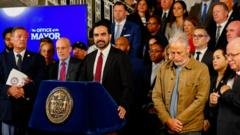
9/11 Air Quality Documents Reveal Ground Zero Cover-Up
1. Executive Summary & Strategic Importance
The release of 170,000 previously suppressed municipal records has shattered a quarter-century of official narratives surrounding the aftermath of the September 11 terrorist attacks. These newly public 9/11 air quality documents, unveiled by New York City Mayor Zohran Mamdani, provide irrefutable proof that local government officials were fully aware of extreme asbestos contamination near Ground Zero while systematically assuring the public, first responders, and returning residents that the air was safe to breathe. This disclosure marks a watershed moment in public health accountability, exposing the deep chasm between internal political risk management and public safety communications during one of the nation’s gravest crises.
The newly released 9/11 air quality documents consist of 170,000 pages of internal municipal records proving that New York City officials discovered widespread asbestos contamination near Ground Zero immediately after the September 11 attacks, yet withheld this data to limit legal liability while publicly declaring the air safe to breathe.
- Systemic Concealment: Newly released municipal records prove New York City officials knew asbestos was 'nearly everywhere' near Ground Zero while publicly declaring the air safe.
- The Harding Memo: An October 2001 internal document warned the Giuliani administration of up to 35,000 legal claims, revealing that liability mitigation took precedence over public health.
- Legal Resolution: The release of 170,000 pages, spanning 68 previously 'lost' boxes, resolves a long-standing lawsuit brought by the advocacy group 9/11 Health Watch.
- Ongoing Health Crisis: Toxic exposure from the World Trade Center collapse has now claimed more lives through chronic illnesses and cancers than the physical attacks on September 11.
For twenty-five years, survivors, emergency personnel, and local residents have battled debilitating illnesses, contending with a government apparatus that repeatedly denied possessing comprehensive environmental monitoring data. The publication of these files, facilitated by a $34 million (£25 million) municipal digitization initiative, directly resolves a protracted legal battle spearheaded by the advocacy group 9/11 Health Watch. The documents reveal that municipal leaders prioritized limiting financial liability and accelerating the economic stabilization of Wall Street over the physical well-being of the population. As illnesses linked to the disaster continue to claim more lives than the physical attacks themselves, this disclosure redefines our understanding of the post-9/11 cleanup and establishes a chilling precedent for municipal crisis management.
2. Historical Background & Contextual Evolution
In the immediate aftermath of the collapse of the World Trade Center towers on September 11, 2001, a monumental environmental catastrophe unfolded in Lower Manhattan. The destruction of the towers pulverized hundreds of tons of structural materials, releasing a dense, highly alkaline cloud of World Trade Center toxic dust containing heavy metals, glass fibers, dioxins, polychlorinated biphenyls (PCBs), and, most critically, chrysotile asbestos. As the dust settled over a multi-block radius, the immediate priority of municipal, state, and federal authorities shifted from rescue to recovery, and rapidly toward economic normalization.
Within days of the tragedy, the U.S. Environmental Protection Agency (EPA), alongside local New York City health agencies, issued public declarations assuring the public that the ambient air was safe to breathe. These statements encouraged financial sector workers, business owners, and residents to return to the area to signal national resilience. However, the newly uncovered archive reveals that behind closed doors, the testing data painted a radically different picture. The city’s own environmental testing repeatedly detected elevated levels of asbestos “nearly everywhere” around the disaster perimeter.
For decades, successive mayoral administrations—from Rudy Giuliani to Michael Bloomberg and Bill de Blasio—maintained that all relevant environmental monitoring records had been disclosed or did not exist. The breakthrough occurred last year when city workers discovered 68 boxes of highly sensitive documents hidden within municipal archives. This discovery directly contradicted decades of official denials and provided the legal leverage necessary for the 9/11 Health Watch lawsuit to finally force their public release. Standing alongside prominent survivor advocate and television host Jon Stewart, Mayor Mamdani emphasized that the city would no longer participate in a multi-decade cover-up, committing to a phased release of the remaining archive over the coming year.
3. In-Depth Technical & Policy Breakdown
The technical and policy revelations contained within the 170,000 pages of documents expose a highly coordinated effort to manage public perception and insulate the city from future litigation. To understand the gravity of these disclosures, it is necessary to examine the specific mechanisms, internal memos, and scientific data that were withheld from the public eye.
The Harding Memo: Quantifying Liability Over Human Life
Among the most damning pieces of evidence within the newly released archive is an October 2001 document known as the “Harding Memo.” Addressed to then-Deputy Mayor Robert Harding, who served under Mayor Rudy Giuliani, the memorandum was compiled by senior municipal aides to assess the city’s legal exposure. The memo explicitly warned that New York City could face up to 35,000 legal claims resulting from its emergency response and public health directives.
Crucially, the author of the memo noted that the city’s vulnerability to litigation stemmed from its public advisories, which actively encouraged individuals “to return to the area too soon (causing toxic exposure or emotional harm).” Rather than prompting an immediate pause in the repopulation of Lower Manhattan or a mandate for comprehensive respiratory protection, the memo was utilized to construct a legal defense framework designed to limit municipal liability. This document establishes that the city was fully aware of the toxic exposure risks it was actively facilitating.
The Scientific Reality of Asbestos Dispersion
Asbestos is a highly carcinogenic mineral fiber that, when inhaled, becomes permanently lodged in lung tissue, leading to mesothelioma, lung cancer, and asbestosis. The pulverized structural components of the Twin Towers created microscopic asbestos fibers that were easily respirable. The newly released air quality reports indicate that asbestos concentrations in the air and settled dust near Ground Zero routinely exceeded safe occupational thresholds.
Despite these findings, municipal agencies utilized flawed testing methodologies and averaged localized spikes over broader geographical areas to artificially lower the reported levels of contamination. This scientific manipulation allowed officials to maintain the public narrative of safety while ignoring the localized “hot spots” where first responders and cleanup crews were working twelve-hour shifts without military-grade respiratory protection.
The EPA Ground Zero Safety Declarations and Federal Complicity
The local cover-up was heavily supported by federal agencies. Days after the collapse, the EPA, under the leadership of Administrator Christine Todd Whitman, made its infamous EPA Ground Zero safety declarations. Whitman assured New Yorkers that the air was safe, a statement that she later apologized for, claiming the agency acted with the best available knowledge at the time. However, the newly released documents demonstrate that local officials possessed specific, localized data that directly contradicted the EPA’s generalized pronouncements, yet chose to remain silent to avoid disrupting the federal narrative of a rapid recovery.
4. Comparative Industry Framework
To contextualize the divergence between public communication and internal knowledge, the following table outlines the critical dimensions of the city’s response as documented in the newly released files versus the public statements made at the time.
| Dimension of Analysis | Public Narrative (2001) | Internal Document Revelations | Long-Term Medical & Legal Reality |
|---|---|---|---|
| Air Quality & Safety | The air is safe to breathe; public health risks are minimal and temporary. | Asbestos detected “nearly everywhere” near Ground Zero; severe toxic hazards identified. | Surpassment of initial attack casualties by toxic exposure-related deaths. |
| Asbestos Prevalence | Localized, manageable levels confined strictly to the immediate debris pile. | Widespread dispersion throughout Lower Manhattan streets, offices, and residences. | Epidemic of mesothelioma, chronic respiratory diseases, and rare cancers among survivors. |
| Legal & Financial Liability | The city is acting solely in the interest of public recovery and national resilience. | The “Harding Memo” projects up to 35,000 lawsuits; focus shifts to limiting municipal liability. | Establishment of the multi-billion dollar Victim Compensation Fund and ongoing litigation. |
| Data Transparency | All relevant environmental testing data is being shared openly with the public. | 68 boxes of critical air monitoring reports hidden in archives for nearly 25 years. | A quarter-century delay in truth-seeking, resolved only via a forced advocacy lawsuit. |
The comparative analysis reveals a systematic strategy of risk containment. The primary objective of the municipal administration was not the mitigation of the environmental hazard itself, but rather the mitigation of the financial and political fallout resulting from the hazard. By framing the environmental crisis as a temporary inconvenience, the city successfully delayed legal reckoning for decades, albeit at an catastrophic cost to human life.
5. Socio-Economic, Enterprise & Global Ramifications
The ramifications of the 9/11 air quality cover-up extend far beyond the borders of New York City. The long-term economic toll of treating tens of thousands of affected individuals has placed an immense burden on public and private healthcare systems. The World Trade Center Health Program, funded by the federal government, currently monitors and treats over 120,000 first responders and survivors, with program costs projected to run into tens of billions of dollars over the coming decades.
According to the World Health Organization, there is no safe level of exposure to asbestos, and even brief exposures can lead to late-onset cancers decades later. The suppression of these critical environmental reports prevented thousands of individuals from seeking early medical interventions or taking basic precautionary measures, such as professional remediation of their homes and workplaces. This has resulted in a secondary public health crisis that continues to unfold as the latency period for asbestos-related diseases, which typically spans 20 to 50 years, reaches its peak.
Furthermore, this revelation severely damages the credibility of public health and regulatory agencies globally. When citizens realize that environmental safety declarations are subject to political and economic pressures, compliance with future emergency directives is compromised. As reported by global investigative outlets like Reuters, the erosion of public trust during environmental disasters often leads to widespread skepticism of government-led recovery efforts, hindering effective crisis response in future industrial or ecological catastrophes.
6. Strategic Outlook & What Comes Next
The release of these 170,000 pages is only the beginning of a prolonged process of legal, political, and historical reassessment. Over the next twelve months, New York City Hall will continue to upload and categorize the remaining documents from the recovered 68 boxes. This ongoing disclosure will undoubtedly provide fresh ammunition for legal teams representing 9/11 survivors and their families, potentially reopening closed liability claims and prompting new class-action filings against municipal contractors and agencies.
For survivors like Elizabeth Cascio, a former FDNY emergency medical technician who has suffered from chronic sinus issues and headaches since responding to the attacks, the documents offer a bittersweet validation. Her recollection of the physical sensation of breathing in the toxic air—feeling as though she had to hold her breath to survive—stands in stark contrast to the sanitized assurances of safety issued by officials at the time. The challenge moving forward will be ensuring that the lessons of this cover-up are institutionalized, preventing future administrations from prioritizing economic expediency and liability limitation over the lives of the citizens they are sworn to protect.
7. Frequently Asked Questions (FAQ)
This section addresses the most common search queries regarding the newly released 9/11 air quality documents, the historical context of the cover-up, and the ongoing health impacts on survivors.
