
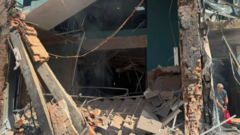
Kyiv Drone Strikes Hit Media Hub as Peace Talks Stall
A devastating Russian aerial assault has directly targeted the heart of Ukraine’s independent press, shattering a fragile, unannounced three-day pause in hostilities and signaling a brutal escalation in the Kremlin’s winter campaign. The strike, which partially collapsed the Kyiv headquarters of the prominent national broadcaster “We Are Ukraine” during a live transmission, underscores the extreme vulnerability of civilian and media infrastructure under the relentless pressure of Russian bombardment. This attack occurred immediately following the departure of high-level American diplomatic representatives, illustrating the profound disconnect between backchannel peace initiatives and the violent reality on the ground.
Kyiv drone strikes refer to the systematic aerial bombardments of Ukraine's capital by Russian unmanned aerial vehicles (UAVs), designed to degrade critical infrastructure, terrorize civilian populations, and disrupt wartime media operations. The latest strikes targeted the 'We Are Ukraine' TV channel, killing five people and underscoring escalating geopolitical tensions.<\/p>
- Targeted Media Attack: A Russian drone strike partially collapsed the Kyiv headquarters of the 'We Are Ukraine' TV channel during a live broadcast, marking a dangerous escalation in targeting civilian press.
- Diplomatic Collapse: The strikes resumed immediately after the departure of high-profile US envoys Steve Witkoff and Jared Kushner, signaling the failure of an informal three-day capital strike halt.
- Record Air Raid Alerts: Analytical data confirms Kyiv is experiencing its highest frequency of daily air raid alerts since the 2022 invasion, severely straining local defense systems.
- Maximalist Kremlin Stance: Russian officials reiterated that their military objectives remain unchanged, rejecting compromise despite renewed international diplomatic pressure.
1. Executive Summary & Strategic Importance
The escalation of Kyiv drone strikes has reached a critical flashpoint following a direct hit on a major television headquarters, resulting in at least five civilian deaths and exposing the profound limitations of backchannel diplomacy. The strike on the “We Are Ukraine” TV channel represents a calculated assault on the country’s information space, occurring at a moment of intense international diplomatic maneuvering. The incident unfolded just hours after Reuters reported the departure of key US envoys from the region, effectively ending a temporary, unpublicized three-day moratorium on capital-to-capital strikes.
Strategically, this development highlights several critical realities of the current phase of the war:
- The Weaponization of Information Infrastructure: By targeting a live broadcasting studio, the Russian military continues to expand its targeting matrix to include institutions vital to national morale and international reporting.
- The Limits of Informal Diplomacy: The rapid resumption of hostilities after the departure of US envoys Steve Witkoff and Jared Kushner demonstrates that temporary pauses are being utilized by combatants to reposition assets rather than build genuine diplomatic trust.
- Systemic Air Defense Attrition: The continuous wave of overnight and daytime attacks is systematically depleting Ukraine’s defensive stockpiles, forcing difficult tactical decisions regarding the allocation of air defense assets between the frontlines and urban centers.
2. Historical Background & Contextual Evolution
To understand the gravity of the current bombardment, one must examine the evolution of Russia’s aerial campaign against Kyiv. Since the winter of 2022, the Kremlin has periodically shifted its targeting focus. Initially targeting the electrical grid to freeze the population into submission, the strategy has evolved into a continuous, low-cost, high-frequency drone campaign designed to exhaust Ukrainian resources and psychological resilience.
According to data analyzed by BBC Verify, Kyiv is currently experiencing more daily air raid alerts than at any other period since the full-scale invasion began in February 2022. This shift to round-the-clock operations relies heavily on cheap, Iranian-designed Shahed-136 delta-wing drones (locally designated as Geran-2) alongside sophisticated decoy drones that carry no explosives but mimic the radar signature of armed UAVs. This tactic forces Ukrainian air defense systems Kyiv relies upon to expend highly expensive, scarce interceptor missiles on non-lethal targets.
The targeting of media entities is not entirely unprecedented, but the direct strike on “We Are Ukraine” marks a distinct escalation. During the opening weeks of the 2022 invasion, the Kyiv TV tower was struck, killing five people. However, the systematic targeting of active, civilian-staffed newsrooms in the heart of the capital suggests a shift toward suppressing independent reporting and disrupting the flow of verified information to the Ukrainian public.
3. In-Depth Technical & Policy Breakdown
The technical execution of the recent strikes reveals a highly coordinated, multi-vector approach designed to saturate local defenses. The attack on the television headquarters was part of a broader, multi-wave offensive that utilized both low-altitude maneuverable drones and high-speed ballistic missiles.
The Mechanics of the Strike on ‘We Are Ukraine’
The strike on the media facility was carried out during daylight hours, a tactic increasingly used to catch civilian populations outside of shelters. Witnesses and structural engineers report that the weapon used was a late-model loitering munition equipped with a thermobaric or high-explosive fragmentation warhead. The blast caused a partial collapse of the upper floors of the multi-story facility, trapping staff and disrupting the live broadcast feed. The resilience of the station’s staff, who continued to broadcast from improvised basement studios, highlights the highly adaptive nature of Ukraine’s wartime media infrastructure.
The Geopolitical Failure of the Three-Day Pause
The timing of the strike is perhaps its most politically significant aspect. Over the preceding weekend, an informal agreement facilitated by incoming US diplomatic envoys Ukraine hosted—specifically Steve Witkoff and Jared Kushner—had established a temporary halt on strikes targeting Moscow and Kyiv. This brief window of relative calm was intended to create a stable environment for exploratory talks.
However, the talks yielded no structural breakthroughs. Upon the envoys’ departure, the Russian Federation immediately launched a massive strike package. In Moscow, Kremlin adviser Yuriy Ushakov emphasized that the Russian armed forces were making “significant advances” and that the Kremlin’s maximalist objectives—which include the complete capitulation of Ukrainian territories currently claimed by Russia—would be achieved regardless of diplomatic interventions. This hardline stance effectively neutralized the optimistic statements made by Witkoff regarding “substantive progress.”
The Strain on Air Defense Systems Kyiv Relies Upon
The defensive operations over Kyiv during the latest attack involved a complex layer of mobile fire groups, electronic warfare (EW) jamming, and medium-to-long-range surface-to-air missile (SAM) systems. While Ukrainian forces successfully intercepted a high percentage of the incoming threats, the sheer volume of the attack guaranteed that some munitions would penetrate the defensive umbrella.
The economic asymmetry of this defensive battle is unsustainable over the long term. A single Shahed-class drone costs approximately $20,000 to produce, whereas the Western-supplied interceptors used by Patriot or NASAMS batteries cost between $1 million and $4 million per shot. This disparity is a central pillar of Russia’s war of attrition.
4. Comparative Industry Framework
To contextualize the current state of the conflict, the following table compares the strategic positions, capabilities, and objectives of the primary actors involved in the current diplomatic and military standoff.
| Dimension | Ukrainian Position | Russian Position | US/Western Diplomatic Stance |
|---|---|---|---|
| Primary Military Objective | Preserve territorial integrity, protect critical infrastructure, and secure long-term security guarantees (NATO/EU). | Achieve complete control over annexed regions, enforce demilitarization, and prevent NATO integration. | Facilitate a negotiated settlement that prevents further escalation while maintaining European stability. |
| Diplomatic Strategy | Insist on international law, demand security guarantees, and seek trilateral negotiations involving the US and Europe. | Leverage battlefield gains, demand unilateral territorial concessions, and bypass European allies to negotiate directly with Washington. | Utilize backchannel envoys to establish temporary pauses, testing the viability of a frozen conflict model. |
| Targeting Philosophy | Focus on military logistics, oil refineries, and command centers within Russian border regions. | Saturate civilian centers, degrade energy grids, and target media and communication hubs to weaken resolve. | Restrict the use of long-range Western weapons to prevent direct conflict between NATO and the Russian Federation. |
Analytical Takeaway: The comparative framework illustrates a profound misalignment in fundamental objectives. Russia’s strategy relies on leveraging its current tactical advantages on the battlefield to force a diplomatic capitulation, while Ukraine seeks to internationalize the conflict’s resolution to secure binding security guarantees that prevent future aggression.
5. Socio-Economic, Enterprise & Global Ramifications
The ongoing bombardment of Kyiv and other major urban centers has far-reaching consequences that extend well beyond the immediate physical destruction. The targeting of media hubs and civilian infrastructure directly impacts the broader socio-economic fabric of the nation.
For enterprises operating within Ukraine, the constant threat of aerial attacks has institutionalized a state of permanent crisis management. Businesses must invest heavily in redundant power systems, secure underground workspaces, and comprehensive employee safety protocols. The disruption to daily commerce caused by prolonged air raid alerts is substantial, reducing productivity and deterring foreign investment. According to economic assessments by the World Bank, the cumulative cost of reconstruction and recovery in Ukraine has soared to hundreds of billions of dollars, a figure that grows exponentially with each passing week of infrastructure targeting.
Furthermore, the attack on “We Are Ukraine” highlights the growing dangers faced by journalists operating in active conflict zones. The deliberate targeting of media facilities violates international humanitarian law and represents an attempt to create an information vacuum. Despite these dangers, Ukrainian media organizations have demonstrated remarkable adaptability, utilizing decentralized cloud-based broadcasting technologies and mobile newsrooms to maintain operations under fire.
6. Strategic Outlook & What Comes Next
As winter deepens, the conflict is poised to enter a highly volatile phase characterized by intense localized ground combat and sustained aerial campaigns. The failure of the informal three-day pause suggests that any future Ukraine peace negotiations will be exceptionally difficult to establish and maintain.
Several key indicators will determine the trajectory of the conflict in the coming months:
- The Evolution of US Policy: The transition of power in Washington will play a decisive role. The initial efforts by Trump’s envoys indicate an appetite for rapid negotiations, but the Kremlin’s refusal to moderate its demands suggests that a simple diplomatic solution is unlikely.
- Air Defense Replenishment: The ability of Western allies to supply Ukraine with sufficient interceptors and advanced electronic warfare systems will dictate whether Kyiv can protect its remaining infrastructure from devastating winter strikes.
- Domestic Political Resilience: The Ukrainian population’s ability to endure a winter of continuous alerts and infrastructure damage will remain a critical factor. The targeting of media hubs is specifically designed to erode this resilience by disrupting the national narrative.
Ultimately, the strike on the “We Are Ukraine” headquarters serves as a stark reminder that the path to peace is fraught with strategic obstacles. As long as the combatants perceive an advantage in continued military action, diplomatic gestures are likely to remain symbolic, overshadowed by the ongoing violence of the aerial campaign.
7. Frequently Asked Questions (FAQ)
What makes the recent Kyiv drone strikes different from previous attacks?
The recent strikes are distinguished by their specific targeting of active media infrastructure during daylight hours and their timing immediately following high-level diplomatic talks. This suggests a deliberate effort to disrupt independent reporting and signal defiance to international mediators.
How did the “We Are Ukraine” TV channel respond to the strike?
Despite suffering a partial building collapse and injuries to several staff members, the channel maintained its broadcasting operations by utilizing secure, pre-prepared basement studios and decentralized digital infrastructure, demonstrating the high level of preparedness within Ukraine’s media sector.
What was the outcome of the meetings with the US diplomatic envoys?
The meetings involving Steve Witkoff, Jared Kushner, and officials in Kyiv and Moscow concluded without any formal breakthroughs. While the envoys reported that “substantive progress” was made, the immediate resumption of heavy strikes and the hardline statements from the Kremlin indicate that fundamental differences remain unresolved.
Why is Russia targeting media infrastructure in Kyiv?
Targeting media infrastructure is part of a broader psychological warfare strategy. By disrupting national broadcasts, the Kremlin aims to weaken public morale, create confusion, and limit the capacity of independent journalists to document the impact of the war on civilian populations.
What role do air defense systems play in protecting Kyiv’s civilian infrastructure?
Air defense systems are critical to preserving life and key infrastructure in the capital. However, the continuous use of low-cost drone swarms by Russian forces is designed to deplete these systems’ limited and expensive ammunition supplies, creating vulnerabilities that can be exploited by more destructive ballistic and cruise missiles.
