
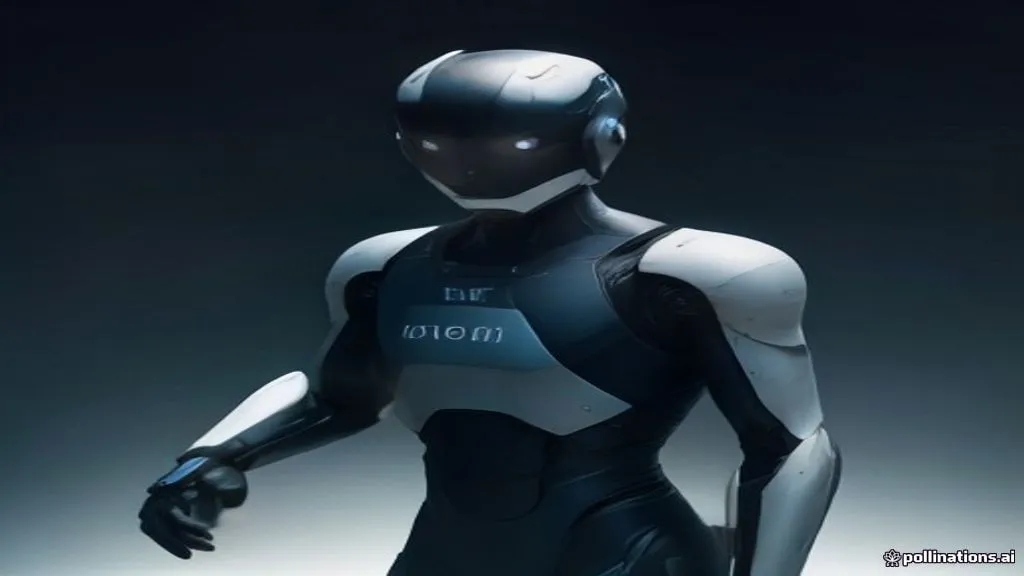
Virtual Robot Training: Inside the Ultra-Fast Synthetic Worlds
In a modest office space in Cambridge, a small bipedal robot named Freddo steps across the room, stops, and gently grasps a plastic water bottle held by a software engineer. On its face, it looks underwhelming. Human children master this motion before they learn their alphabets. Robots recently shattered sprinting records on flat tracks, so grabbing a vessel of water hardly seems like a historic breakthrough. Yet, what happened inside Freddo’s silicone brain just three minutes prior represents a tectonic shift in virtual robot training and embodied artificial intelligence.
Virtual robot training is a methodology where robotic controllers practice physical tasks millions of times inside high-speed, computer-generated physics engines. By executing control loops across parallel GPU architectures, researchers generate optimal behavioral strategies in minutes before flashing them directly onto real-world mechanical hardware.<\/p>
- Minutes, Not Days: Next-generation simulators harness parallel GPU architecture to compress months of physical trial-and-error into mere minutes.
- Moravec's Paradox: While dynamic locomotive tasks like sprinting are largely solved, micro-dexterity like grasping a flexible bottle remains robotics' toughest barrier.
- Onboard Real-Time Futures: Ultra-lightweight simulation algorithms now allow physical robots to project 20,000 potential future trajectories per second locally.
- The Sim-to-Real Deficit: Deformable materials, liquid dynamics, and variable friction still challenge synthetic models, requiring hybrid learning methodologies.
Instead of Spending weeks calibrating joint motors, tweaking reward functions, or manually scripting grip pressure, Freddo’s engineering team downloaded a fully formed motor control policy into its flash memory moments before the demonstration. The neural network had already picked up that bottle millions of times inside a synthetic universe before touching a physical object in the real world.
The Paradox of Machine Dexterity
Walk through any high-tier academic lab or industrial automation floor, and you will witness an infuriating dynamic known to computer scientists as Moravec’s paradox. AI models routinely defeat grandmasters at chess, generate photorealistic cinema, and execute backflips on complex terrain. Yet asking that same platform to pick up a slippery, half-empty plastic container and hand it back without dropping or crushing it remains a multi-million-dollar challenge.
“It’s a weird situation with robotics,” says Kier Storey, co-founder of Cambridge startup Vsim. “The stuff that we find as humans to be incredibly difficult, like gymnastics, you can get robots to do reasonably well. The stuff that humans are really good at, like fine dexterity, is really hard in robots.”
The issue boils down to physical contact mechanics. A walking robot relies heavily on momentum, balance algorithms, and rapid force vectors applied against a hard floor. Dexterous manipulation, however, involves complex interactions with uncalibrated everyday items: pliable plastics, squishy fruit, slick glass, and variable weights. In physical testing, attempting millions of trial-and-error attempts burns out expensive actuators, destroys gearboxes, and takes years of clock time.
Rewriting Legacy Physics Engines for Parallel Silicon
To bypass physical limitations, the robotics industry relies heavily on robotics simulation software. If you can simulate reality accurately inside a computer, you can run reinforcement learning algorithms across vast digital clusters at thousands of times real-time speed. However, legacy simulators come with their own historical baggage.
Storey and his co-founder, Michelle Lu, previously worked at graphics giant Nvidia, contributing to early iterations of Isaac Sim—the tech titan’s flagship digital twin framework. They realized that while compute hardware evolved dramatically with the rise of modern graphics processing units (GPUs), the software foundations supporting physical dynamics remained stuck in the past.
“The underlying algorithms that we were using for most of these robotic simulations hark back to the 1970s and 1980s, but those algorithms are not really brilliant fits for GPUs,” Storey explains.
Legacy physics solvers were built sequentially for central processing units (CPUs), calculating collision vectors one step at a time. modern GPU accelerated physics demands massive parallelism—solving thousands of simultaneous matrix operations across tens of thousands of processing cores.
In 2022, Lu and Storey launched Vsim to build an environment optimized specifically for modern tensor architectures. By ditching forty years of legacy physics code and rewriting the core linear algebra from scratch, Vsim achieved dynamic simulation speeds that caught the industry off-guard. Within eighteen months, their team of ten engineers produced an ultra-lightweight, high-throughput solver capable of condensing days of policy optimization into minutes.
Running 20,000 Futures on the Fly
The speed boost does more than shorten training runs during offline development. It changes how physical platforms operate inside unpredictable human spaces.
Because Vsim’s physics solver is optimized to consume minimal compute resources, the algorithm can run directly on the low-power onboard chips carried inside Freddo’s physical chassis. As the robot navigates a messy room, it doesn’t just react to sensor inputs in real time—it actively simulates thousands of probable immediate futures while moving.
“It can look about a second or so ahead into the future for 20,000 different kind of combinations of things that might happen,” Storey notes. This local predictive horizon proves critical when an autonomous system encounters human unpredictability.
“Things outside of the robot’s control, like humans, animals or even other robots, could do things that require a change of strategy,” says Lu. “These unexpected events could happen very quickly and the robot needs to be able to quickly adapt to ensure its actions remain safe and on-mission.”
If a person drops a towel in front of the robot or a pet darts across its path, the system evaluates thousands of alternate contact trajectories in milliseconds, choosing the trajectory that avoids a collision without stalling the task entirely.
The Industry Playbook: Vsim vs. Nvidia vs. MuJoCo
The race to construct ultra-accurate, hyper-fast digital proving grounds has splintered into distinct architectural philosophies. On one end stands specialized startups like Vsim; on the other are mega-corporations using brute-force compute, and open-source academic tools used worldwide.
| Platform / System | Core Architecture | Primary Compute Engine | Key Strength | Primary Challenge |
|---|---|---|---|---|
| Vsim | Custom parallel matrix solver | Onboard & Dedicated GPU | Extremely high throughput; lightweight execution on physical hardware | Smaller ecosystem; ongoing expansion of material physics |
| Nvidia Isaac Sim / Cosmos | Omniverse platform / Generative World Models | Enterprise Cloud / Multi-GPU Clusters | Massive scale, high-fidelity rendering, generative AI agent workflows | Heavy resource footprints; steep system integration overhead |
| MuJoCo (Google DeepMind) | Convex optimization physics engine | CPU & GPU bindings | Open-source, highly reliable contact dynamics, broad academic adoption | Requires careful tuning for extreme parallel scaling |
SEEUY INTELLIGENCE
Virtual Robot Training – Analytical Overview
Vsim
Custom parallel matrix solver
Nvidia Isaac Sim / Cosmos
Omniverse platform / Generative World Models
MuJoCo (Google DeepMind)
Convex optimization physics engine
At the corporate enterprise level, industry developments reported by Reuters show Nvidia doubling down on platform dominance. Rather than building physical robotic hardware, Nvidia offers enterprise infrastructure—supplying chip architecture along with broad world-modeling software suites like Cosmos.
Spencer Huang, Director of Product for Robotics at Nvidia, acknowledges that scaling long-duration tasks remains a significant obstacle even with enterprise-grade compute. Manipulating an object in a brief interaction is straightforward. Asking a robot to pick up a vessel, walk to a tap, fill it, and transport it without spilling requires maintaining coherent policy execution over extended time horizons.
To overcome the labor-intensive chore of manually coding millions of virtual environments, Nvidia now deploys generative AI agents inside its world models. These agents procedurally generate 3D locations, introduce random lighting conditions, and position obstacles automatically.
“When we talk about creating the virtual world and actually scanning it in—a lot of that is actually manual labour,” Huang notes. “We’re just throwing agents at it… it’s basically given us a huge workforce.”
Addressing the Sim-to-Real Gap
Despite massive compute allocations, synthetic environments remain approximations of our physical reality. Roboticists refer to the persistent discrepancy between digital prediction and physical execution as the sim-to-real gap.
Dr. Rika Antonova, an associate professor at the University of Cambridge’s Department of Computer Science and Technology, has spent over a decade analyzing how synthetic learning policies transition into physical hardware. Working extensively with MuJoCo—an open-source physics engine acquired by Google DeepMind in 2021—she notes that while fast simulators like Vsim present compelling speed advantages, physical reality retains nuances that resist code generation.
“If you have a very, very fast simulator, then you can simulate hundreds of millions of samples in that few seconds that your robot is thinking about how to adjust its motion,” Antonova points out. “But there are certain things that are hard to model in simulation, like highly deformable objects and cutting.”
Consider cutting a piece of fruit, folding a wet towel, or opening a worn cardboard box. These tasks involve continuous structural deformation, variable surface friction, shear stress, and micro-fractures. In traditional physics engines, calculating these non-rigid interactions requires intense computational overhead, often dragging fast parallel execution to a crawl.
When a control policy trained in a simplified digital environment encounters physical complexities—such as soft fabrics or shifting fluids—its confidence collapses. The machine stumbles, misjudges grip force, or drops items.
The Emergence of Embodied AI Paradigms
To eliminate these shortcomings, tech teams are combining high-speed simulation with human demonstration data. Recent market analyses highlighted by financial reporting from Bloomberg indicate that venture capital funding is shifting rapidly toward startups building holistic embodied AI architectures—systems that blend visual learning, physical dynamics, and rapid tactile feedback loops.
Instead of relying strictly on pure mathematical simulation, systems train on high-definition video demonstrations of real humans completing physical work. The neural network infers functional intent from video, translates that intent into a baseline policy, and then uses hyper-fast simulation environments like Vsim or Isaac Sim to refine motor execution across millions of synthetic iterations.
Why Hybrid Training Models Are Winning
- Reduced Sim-To-Real Variance: Human demonstration data grounds the neural network in realistic motion profiles, while digital simulation explores edge-case safety failures safely.
- Sub-Second Adaptability: Onboard physics verification lets robots evaluate structural stability before exerting full motor torque on fragile objects.
- Hardware Independence: Abstract control policies learned in software can be rapidly fine-tuned for diverse robot designs—from single bipedal platforms to multi-jointed industrial arms.
The Horizon: Meet Nacho
Back in Cambridge, Vsim is preparing to bring its second research robot, dubbed “Nacho,” into the lab. Nacho will work alongside Freddo, testing whether control policies generated inside their high-speed software framework translate seamlessly across different physical forms, motor topologies, and weight distributions.
Lu emphasizes that the goal isn’t merely building fast computer software—it is delivering absolute mathematical fidelity that eliminates guesswork when transferring code to physical machines. “We’ve reduced approximation, using accurate simulations to train models that genuinely work in reality as well as they do in simulations,” she says.
The era of manually programming industrial robots for every explicit task is drawing to a close. As synthetic physical worlds become indistinguishable from our own, machines will spend their nights living millions of virtual lives—mastering the delicate mechanics of physical reality before taking a single physical step into our homes and workplaces.
<button type="button" onclick="this.parentElement.innerHTML='✓ Thank you, we will refine our analysis!‘” style=”background:#ffffff; border:1px solid #cbd5e1; border-radius:6px; padding:4px 12px; font-size:12px; cursor:pointer; color:#334155;”>👎 No
Latest Analytical Follow-up: For continuous developments on this subject, read our full investigation on Gemini AI Security Breach Signals New Frontier in Cyber Risk.
Latest Analytical Follow-up: For continuous developments on this subject, read our full investigation on How White House Press Bans Redefine Free Speech.
Latest Analytical Follow-up: For continuous developments on this subject, read our full investigation on The Real Danger Behind Meta Muse Privacy Concerns.
