
Democrat Endorses Republican in Critical Michigan Senate Race
DETROIT — In a dramatic twist just forty-eight hours before polls open, the high-stakes contest for Michigan’s open U.S. Senate seat was thrown into utter chaos. U.S. Representative Haley Stevens, a prominent centrist Democrat who lost a bruising primary earlier this year, publicly crossed party lines to throw her weight behind Republican candidate Mike Rogers. The stunning Michigan Senate race endorsement has sent shockwaves through national political circles, turning a tense battleground into a chaotic referendum on party unity.
A major political rift hit the Michigan Senate race endorsement landscape when Representative Haley Stevens unexpectedly backed Republican candidate Mike Rogers over Democratic nominee Abdul El-Sayed. Driven by primary tensions and ideological splits over foreign policy, this rare cross-party endorsement jeopardizes Democratic efforts to retain a vital Senate seat.<\/p>
- Unprecedented Defection: Sitting Democratic Congresswoman Haley Stevens publicly endorsed Republican Mike Rogers just 48 hours before election day.
- Ideological Fracture: Tensions between the party's centrist wing and progressive nominee Abdul El-Sayed erupted over foreign policy advertising and primary grievances.
- Immediate Backlash: Top party leaders labeled the move a betrayal, prompting immediate staff resignations within Stevens' office while Republicans seized the momentum.
- High-Stakes Battleground: The seat, held by Democrats since 1994, remains pivotal for determining overall control of the United States Senate.
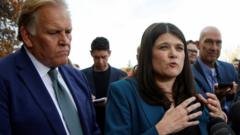
Standing outside a suburban church on Sunday morning alongside Rogers, Stevens made the kind of political break rarely witnessed in modern American politics. The move brought long-simmering animosity between the party’s moderate and progressive factions into full public view.
The October Surprise That Shattered Party Unity
The announcement wasn’t just a press release tucked away late at night. It unfolded live as Stevens stood shoulder-to-shoulder with her former political adversary. Shortly after appearing with Rogers, Stevens released a video on X outlining her reasons for the Democrat cross-party endorsement.
“I don’t belong in Abdul’s campaign,” Stevens said, addressing voters directly. “Who we are as Michiganders is not hate and is not what we are getting out from our Democratic nominee right now. That’s why I am endorsing Mike Rogers.”
Her target was Abdul El-Sayed, the progressive public health official who won the Democratic nomination after defeating Stevens in a hard-fought primary. The feud between the two hit a breaking point over the weekend regarding an ad produced by an outside liberal political action committee. The advertisement linked American foreign policy in the Middle East with domestic inflation—a narrative Stevens vigorously repudiated as inflammatory.
“This is a very close election, we all know that,” Stevens told reporters outside the church service. “But Abdul made clear that I was not welcome in his campaign, that he didn’t need me there, that he didn’t want me there.”
When pressed on the public break, El-Sayed brushed off the spectacle. “At the end of the day, I don’t think about Haley Stevens,” El-Sayed stated while campaigning in Wayne County. “None of this matters. We are focused entirely on the working families of this state.”
An Ideological Schism Boils Over
The bitter conflict between the two politicians exposes the deep fault lines dividing the Democratic coalition ahead of upcoming national elections. On one side stands El-Sayed, the son of Egyptian immigrants, who built a powerful grassroots movement centered on progressive economic populist messaging and sharp criticism of Washington’s foreign policy consensus. On the other side sits Stevens, an establishment favorite who championed traditional manufacturing and centrist policies with support from figures like Michigan Governor Gretchen Whitmer.
Efforts to stage a public reconciliation completely collapsed over the weekend. Stevens was originally slated to join El-Sayed at a unity rally aimed at rallying suburban voters. However, after Stevens publicly demanded that El-Sayed denounce the outside group’s controversial advertisement, the invitation was abruptly rescinded.
Rather than staying home, Stevens pivoted sharply. She arranged a joint appearance with Rogers, fundamentally altering the dynamics of the Senate battleground Michigan voters are weighing.
Comparing the Candidates and Key Figures
To understand the policy and tactical chasm defining this Senate race, consider how the key players align across pivotal issues:
| Candidate / Figure | Party & Faction | Key Stance on Foreign Policy | Economic Focus | Position on Party Unity |
|---|---|---|---|---|
| Abdul El-Sayed | Democrat (Progressive) | Skepticism of foreign military aid; critical of foreign intervention | Grassroots labor protections, healthcare expansion | Focuses on turnout over traditional consensus |
| Mike Rogers | Republican (Conservative) | Traditional hawkish defense posture; strong support for allies | Tax reduction, deregulation, industrial revitalization | Welcomes cross-party support from moderate Democrats |
| Haley Stevens | Democrat (Centrist) | Pro-defense establishment; strong bipartisan national security posture | Manufacturing investments, supply-chain resilience | Broke ranks following primary disputes and ad controversies |
Repercussions Across the Battleground Map
The fallout from Stevens’ announcement was swift, severe, and immediate. Within hours, several members of her congressional staff resigned in protest. Party leadership scrambled to limit the structural fallout, releasing coordinated statements aimed at isolating the congresswoman.
Senate Majority Leader Chuck Schumer spared no rhetoric, calling Stevens’ decision a “despicable betrayal” of the voters who elected her. Curtis Hertel, Chairman of the Michigan Democratic Party, offered a blistering critique of the congresswoman’s turn.
“This decision shows that she has abandoned everything she claims to care about,” Hertel said in an official statement. “We reject the attempts by Stevens and bad-faith actors to divide our party and undermine our momentum at this critical hour.”
Unsurprisingly, Republicans rushed to capitalize on the rift. Republican candidate Mike Rogers praised Stevens for showing “tremendous courage” in standing up against her own nominee. Former President Donald Trump amplified the story during a campaign stop in Iowa.
“I don’t know Haley. I’ve never met Haley. But Haley said what few people were willing to say,” Trump told a cheering crowd. “She was very brave. I’d love her to join the Republican Party actually.”
According to analysis from Reuters, cross-party endorsements of this scale in modern Senate races are exceptionally rare, often altering suburban turnout dynamics in unexpected ways.
Grassroots Resentment and Swing Voter Skepticism
Despite the high-altitude political drama, questions remain over whether the Haley Stevens Mike Rogers alliance will actually sway undecided voters in Michigan. On the streets of downtown Detroit and its surrounding suburbs, reactions range from deep frustration to complete indifference.
“I just genuinely don’t understand it,” said Summer Lawrence, a 21-year-old student at Wayne State University. “I do think it’s a betrayal of the party because the fundamental things she stands for are not the same things that Mike Rogers stands for as a conservative Republican.”
Others saw the move as an act of political retribution following a bitter primary campaign.
“People can see right through her actions,” argued Marissa Lee, a voter in Macomb County who plans to vote for Rogers anyway. “She’s just angry she lost the primary. I don’t think it’s going to make anybody actually change their mind about how they vote.”
Political strategists monitoring Abdul El-Sayed Michigan operations note that progressive enthusiasm remains high in university towns and urban centers, but the loss of Stevens could hurt El-Sayed’s margin among affluent, moderate suburban women who supported Stevens in previous elections.
Control of the Senate Hangs in the Balance
The stakes in Michigan could not be higher. The seat, currently held by a retiring Democrat, has been in Democratic hands since 1994. However, the state’s presidential track record underscores its razor-thin margins: Michigan backed Joe Biden in 2020 before swinging back toward Donald Trump in 2024.
To secure an absolute majority in the upper chamber, national Democrats cannot afford a loss in Michigan. A loss here means the party would need to net five flips elsewhere—a mathematically daunting task in the current political map, as detailed by recent political forecasting from Bloomberg.
Whether Stevens’ endorsement shifts critical suburban votes or simply solidifies El-Sayed’s base against perceived political betrayal will be answered when the polls close. But one reality is clear: the intra-party war in Michigan has reshaped the final hours of the campaign, leaving both national parties holding their breath.
<button type="button" onclick="this.parentElement.innerHTML='✓ Thank you, we will refine our analysis!‘” style=”background:#ffffff; border:1px solid #cbd5e1; border-radius:6px; padding:4px 12px; font-size:12px; cursor:pointer; color:#334155;”>👎 No
Latest Analytical Follow-up: For continuous developments on this subject, read our full investigation on Russian Aid Centre Strike Kills 26 in Komyshuvakha.
Latest Analytical Follow-up: For continuous developments on this subject, read our full investigation on Ranbir Kapoor Ramayana AI: Scale, Soul, and Fatherhood.
