
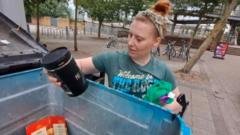
Dumpster Diving Savings: The Underground Scavenger Economy
Outside a North London supermarket, the pavement was strewn with bloated black garbage bags. When Darryl Baker peered beneath the plastic flaps of the adjacent commercial bins, she did not find rotting food or industrial sludge. Instead, she uncovered pristine Nike hoodies, tags still fluttering in the breeze, stacked alongside crisp Ralph Lauren knitwear. For anyone seeking to maximize their dumpster diving savings, this was not trash—it was an unmined retail goldmine.
Dumpster diving savings represent the tangible financial returns achieved by recovering discarded retail goods, clothing, food, and industrial metals from commercial waste bins. Practitioners frequently save thousands annually on household expenses while creating secondary revenue streams through online resale platforms, directly challenging traditional retail supply chain waste.<\/p>
- Substantial Financial Relief: Household scavengers report saving hundreds to thousands of pounds annually on clothing, toiletries, and hardware.
- Resale Ecosystems: Salvaged items frequently feed the secondhand resale market, yielding secondary incomes through platforms like Vinted, eBay, and Depop.
- Corporate Overproduction: Commercial waste streams are routinely filled with mint-condition, tagged inventory due to supply chain inefficiencies.
- Complex Legal Terrain: Scavenging laws vary wildly by jurisdiction, creating distinct legal risks of scavenged goods between UK trespass torts and US municipal theft codes.
Baker, a 39-year-old freelance journalist and mother of two, was appalled by the spectacle. She asked store managers for permission to clear the pile. They shrugged and agreed. Within hours, she had outfitted her children with brand-new wardrobes that would easily stretch across upcoming growth spurts. During a single six-month stint, she calculates she spared her family budget hundreds of pounds, while turning a tidy profit by selling salvaged items like a pristine Barbour jacket for £30.
The High Street Waste Machine and Dumpster Diving Savings
What Baker stumbled upon is not an isolated anomaly. It is the visible byproduct of systemic dysfunction across modern retail logistics. Global supply chains produce vast surpluses of physical goods. When stores run out of shelf space or cycle through seasonal shifts, discarding surplus inventory often costs less than re-shipping it to centralized distribution hubs. This economic reality has fueled a quiet, subterranean movement across European and American cities.
Every night, an army of urban scavengers, frugal parents, upcycling artists, and climate activists systematically harvest commercial skips. They are not pulling rags from landfill sites out of desperation; they are intercepting mint-condition goods before municipal compaction vehicles crush them into oblivion. According to reporting by Reuters on global consumer supply chains, inventory write-offs costs major conglomerates billions annually—a systemic leakage that divers are more than happy to capture.
“My mind was blown. This stuff was just strewn all over the floor. Brands like The North Face and Nike, completely unused, sitting beside municipal bins.” — Darryl Baker
The practice represents a radical friction point against traditional retail. Consumer spending traditionally dictates household solvency. By decoupling consumption from traditional retail transactions, divers convert corporate waste directly into personal balance-sheet liquidity.
Quantifying the Scavenger Economy
The financial scale of urban foraging varies wildly based on geography, access, and individual expertise. While casual divers focus on eliminating domestic grocery bills, seasoned operators manage structured operations that resemble small-scale logistics enterprises.
| Practitioner Profile | Primary Location | Target Materials | Est. Annual Financial Impact | Primary Distribution Channel |
|---|---|---|---|---|
| Darryl Baker (Parent / Journalist) | London, UK | Apparel, homewares, toys | £800 – £1,500 saved/earned | Personal use, charity, local resale |
| Jeff Ferrell (Academic / Author) | Fort Worth, USA | Scrap metal, tools, toiletries | $10,000 – $20,000 equivalent | Scrapyards, eBay, direct gifting |
| Millie Diamond (Stylist) | London, UK | Textiles, vintage garments | £5,000+ fashion value reclaimed | Custom upcycled design sales |
| Charlotte Bayford (Sales Assistant) | Essex, UK | Toiletries, sealed food, decor | £1,000+ cumulative expense cuts | Home consumption, local donation |
To understand the depth of this economic parallel market, one must look toward the long-term practitioners who have turned urban gleaning into a science. Circular economy trends suggest that consumer reliance on secondary reclamation increases sharply during inflationary periods, turning niche thrift tactics into mainstream survival mechanisms.
Academic Scavenging: Anarchism Meets Practical Thrift
Jeff Ferrell does not view his daily routine as a hobby. He sees it as an intellectual and political imperative. A 72-year-old professor emeritus of sociology at Texas Christian University, Ferrell has spent more than half a century pedaling through the affluent neighborhoods of Fort Worth, Texas, on a custom bicycle fitted with heavy-duty cargo baskets.
Ferrell is the author of several sociological texts on urban decay and waste. Yet his daily practice is decidedly hands-on. “I still dumpster dive every day by bicycle,” he explains. “I still enjoy it as much, or more, than ever.” His home is almost entirely furnished through urban recovery. He has not purchased soap, toothpaste, basic hand tools, footwear, or gardening supplies at retail outlets in decades.
Ferrell operates as a self-described blend of Robin Hood and practical anarchist. His strategy focuses on high-income residential zones and commercial hubs where consumer turn-over is rapid. Every two weeks, he hauls discarded copper wiring, brass fittings, and aluminum framework to commercial scrap facilities, generating approximately $150 in cash revenue. Meanwhile, his wife catalogs more valuable artifacts—vintage jewelry, mid-century decor, rare books—for sale across the secondhand resale market.
“Almost everything in our home is scrounged. Through direct savings and selling valuable finds, the total value easily reaches tens of thousands of dollars a year.” — Jeff Ferrell
For Ferrell, the activity strips away the artificial scarcity manufactured by modern commercial ecosystems. Waste is not an inevitable byproduct of living; it is a policy choice made by corporations seeking to maintain price floor artificiality.
Upcycling the Urban Spill: Fashion and Art from the Bin
While veterans like Ferrell focus on raw materials and practical domestic goods, a younger generation of urban scavengers approaches commercial waste with a creative lens. In London, 36-year-old fashion stylist Millie Diamond turns urban salvage into custom haute couture.
Diamond’s journey began when she stumbled upon a closed textile business unloading unused inventory directly into commercial bins. Clambering inside, she unearthed bolt after bolt of vintage fabrics, deadstock threads, and discarded garments. Today, she documents her dives on social media, showing thousands of followers how to convert discarded street textiles into high-end fashion.
The financial payoff can be staggering. Diamond once salvaged a single designer dress valued at approximately £600 from a commercial refuse point. By applying professional tailoring and restructuring discarded raw materials, she bypasses the rising costs of raw textiles while creating unique pieces for her clients.
This methodology directly addresses the dark side of retail waste management. Fast-fashion brands regularly discard returns or slightly flawed garments because the labor cost of inspecting, pressing, and re-bagging an item exceeds its production cost in overseas factories. For creative scavengers, this corporate calculus represents an endless stream of free raw materials.
Seasonal Cycles and the Student Exodus
For Charlotte Bayford, a 44-year-old retail sales assistant living in Essex, successful waste reclamation relies on understanding temporal cycles. Her primary harvesting season coincides with the end of the academic year, when thousands of university students vacate their dormitories and rental flats.
When international and out-of-region students return home, strict airline luggage limits force them to leave behind vast quantities of practical goods. Skips outside university housing units become overflowing repositories of unopened personal care products, kitchenware, small electronics, and non-perishable pantry items.
“I haven’t bought shampoo for eight years,” Bayford admits candidly. “I’d say that has saved me a considerable amount over time.” Her kitchen cupboards feature sealed tins of baked beans, un-cracked jars of pasta sauces, and pristine boxed dry goods. What her household cannot consume is redistributed through local charity networks or given directly to neighbors struggling with food inflation.
Legal Friction and the Boundaries of Property
Despite its financial benefits and environmental utility, urban foraging occupies a contentious legal space. The legal status of discarded items hinges on precise statutory definitions of property, abandonment, and physical boundary enforcement.
In the United States, legal frameworks vary drastically by municipality. Jeff Ferrell notes that major metropolitan areas—including New York, Cleveland, and Wichita—have enacted strict local codes that criminalize the extraction of waste from commercial and municipal bins. The overarching legal theory assumes that once an item is placed in a receptacle, ownership transfers instantly to the municipality or the franchised waste management service.
Furthermore, property owners frequently invoke criminal trespass statutes to deter foragers. Bins situated behind locked gates, inside enclosed loading bays, or labeled with clear negative covenant signage automatically transform an act of salvage into potential misdemeanor trespass.
In the United Kingdom, the legal analysis is subtle. Sunjay Versani, a prominent legal practitioner at Duncan Lewis Solicitors, emphasizes that UK law does not contain a blanket exemption allowing citizens to claim any item left outdoors.
“In many cases involving genuinely discarded goods where the owner has relinquished all rights, criminal prosecution remains unlikely. However, there is no automatic rule that an item is free to take simply because it rests in a bin. If the original owner retains an interest or if the bin sits on private land, taking items can constitute theft or trespass. Seeking permission remains the safest operational rule.” — Sunjay Versani
Understanding the legal risks of scavenged goods is crucial for modern divers. Many commercial chains have responded to public foraging by installing compactors, padlocking dumpster enclosures, or pouring chemicals over discarded food products to enforce absolute destruction of surplus stock.
The Future of Scavenging: Subversion or Integration?
As economic pressures mount, the cultural perception of dumpster diving has shifted dramatically. What was once dismissed as a desperate act of destitution is now openly celebrated across digital platforms as a smart, eco-conscious financial strategy. Short-form videos detailing multi-hundred-pound bin hauls rack up millions of views, inspiring a broad demographic of young adults to re-evaluate how they source their daily needs.
Financial analysts reporting for outlets like Bloomberg highlight how shifting consumer preferences toward circular economies are forcing brands to rethink inventory destruction policies. Yet, despite corporate pledges toward zero-landfill targets, the structural reality of mass production means commercial bins will likely remain full for the foreseeable future.
For Darryl Baker, Jeff Ferrell, Millie Diamond, and Charlotte Bayford, the practice remains a pragmatic response to an absurd economic paradigm. As long as commercial supply chains continue to throw away valuable, functional, and luxury assets, ordinary citizens will be waiting at the back gate, canvas bags in hand, ready to reclaim the wealth hidden inside the trash.
<button type="button" onclick="this.parentElement.innerHTML='✓ Thank you, we will refine our analysis!‘” style=”background:#ffffff; border:1px solid #cbd5e1; border-radius:6px; padding:4px 12px; font-size:12px; cursor:pointer; color:#334155;”>👎 No
