
US Iran War Midterms: Tehran Capitalizes on Voter Backlash
When the midterm election numbers finalized across key American battlegrounds, the political shockwaves echoed far beyond Capitol Hill. They landed directly in Tehran. For months, Washington insisted that military operations against Iranian infrastructure were containment measures yielding swift results. Yet, as voters delivered a stinging rebuke to congressional Republicans, the political consensus collapsed overnight. The primary driver wasn’t just abstract grand strategy—it was the brutal reality at the gas pump.
The US Iran war midterms fallout centers on widespread voter rejection of military escalation following sharp spikes in domestic gasoline prices. Iran's leadership interpreted the Republican electoral defeat as a public mandate against foreign intervention, while Washington faces mounting economic pressures and volatile shipping disruptions in the Strait of Hormuz.<\/p>
- Political Reckoning: President Donald Trump conceded that energy cost spikes linked to the Iran conflict heavily impacted Republican midterm losses.
- Tehran's Hardline Stance: Iranian Speaker Mohammed Bagher Ghalibaf warned that bypassing voter desire for peace would trigger a severe escalation.
- Maritime Chaos: Unrest in the Strait of Hormuz persists with sea mines, drone shootdowns, and strikes near Oman threatening 20% of global oil transit.
- Stalled Diplomacy: Despite Iranian claims of a condensed seven-step peace framework mediated by Qatar, mistrust and active skirmishes stall progress.
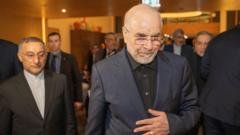
Tehran wasted no time seizing the narrative momentum. Capitalizing on the political shifts triggered by the US Iran war midterms, Iran’s chief negotiator and parliament speaker, Mohammed Bagher Ghalibaf, publicly proclaimed that the American public had delivered an undeniable verdict: a resounding vote against military escalation.
Ballot Boxes, Gas Pumps, and Political Fallout
In the aftermath of the electoral upset, political strategists on both sides of the Atlantic are parsing the exact catalyst for the sudden shift in voter sentiment. Donald Trump himself offered an exceptionally candid post-mortem. Speaking with conservative broadcast outlets, the president conceded that foreign intervention came with an immediate domestic price tag that suburban households were simply unwilling to absorb.
“People agree with what I’m doing on Iran, but they really probably weren’t willing to do the short-term consequences of paying more for gasoline—I understand that,” Trump acknowledged, while maintaining that he harbored no regrets regarding the joint offensive launched alongside Israel in February.
That short-term consequence, however, proved politically fatal in critical suburban districts. The surge in crude prices hit American consumers almost immediately after military operations disrupted oil tankers attempting to pass through volatile maritime choke points. Democratic candidates weaponized energy inflation, portraying the conflict as an unnecessary tax on working families. The messaging struck a nerve.
In Tehran, Ghalibaf seized on the election results via social media, issuing a stern warning aimed directly at the White House: “If the US government betrays their public will to serve international paymasters and blackmailers, it will learn our NO comes with a Nightmare.”
The rhetoric underscores how deeply foreign policy and domestic election cycles have fused. According to reporting from Reuters, energy market analysts had repeatedly cautioned Washington that prolonged maritime skirmishes would trigger compounding shocks to global supply chains—shocks that voters ultimately punished at the ballot box.
The War in the Waterways: Escalation in the Strait
While politicians debate mandates, the tactical reality along the Strait of Hormuz remains dangerously unpredictable. The narrow shipping corridor, through which roughly twenty percent of the world’s petroleum normally flows, has devolved into a deadly playground of asymmetric warfare.
Recent days saw conflicting reports regarding multi-tanker explosions in the narrowest transit zones. Iran’s Islamic Revolutionary Guard Corps (IRGC) claimed that four commercial tankers sustained heavy damage after striking naval sea mines in prohibited southern transit lanes. While independent verification networks like BBC Verify have urged caution regarding Tehran’s official counts, maritime security agencies confirm that violence is escalating rapidly.
Recent High-Risk Incidents in the Hormuz Corridor
- Projectiles Off Oman: The UK Maritime Trade Operations (UKMTO) documented a commercial tanker struck by two unidentified high-velocity projectiles 14 nautical miles northeast of Limah.
- Fatal Attacks on Commercial Craft: A dhow attack north-east of Oman resulted in the death of an Indian crew member, highlighting the extreme risk facing civilian mariners.
- Air Defense Intercepts: IRGC air defense units claimed the shootdown of another American MQ-9 Reaper drone over the waterway, triggering targeted retaliatory strikes by US forces on Qeshm Island.
The strategic bottleneck has effectively severed standard commercial traffic. To keep energy exports flowing from Gulf partners, the United States Navy has been forced to dedicate significant surface combatants to escorting commercial vessels. Yet, these armed convoys remain vulnerable to low-cost, high-impact threats like drifting sea mines and swarm motorboats.
Tehran’s Dual Strategy: Hardline Warnings and Shadow Diplomacy
Inside Iran, political power dynamics have undergone their own seismic shift. Following the death of former Supreme Leader Ali Khamenei in an earlier strike, his son and successor, Mojtaba Khamenei, has maintained a shadowy posture. Unseen in public since sustaining severe injuries in the very strike that killed his father, Mojtaba issued a stark, non-negotiable statement through official channels.
He dismissed any notion that American domestic election outcomes would alter Washington’s structural hostility toward the Iranian nation, warning that any resumption of broad-scale offensive operations would yield “much wider dimensions” of regional conflict.
Yet behind the fierce rhetoric lies a pragmatic necessity for economic relief. Iran’s civilian government, led by President Masoud Pezeshkian, has quietly signaled a desire to revive indirect talks mediated by Qatar. Foreign Ministry spokesperson Esmaeil Baqai confirmed that Tehran presented a streamlined version of its seven-step peace proposal—a document Iranian diplomats claim could be finalized within forty-eight hours if Washington shows genuine willingness.
Key Conflict Metrics: Pre-Election vs. Post-Election Shift
| Metric / Area | Pre-Midterm Baseline | Post-Midterm Status | Market / Policy Impact |
|---|---|---|---|
| US Gas Prices (National Avg) | $3.45 / gallon | $4.85 / gallon | Severe voter discontent; major driver of electoral shifts. |
| Strait Transit Capacity | 100% (Normal Flow) | Under 35% (Escorted Only) | Global crude supply crunch; spiked freight insurance rates. |
| US Military Stance | Active Joint Strike Operations | Defensive Escorts & Limited Strikes | Pivot toward containment following congressional pressure. |
| Iranian Negotiating Posture | Rigid 7-Step Framework | Condensed 48-Hour Proposal | Tehran testing Washington’s appetite for a quick exit. |
The Dilemma Facing Washington
President Trump now finds himself caught between strategic commitments and a revised domestic political landscape. Before the votes were tallied, the administration projected supreme confidence, hinting in interviews with financial publications that US forces were “locked and loaded” should military escalation resume post-election.
Now, that calculus is fraught with risk. Members of Congress—including newly empowered lawmakers who campaigned on anti-interventionist platforms—are signaling an unwillingness to authorize expanded budget allocations for Persian Gulf military deployments.
“The strategic math has changed overnight,” notes a senior foreign policy analyst tracking Middle East security dynamics. “Washington thought it could isolate the conflict to foreign shores. The electorate proved that energy markets bring foreign policy directly into the living room.”
Industry insiders observe that the initial preliminary agreement struck in June—which collapsed within weeks over renewed vessel targeting and reimposed blockades—remains the only logical starting point for de-escalation. However, restoring trust appears nearly impossible. Tehran refuses to surrender total control over its coastal transit routes, while Washington demands guaranteed freedom of navigation before lifting sanction regimes.
The Long Shadow Over Global Energy Realities
As winter approaches, global energy markets remain on edge. Analysts at major financial institutions monitor every drone intercept and diplomatic communique out of Qatar. Further breakdown in negotiations could easily push crude prices into triple-digit territory, compounding domestic inflation concerns across the West.
For detailed economic context on global trade dependencies, tracking data from Bloomberg Energy indicates that prolonged blockades in Hormuz could shave upwards of one percent off global GDP growth within two quarters.
The ballot box has spoken in America, but in the tactical waters of the Gulf, the weapons remain armed. Whether Washington translates voter discontent into a diplomatic exit strategy—or whether Tehran’s hardline faction miscalculates American political division as strategic weakness—will dictate the geopolitical trajectory of the coming year.
<button type="button" onclick="this.parentElement.innerHTML='✓ Thank you, we will refine our analysis!‘” style=”background:#ffffff; border:1px solid #cbd5e1; border-radius:6px; padding:4px 12px; font-size:12px; cursor:pointer; color:#334155;”>👎 No
Latest Analytical Follow-up: For continuous developments on this subject, read our full investigation on Pope’s Latin America Tour Begins After Lung Surgery.
Latest Analytical Follow-up: For continuous developments on this subject, read our full investigation on White House Denies Hegseth Exit Amid Midterm Fallout.
