
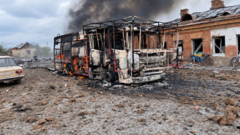
Russian Aid Centre Strike Kills 26 in Komyshuvakha
KOMYSHUVAKHA, Ukraine—The morning routine in this quiet village had barely begun when the sky collapsed. Residents had gathered outside a local municipal school, designated as a weekly food and relief distribution hub for families displaced by frontline combat across the Zaporizhzhia region. Then came the first impact. A devastating explosion shattered the main complex, sending a column of dense grey smoke into the air and turning brick corridors into pulverised rubble. Minutes later, as survivors frantically pulled neighbors from the debris, a second wave hit. A devastating Russian aid centre strike had claimed at least 26 lives, leaving a colossal crater where hope once stood.
The recent Russian aid centre strike in Komyshuvakha, Zaporizhzhia, resulted in at least 26 civilian deaths and dozens of injuries. Moscow deployed massive 3,000kg aerial bombs in a coordinated double-tap strike against a school turned humanitarian hub, severely undermining fragile diplomatic momentum ahead of scheduled regional peace negotiations.<\/p>
- Massive Lethality: At least 26 civilians, including emergency personnel and police officers, died following a double-tap strike utilizing heavy 3,000kg aerial glide bombs on a humanitarian hub.
- Targeted Rescuers: First responders were caught in a secondary strike while searching the rubble, with ongoing Russian drone activity repeatedly forcing search teams to halt operations.
- Diplomatic Disruption: The tragedy shattered fragile momentum gained from a previous civilian evacuation effort, threatening to derail upcoming negotiations scheduled in the United Arab Emirates.
- Air Defense Deficit: Ukraine's critical shortage of Western-supplied interceptors has left frontline rear positions dangerously vulnerable to high-yield standoff glide weapons.
By Monday evening, Ukrainian emergency services (DSNS) confirmed that the death toll had escalated rapidly as search teams dug through twisted rebar and crushed concrete. Among the dead were four police officers tasked with managing crowd safety and two emergency responders caught in the secondary blast. At least five others were severely injured, while 27 people remained unaccounted for beneath thousands of tons of fallen masonry. The attack represents one of the deadliest single incidents against civilian aid infrastructure in the southern theater this year.
Anatomy of a Double-Tap Bombardment
Military analysts and local officials indicate that the destruction was carried out using exceptional firepower. Regional governor Mykhailo Semikin reported that Russian forces released at least nine heavy aerial munitions over the settlement, including massive FAB-3000 aerial bombs equipped with standoff guidance technology. These 3,000-kilogram weapons, originally designed to destroy fortified subterranean bunkers, generate catastrophic shockwaves capable of flattening entire building blocks within seconds.
The sequence of the assault points toward a deliberate tactics choice long condemned by international humanitarian groups: the “double-tap” strike. Ukrainian President Volodymyr Zelensky detailed the timeline during a late-night video address, explaining that the initial munition detonated directly atop the school building while residents collected vital rations. As survivors sought cover in an adjacent structural shelter and emergency crews rushed to the scene, a second strike obliterated the designated safe area.
“The Russians could not have been unaware that the local residents who remained in Komyshuvakha received humanitarian aid there every week on Monday,” President Zelensky stated. “With such killings, Russia is sending the exact opposite signal—Russia is counting on further killings.”
The sheer scale of the ordnance left behind a crater measuring dozens of meters across. According to reporting monitored by Reuters, the Russian defense ministry maintained its silence in the immediate aftermath, offering no public comment or operational rationale for deploying high-yield munitions against a non-military rural village.
Rescue Operations Under Fire in Zaporizhzhia
For rescue teams on the ground, the ordeal did not end with the initial detonations. Operations throughout Monday afternoon and overnight were repeatedly suspended due to the persistent threat overhead. Russian reconnaissance and attack drones hovered above the blast site, harassing rescue personnel as they worked frantically to clear structural debris with heavy machinery and manual tools.
“This is a terrible tragedy for our community,” Semikin stated during a press briefing near the site. “People are still buried beneath the rubble. Our rescue workers are attempting to save whoever might still be breathing, but they are being forced to take shelter every few hours because enemy drones are targeting the work zone.”
The Human Toll Behind the Frontlines
Komyshuvakha, situated roughly 30 kilometers from the active frontline in southern Zaporizhzhia, had become a sanctuary for civilians fleeing heavy artillery exchanges along the Dnipro River. The weekly humanitarian distribution had become a vital lifeline for elderly residents, mothers with young children, and displaced agricultural workers stripped of their livelihoods. A regional day of mourning was officially declared across Zaporizhzhia on Tuesday, with flags lowered to half-mast on all public buildings.
The Abu Dhabi Peace Talks in Jeopardy
The timing of the strike carries profound political ramifications. The attack occurred just days before trilateral delegations from Ukraine, Russia, and the United States were scheduled to assemble in Abu Dhabi, United Arab Emirates, to restart diplomatic talks that had been abruptly suspended in February. Hope for diplomatic leverage had spiked briefly following a rare, successful civilian evacuation operation from the occupied southern city of Oleshky—an effort mediated in part through an unexpected diplomatic intervention involving US First Lady Melania Trump during a temporary local ceasefire.
That fragile momentum has now vanished. Ukrainian leadership framed the strike in Komyshuvakha as direct proof that Moscow has little interest in genuine de-escalation. By launching high-yield munitions into civilian gathering points on the eve of negotiations, Kyiv argues, Russia is seeking to enforce a policy of absolute terror while asserting dominant air posture.
Geopolitical analysts tracking the region suggest the escalation is engineered to extract maximum concessions at the bargaining table. Intelligence reports reviewed by international outlets like Bloomberg indicate that Russian forces have systematically intensified strike operations along the southern axis, capitalizing on acute shortages of air defense ammunition currently hampering Ukrainian forces.
The Defense Deficit: Ukraine’s Interceptor Drought
Underpinning the military crisis is a stark strategic reality: Ukraine’s stock of surface-to-air missile interceptors has reached dangerously depleted levels. Months of sustained missile and drone barrages, combined with political delays in Western military aid packages, have left regional air defense networks severely compromised. Frontline regions like Zaporizhzhia, Kherson, and Kharkiv bear the brunt of this supply gap.
Without sufficient Western-supplied interceptors—such as Patriot, NASAMS, or IRIS-T batteries—to project a protective umbrella over rear-echelon towns, Russian tactical aircraft can operate with near impunity. Su-34 fighter-bombers are now capable of releasing heavy glide bombs from distances exceeding 60 kilometers, far beyond the reach of short-range Ukrainian tactical air defenses.
Comparing Heavy Munition Impacts on Civilian Sectors
The deployment of unguided bombs converted with UMPK guidance kits has drastically altered the tactical balance along the 1,000-kilometer front lines. The following data highlights the operational characteristics and casualties linked to recent heavy glide bomb strikes across Ukraine’s southern regions:
| Munition Type | Payload Weight | Stand-off Range | Primary Target Type | Key Strategic Impact |
|---|---|---|---|---|
| FAB-500 UMPK | 500 kg | 40–55 km | Frontline positions, urban edge | High tactical mobility, moderate structural demolition. |
| FAB-1500 UMPK | 1,500 kg | 50–65 km | Command posts, fortified structures | Severe structural damage, wide fragmentation radius. |
| FAB-3000 UMPK | 3,000 kg | 60–70 km | Humanitarian centers, heavy logistics | Catastrophic blast footprint, massive subterranean shockwave. |
A Pattern of Systemic Warfare
The tragedy in Komyshuvakha is not an isolated tactical anomaly; it represents a broader structural shift in how standoff air power is deployed in modern protracted conflicts. When precision-guided heavy ordnance is directed at dual-use or purely civilian administrative infrastructure, the resulting loss of life is predictably devastating. The structural destruction of the local school leaves thousands of surrounding residents without access to basic food logistics, clean water distributions, or emergency medical aid.
As search crews continue to clear the debris in Komyshuvakha under the constant drone threat, the prospect of a diplomatic breakthrough in Abu Dhabi seems distant. For the families standing vigil beside the blast crater in Zaporizhzhia, international negotiations offer little comfort against the reality of heavy aerial warfare.
<button type="button" onclick="this.parentElement.innerHTML='✓ Thank you, we will refine our analysis!‘” style=”background:#ffffff; border:1px solid #cbd5e1; border-radius:6px; padding:4px 12px; font-size:12px; cursor:pointer; color:#334155;”>👎 No
