
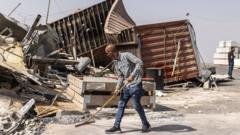
Palestinian Families Displaced as Hebron Homes Flattened
Bulldozers moved in before dusk, tearing through residential blocks and commercial storefronts without delay. By Saturday morning, more than 200 Palestinian families displaced in Hebron were left searching through twisted rebar and crushed masonry for whatever belongings remained. The ancient city of 200,000 now sits under heavy military lockdown, its streets ringed by armored checkpoints and echoing with the mechanical crunch of heavy excavation gear.
More than 200 Palestinian families displaced in Hebron following a massive Israeli military crackdown after a deadly checkpoint shooting. Israeli forces deployed armored bulldozers to flatten entire streets, commercial sites, and infrastructure across 0.35 square kilometers in the Ein Deir Baha and Farsh al-Hawa neighborhoods, blockading the city of 200,000 residents.<\/p>
- Mass Urban Displacement: Over 200 families (an estimated 2,000 to 2,500 individuals) have been displaced in Hebron following sweeping demolitions by Israeli forces.
- Targeted Neighborhoods: Destruction centered on Ein Deir Baha and Farsh al-Hawa, covering roughly 0.35 square kilometers of dense urban terrain.
- Electoral Timing: The military sweep comes four days before Israel's general election, leading local leaders to characterize the operation as politically motivated.
- Escalating Regional Strategy: Far-right cabinet ministers are advocating for Gaza-style military operations across the West Bank, while Prime Minister Netanyahu hints at broader action against the Palestinian Authority.
The scale of the destruction caught many by surprise. Entire stretches of pavement were ripped up, electricity lines severed, and multi-story structures marked with bright red spray paint before being systematically leveled. Families reported being given mere minutes to vacate their homes, forced to watch from perimeter roads as decades of family history collapsed into dust.
Trigger Event and the Swift Military Response
The immediate pretext for the sweep came early Friday morning. Two Palestinian gunmen opened fire on a military checkpoint near Hebron, killing two Israeli soldiers and wounding three others before being shot dead by return fire. Within hours, Israeli Prime Minister Benjamin Netanyahu canceled his morning campaign schedules, put on protective armor, and flew directly to the site of the attack.
Flanked by military commanders, Netanyahu delivered an uncompromising message on social media, promising that the neighborhoods tied to the attackers would face immediate retribution. Buildings around the attack site were designated for immediate destruction, setting off an expansive West Bank military crackdown that local officials describe as unprecedented in recent years.
“We will evacuate the residents, go house to house, remove the weapons we find there, and deal with and destroy all terrorist infrastructure,” Netanyahu declared from the scene.
Mapping the Destruction: Ein Deir Baha and Farsh al-Hawa
The core of the demolition campaign has concentrated on two densely built urban sectors: Ein Deir Baha and Farsh al-Hawa. Israeli Defence Minister Israel Katz confirmed that the military operation targeted residential units, commercial enterprises, industrial workshops, and local utilities spanning approximately 0.35 square kilometers.
Katz acknowledged that around 2,000 residents were displaced almost overnight, with military projections indicating that total displacements could reach 2,500 people before operations conclude. Dozens of displaced families spent the night in open fields and improvised community shelters after troops prohibited them from removing their personal vehicles during evictions.
| Metric / Data Point | Official / Reported Value | Primary Source / Authority |
|---|---|---|
| Total Displaced Families | 200+ Families (~2,000–2,500 individuals) | Hebron Municipal Council / Israeli Ministry of Defense |
| Targeted Demolition Area | 0.35 Square Kilometers | Israeli Defence Minister Israel Katz |
| Primary Neighborhoods Affected | Ein Deir Baha & Farsh al-Hawa | Local Hebron Field Reports |
| Urban Population Under Lockdown | 200,000 Residents | Palestinian Central Bureau of Statistics |
| Targeted Infrastructure Type | Homes, Shops, Workshops, Water/Power Lines | Hebron Governor’s Office |
Electoral Pressure and Political Calculus Behind Palestinian Families Displaced
This military intervention does not occur in a political vacuum. Israel’s national election is taking place in just four days, and security has emerged as the central battleground issue. Netanyahu, who has anchored his campaign on his ability to enforce ironclad security across Israeli-controlled territories, faced instant pressure from his far-right coalition partners to deliver a crushing response.
Local leadership in Hebron views the sudden, high-visibility demolitions through a explicitly political lens. Hebron Mayor Youssef al-Jaabari openly asserted that the operation was directly motivated by campaign strategy, aiming to secure crucial far-right and settler votes before polls open.
The rhetoric from cabinet members underscores the escalating stakes. Finance Minister Bezalel Smotrich publicly called on the military to execute operations in the West Bank “exactly like in Gaza or Lebanon.” Simultaneously, National Security Minister Itamar Ben Gvir repeated his demands to dismantle the Palestinian Authority (PA) entirely. In a subsequent interview with Israel’s i24 news network, Netanyahu warned of a “very big surprise” targeting the PA while confirming he had reviewed blueprints for the largest comprehensive IDF West Bank operation since 1967.
Legal Concerns Over Collective Punishment Hebron
International observers and human rights advocates have repeatedly pointed out that broad-spectrum property destruction violates basic humanitarian law. Major human rights monitoring groups argue that demolishing homes belonging to relatives or neighbors of suspect attackers constitutes a textbook example of collective punishment Hebron residents have long endured.
While the IDF announced on social media that its forces were striking dozens of suspected military targets across the West Bank, human rights organizations emphasize that destroying civic infrastructure and rendering non-combatants homeless worsens regional volatility. Extensive legal reporting by Reuters news agency highlights how punitive demolitions rarely act as a deterrent and instead fuel deep-seated grievances among displaced populations.
The Growing Humanitarian Challenge on the Ground
With hundreds of residents abruptly displaced, local community organizations are struggling to manage the basic survival needs of families stripped of shelter. Temporary aid networks have sprung up across adjacent districts, but movement restrictions severely hamper relief distribution.
- Emergency Shelter: Displaced families are being squeezed into crowded schools, mosques, and homes of extended relatives outside the cordon zone.
- Infrastructure Disruption: Heavy machinery has severed municipal water connections and electrical grids across Farsh al-Hawa, leaving adjacent neighborhoods without power.
- Economic Stagnation: Roadblock networks surrounding Hebron have halted movement for commercial transport, freezing the city’s vital leather and glass manufacturing sectors.
Financial analysis by Bloomberg financial reporting indicates that prolonged closures across major West Bank commercial nodes could cascade into broader regional economic collapse, further imperiling fragile civic institutions.
An Uncertain Horizon for the West Bank
Netanyahu explicitly likened the Hebron sweep to military actions carried out in northern West Bank refugee camps during 2025, when large-scale structural destruction forced tens of thousands to flee. As military excavators continue clearing debris in Hebron, Palestinian officials are calling for swift international intervention to prevent permanent displacement.
With national elections fast approaching and military operations slated to continue over coming days, the situation in Hebron remains razor-thin. For the families watching their neighborhoods turn to rubble, political maneuvering offers no shelter from the immediate reality of displacement.
<button type="button" onclick="this.parentElement.innerHTML='✓ Thank you, we will refine our analysis!‘” style=”background:#ffffff; border:1px solid #cbd5e1; border-radius:6px; padding:4px 12px; font-size:12px; cursor:pointer; color:#334155;”>👎 No
