
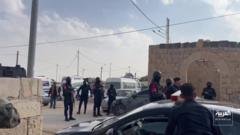
Jordan Church Shooting Leaves Seven Dead in Karak Funeral Attack
Shockwaves rippled through central Jordan on Friday when a bloody attack shattered the peace of a rural sanctuary. A targeted Jordan church shooting left seven people dead and at least 34 others severely injured after heavily armed assailants stormed a funeral service in the quiet village of Hmoud, nestled within the Karak governorate. The assault, characterized by government officials as an act of calculated extremist terror, represents one of the most violent breaches of domestic tranquility in the Hashemite Kingdom in recent memory.
The recent Jordan church shooting occurred in Hmoud village, Karak governorate, where armed extremists opened fire during a funeral service at a Greek Orthodox church. The attack left seven people dead and at least 34 injured, prompting King Abdullah II to announce severe counter-terrorism penalties and triggering widespread security lockdowns across central Jordan.<\/p>
- Tragic Casualty Toll: Seven mourners were killed and at least 34 others sustained injuries in Hmoud village.
- Extremist Perpetrators: Security forces are tracking three gunmen who opened fire during a Greek Orthodox funeral service before fleeing in a pickup truck.
- High-Level Government Response: King Abdullah II pledged the harshest penalties against the attackers, while Interior Minister Mazen al-Faraya declared the assault unprecedented in modern Jordanian history.
- Regional Impact: The incident has drawn swift condemnation across the Levant, highlighting growing anxieties surrounding Middle East Christian security.
Pandemonium erupted without warning inside the historic Greek Orthodox facility. Mourners who had gathered to pay their respects to a departed community member suddenly found themselves dodging gunfire and shattering glass. Witnesses described a chaotic scene of utter horror. People threw themselves beneath wooden pews, covering their children with their bodies as automatic weapons fire echoed off stone walls. Security agencies immediately went on high alert, sealing off major transport arteries across the southern regions of the country as elite units launched a massive manhunt for the perpetrators.
Chaos in Karak: Minute-by-Minute Breakdown of the Attack
The tragedy began to unfold in the early afternoon. Between 150 and 200 congregants were gathered inside the sanctuary when a dark-colored vehicle pulled up outside the church gates. CCTV footage verified by investigative analysts shows three men in dark clothing stepping out onto the asphalt road. Armed with handguns and automatic firearms, two of the attackers initially approached the main vehicular entrance, hesitated briefly, and then regrouped with a third accomplice before charging into the church courtyards.
What followed was 15 minutes of uninterrupted terror. Eyewitness Khalid al-Mdanat, who was inside attending the service, described how sacred prayers quickly turned into desperate screams. “People began pushing and throwing themselves to the ground,” al-Mdanat recalled during a interview. “Some were taking cover, some were cradling the dead, others were holding their sons close, some were grabbing their children and fleeing, while others were holding onto their friends who were with them at the church.”
The intensity of the gunfire led many inside to believe an entire military conflict had erupted on their doorstep. Another survivor described hearing violent explosions seconds after a quiet prayer concluded, followed immediately by the rapid clatter of automatic rifles. Glass panes exploded inward, showering injured mourners with razor-sharp debris as men, women, and children scrambled toward back exits.
“I heard something as if a war had just started. I thought it was an electrical short circuit. I looked, people lying on the ground, wounded. The scene was catastrophic.” — Anonymous Survivor of the Hmoud Church Attack
After inflicting devastation inside the sanctuary and along the open courtyards, the three gunmen retreated through the main doors. According to eyewitness accounts, they boarded a nearby pickup truck, continuing to discharge rounds indiscriminately into the air as they accelerated away from the blood-soaked scene. They remain at large, sparking an intense regional search effort involving army checkpoints, drone surveillance, and special counter-terrorism units.
The Political Shockwave: Mazen Al-Faraya News Conference and Royal Reaction
In the administrative capital of Amman, news of the attack produced immediate political shockwaves. During an urgent Mazen al-Faraya news conference, the Interior Minister did not hold back in framing the severity of the crisis. Addressing national reporters, al-Faraya labeled the strike “painful and horrific,” emphasizing that such an outrage was virtually “unparalleled in the history of the Hashemite Kingdom of Jordan.” He explicitly attributed the attack to a “group of extremists” determined to dismantle the country’s celebrated social fabric.
The central leadership moved swiftly to project strength and maintain public order. Jordan’s King Abdullah II issued an uncompromising statement shortly after receiving briefing updates from military intelligence chiefs. The monarch asserted that the state would “confront the terrorist act that targeted Karak with the harshest penalties,” signaling that military and judicial apparatuses would use all necessary measures to root out the network responsible.
Initial confusion surrounding the official death toll reflected the sheer chaos of the medical triage. Early official bulletins stated seven individuals had died on site. A government spokesperson later revised the figure downward to six during emergency briefings, before health officials finalized the confirmed fatality count back at seven late Friday evening. More than three dozen victims remain hospitalized, several in critical condition with severe gunshot wounds.
Atmosphere Charged with Anger Outside Karak Hospitals
By late afternoon, the locus of grief had shifted from the quiet village of Hmoud to the regional medical facilities treating the survivors. Outside the primary hospital in Karak, an atmosphere thick with tension and raw grief quickly took hold. Hundreds of distressed residents, community elders, and weeping family members gathered at the perimeter gates, seeking information regarding their loved ones.
Dozens of heavily armed security officers established strict cordons around the medical facility, forcing civilian vehicles to park miles away. The heightened security measures were implemented not only to preserve emergency access lanes but also to prepare for a personal visit by King Abdullah II, who traveled to Karak to inspect medical operations and meet privately with grieving families. As sirens echoed across the governorate, shouts of frustration and tears broke out among crowds demanding swift justice.
Many local citizens openly voiced anger regarding what they perceived as a strategic vulnerability in rural security enforcement. While Jordan has long maintained a reputation as an island of stability in an otherwise turbulent Middle East, regional analysts note that rural governorates like Karak have occasionally been exploited by underground extremist elements taking advantage of vast terrain and border proximity.
Comparative Analysis of Jordan Counter-Terrorism Incidents
To understand the contextual gravity of the Jordan church shooting, it is essential to examine how this event compares to historical security escalations within the kingdom over the past decade. Jordan’s security services have fought a relentless, often silent war against radical sleeper cells operating within peripheral regions.
| Incident Event | Date / Year | Primary Location | Casualties / Fatalities | Target Type |
|---|---|---|---|---|
| Karak Castle Siege | December 2016 | Karak City | 10 Killed, 34 Injured | Security Forces & Tourists |
| Baqa’a Refugee Camp Attack | June 2016 | Baqa’a Camp, Amman | 5 Intelligence Officers Killed | Security Installation |
| Rukban Border Post Attack | June 2016 | Syrian Border Zone | 6 Border Guards Killed | Military Outpost |
| Hmoud Church Funeral Attack | Recent / Current | Hmoud, Karak Governorate | 7 Killed, 34+ Injured | Civilian / Religious Funeral |
As the data illustrates, while previous incidents targeted state security installations or high-visibility tourist infrastructure, the assault in Hmoud represents a sinister shift toward soft religious targets. Security specialists at international law enforcement agencies, similar to analysts quoted by Reuters, emphasize that striking a civilian funeral service reflects an intent to trigger sectarian division within a region known for historic communal harmony.
A Coexistence Under Siege: Karak’s Christian Heritage
The governorate of Karak holds a deeply symbolic place in Jordan’s national identity. Home to a sizeable, deeply rooted Arab Christian population, the region has historically served as a model for peaceful interfaith coexistence in the Levant. Muslim and Christian tribes in Karak share deep lineage, joint cultural traditions, and interconnected social obligations that date back centuries.
Because of this shared heritage, the deliberate selection of a Greek Orthodox church during a funeral is widely viewed as a direct assault on the Hashemite model of social cohesion. Industry insiders specializing in Levantine politics note that extremist organizations often view interfaith solidarity as a major obstacle to their ideological goals. By attacking a vulnerable religious gathering, the perpetrators sought to break the social contract that underpins Karak governorate security.
The attack triggered instant international solidarity. Lebanese President Joseph Aoun, a prominent Christian head of state in the region, condemned the strike in a formal diplomatic dispatch. Aoun stated that the “heinous terrorist attack violated the sanctity of death and funeral mourners, contradicting all religious and humanitarian values.” The sentiment was echoed by religious leaders across Jerusalem, Beirut, and Damascus, all warning that silence in the face of such atrocities could embolden radical networks across the border.
Evaluating the Middle East Christian Security Landscape
The tragedy in Jordan reopens painful conversations regarding broader Middle East Christian security. Over the past two decades, ancient Christian communities across Iraq, Syria, and Egypt have suffered severe attrition due to sectarian violence, economic collapse, and targeted displacement. Jordan had historically remained the primary sanctuary where Christian heritage thrived without institutional fear or persistent terror threats.
Security analysts note that holding the line in Jordan is crucial for regional stability. If extremist groups succeed in destabilizing the kingdom’s internal security matrix, the consequences would reverberate far beyond Karak. For comprehensive intelligence assessments on Levantine regional dynamics, strategic reports published by defense monitoring groups like Bloomberg Intelligence frequently point out that Jordan’s internal stability remains the linchpin of Western-backed counter-terrorism strategy in the Middle East.
Investigative Angles: How Did the Gunmen Bypass Local Intelligence?
As the funeral massacre investigation progresses, investigative journalists and military experts are zeroing in on key operational questions. How did three armed men manage to transport heavy weaponry into Hmoud without raising red flags? Was this the work of an isolated lone-wolf cell, or does it signal the activation of a sophisticated, cross-border logistics network?
- Weaponry Sourcing: Intelligence personnel are auditing recent black-market arms seizures in southern Jordan to trace the origin of the handguns and assault weapons seen in the CCTV footage.
- Vehicle Identification: Forensic teams are reviewing highway camera networks across Karak governorate to trace the route taken by the getaway pickup truck before and after the attack.
- Ideological Links: Investigators are scanning encrypted messaging channels commonly utilized by regional extremist networks to check for latent claims of responsibility or precursor chatter.
The Road Ahead: Tactical and Policy Realities for Jordan Security
In the coming days, the Jordanian government faces a delicate dual mandate. On one front, the General Intelligence Directorate (GID) and Armed Forces must execute a swift, decisive operational response to neutralize the cell responsible for the Karak massacre. Public outrage demands fast results, and the monarchy cannot afford the perception of hesitation when state security is threatened.
On the policy front, the government must bolster protective measures around non-Muslim religious infrastructure without transforming holy places into militarized fortresses. Enhanced surveillance, community-policing integration, and accelerated intelligence sharing among tribal leaders in the southern governorates are expected to feature prominently in the upcoming national security review.
The tragedy in Hmoud is a stark reminder of the fragile balance required to maintain peace in a turbulent region. As tears are shed for the seven lives cut short inside the church courtyards, the citizens of Karak—both Christian and Muslim—stand united in grief, determined not to let armed extremists dictate the future of their ancient, shared homeland. The efficiency and rigor of the national Jordan terrorism response over the coming weeks will ultimately determine how effectively the kingdom restores its long-standing promise of safety and interfaith unity.
<button type="button" onclick="this.parentElement.innerHTML='✓ Thank you, we will refine our analysis!‘” style=”background:#ffffff; border:1px solid #cbd5e1; border-radius:6px; padding:4px 12px; font-size:12px; cursor:pointer; color:#334155;”>👎 No
