
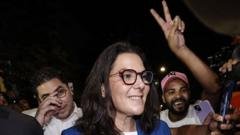
Morocco Female Prime Minister Named in Historic Election Victory
Rabat ushered in a transformative political chapter this week as 50-year-old corporate lawyer and former Marrakesh mayor Fatima Zahra El Mansouri was officially appointed as the nation’s head of government. Her elevation positions her as Morocco’s female prime minister—the first woman to hold the post in the kingdom’s history and only the second female head of government across the entire Arab world, following Tunisia’s Najla Bouden. The landmark appointment came after her centrist, modernizing political vehicle, the Authenticity and Modernity Party (PAM), clinched the largest bloc of seats in last week’s hard-fought parliamentary elections.
Fatima Zahra El Mansouri has been appointed Morocco's female prime minister by King Mohammed VI after her party, the Authenticity and Modernity Party (PAM), secured 97 seats in the parliamentary election. A former mayor of Marrakesh and corporate lawyer, she becomes only the second woman to lead an Arab government.<\/p>
- Historic Appointment: Fatima Zahra El Mansouri is appointed as Morocco's first female prime minister and only the second woman to lead a government in the Arab world.
- Royal Selection: King Mohammed VI chose El Mansouri over influential sports administrator and fellow party heavyweight Fouzi Lekjaa under Article 47 of the Moroccan Constitution.
- Coalition Imperative: With 97 seats won in the 395-seat assembly, the Authenticity and Modernity Party (PAM) must broker a coalition to reach the 198-seat governing majority.
- Pragmatic Leadership: A corporate lawyer and former Mayor of Marrakesh, El Mansouri has balanced progressive reform advocacy with royal reverence amid ongoing debates over Morocco's family law.
The announcement followed days of intense speculation inside political circles in Rabat. Under Morocco’s 2011 constitution, King Mohammed VI selects the prime minister from the party that garners the most seats in the House of Representatives. With PAM emerging victorious, the monarch selected El Mansouri over fellow party heavyweight Fouzi Lekjaa, the influential budget official and head of the Royal Moroccan Football Federation. By choosing El Mansouri, the monarch delivered both a milestone for female political empowerment and a subtle signal about the direction of Moroccan governance as the kingdom navigates pressing socio-economic shifts, regional diplomacy, and massive infrastructure preparations for the 2030 FIFA World Cup.
A Watershed Moment in Arab Governance
For observers of North African politics, El Mansouri’s elevation represents far more than a routine change in executive leadership. Her ascension disrupts long-standing institutional norms in a region where top executive political roles remain almost exclusively male domains. Her appointment, recorded by global news outlets like Reuters, highlights an evolving narrative around gender parity in executive government within constitutional monarchies.
Yet, while her title carries monumental weight, the political reality awaiting her in Rabat is exceptionally complex. Morocco operates under a constitutional framework where executive authority is shared, but ultimate sovereign power remains anchored in the monarchy. King Mohammed VI retains absolute domain over national security, foreign policy, religious affairs, and major strategic economic directives. As head of government, El Mansouri will be tasked with directing day-to-day social and economic policies, legislative initiatives, and public administration, all while managing a delicate multi-party legislative coalition.
“His Majesty is the holder of wisdom… If I am entrusted with the responsibility of head of government, it will be a great honour,” El Mansouri remarked to journalists shortly before her formal royal appointment.
When asked by reporters how state protocol would adapt to a female prime minister during traditional, male-segregated religious events—such as Friday prayers and Eid celebrations where the King acts as Amir al-Mu’minin (Commander of the Faithful)—El Mansouri navigated the topic with characteristic diplomatic tact. Rather than insisting on immediate structural revisions, she lauded the monarch as “the biggest advocate for women” in the country, deflecting potential cultural friction while acknowledging the religious traditions that underpin the Moroccan state.
The Legal Mind of Marrakesh: Who is Fatima Zahra El Mansouri?
To understand El Mansouri’s rise to the summit of Moroccan politics is to examine a career defined by municipal pragmatism, legal discipline, and shrewd political maneuvering. Born into an influential family with deep roots in the kingdom—her father was a respected diplomat and regional governor—she pursued higher education in law at Mohammed V University in Rabat before undertaking advanced legal specialization in commercial and corporate law in France and the United States.
Her entry into the political fray coincided with the founding of the Authenticity and Modernity Party in 2008, a movement initially launched by royal advisor Fouad Ali El Himma to counter established political forces and present a modern, technocratic alternative. In 2009, at just 33 years old, El Mansouri shattered precedents by becoming the first female mayor of Marrakesh, one of Morocco’s premier economic and tourist capitals. She managed the complex municipal bureaucracy of the red city with a focus on urban renewal, historical preservation, and administrative modernization.
Although she stepped away from the mayoral post in 2015, her political hiatus was short-lived. She swept back into the Marrakesh mayoralty following the 2021 municipal elections, proving her persistent grassroots appeal. Simultaneously, she served as Minister of National Territory Planning, Urban Planning, Housing, and City Policy under outgoing Prime Minister Aziz Akhannouch’s coalition government. In February 2024, as PAM sought to overhaul its internal leadership dynamics, El Mansouri was appointed coordinator of a novel collective leadership council, placing her firmly at the helm of the party’s strategic apparatus.
Despite her historic status, El Mansouri has consistently resisted being pigeonholed by media labels or gendered rhetoric. She famously rejected being characterized as an authoritarian administrator, clarifying her perspective in a 2021 party publication:
“I am neither a woman of steel nor iron… I am a free activist.”
Throughout her career, she has approached social reform through a lens of legal pragmatism rather than radical activism. While public debates across Morocco have intensified over reforms to the Moudawana (the legal family code)—specifically concerning contentious topics such as inheritance equality, child custody, and legal restrictions on polygamy—El Mansouri has largely focused on economic modernization, administrative delivery, and institutional governance, maintaining broad cross-ideological appeal.
The Royal Calculus: Choosing El Mansouri Over Lekjaa
Under Morocco’s Article 47 constitutional framework, the King’s mandate to pick the head of government from the winning party contains crucial discretionary room when that party utilizes collective leadership. Because PAM restructured its executive power earlier in the year without a single Secretary-General, King Mohammed VI faced a direct choice between two primary party stalwarts: El Mansouri and Fouzi Lekjaa.
Lekjaa, who serves as Minister Delegate for the Budget and President of the Royal Moroccan Football Federation, was widely viewed as a formidable rival candidate. He achieved international renown by managing Morocco’s historic 2022 World Cup run in Qatar and securing the joint hosting rights for the 2030 tournament alongside Spain and Portugal. Furthermore, financial analysis by international outlets like Bloomberg frequently cited Lekjaa as a primary architect of Morocco’s fiscal expansion and infrastructure modernizations.
However, analysts suggest that King Mohammed VI’s final decision to appoint El Mansouri was guided by distinct strategic advantages:
- Executive Administrative Track Record: Having managed both a major international city (Marrakesh) and a large cabinet ministry (Housing and Urban Planning), El Mansouri possesses extensive hands-on experience dealing with local government, social housing shortages, and urban reform.
- Symbolic Modernization: Elevating a foreign-educated, modern female legal professional aligns directly with Morocco’s efforts to portray itself as a progressive, stable nation committed to gender equity in the MENA region.
- Broad Consensus Appeal: El Mansouri maintains strong operational relationships across party lines, making her uniquely equipped to lead incoming, delicate multi-party coalition negotiations.
Parliamentary Arithmetic: The Coalition Conundrum
While winning 97 seats in the 395-seat House of Representatives secured victory for PAM, it leaves the incoming prime minister far short of the 198-seat threshold required to command an absolute majority. To form a functional government and pass national legislation, El Mansouri must assemble a broad coalition partner grid.
Constructing this governing majority will test her legal and diplomatic acumen. The political landscape in Rabat remains fractured following a contentious electoral campaign marked by debates over inflation, youth employment, severe rural droughts, and economic inequality.
The Major Parties and Parliamentary Seat Distribution
| Political Party | Ideological Alignment | Seats Won (2024 Election) | Coalition Position / Strategy |
|---|---|---|---|
| Authenticity and Modernity Party (PAM) | Centrist, Modernist | 97 | Governing Party: Led by PM El Mansouri; building majority. |
| National Rally of Independents (RNI) | Center-Right, Business-Friendly | 76 | Uncertain Ally: Relations strained following previous coalition rivalries. |
| Justice and Development Party (PJD) | Islamist, Conservative | 54 | Opposition: Leader Benkirane formally rejected coalition talks. |
| Istiqlal Party (Independence Party) | Center-Right, Nationalist | 48 | Potential Partner: Moderate alignment on social and economic priorities. |
| Popular Movement (MP) | Center-Right, Rural Interests | 28 | Potential Partner: Open to joining economic development bloc. |
| Others / Independents | Various / Regional | 92 | Target Area: Minor parties required to solidify margins. |
As the table highlights, the path to 198 seats requires careful maneuvering. Historically, PAM was partnered with the National Rally of Independents (RNI), led by outgoing Prime Minister Aziz Akhannouch. However, political relationships between PAM and RNI frayed toward the end of the previous term over spending priorities and municipal governance disputes. Rebuilding that partnership will require significant compromise over key ministerial posts.
Simultaneously, a potential alliance with the Islamist Justice and Development Party (PJD) has been explicitly ruled out. The PJD experienced a notable rebound in this cycle, capturing 54 seats—up sharply from the 13 seats it managed during its disastrous 2021 electoral contraction. Fueled by the return of former Prime Minister Abdelilah Benkirane, the PJD capitalized on voter dissatisfaction regarding living costs. Following the election results, Benkirane made it unequivocally clear that the PJD would remain in opposition, refusing to enter a government headed by PAM.
Consequently, El Mansouri is expected to initiate formal coalition discussions with traditional centrist and nationalist formations, such as the Istiqlal Party and the Popular Movement, alongside smaller regional parties, to forge a stable parliamentary majority.
Policy Horizons: Moudawana, World Cup 2030, and Regional Realpolitik
The agenda confronting Morocco’s new prime minister is demanding. Nationally and internationally, Morocco is navigating a transformational period marked by high-stakes regional diplomacy, economic transition, and social evolution.
1. Legal Reform and the Moudawana
One of the most sensitive domestic files waiting on El Mansouri’s desk is the ongoing review of the Moudawana—Morocco’s family legal code. King Mohammed VI previously tasked a commission with drafting proposals to modernize the code to enhance rights for women, reform custody arrangements, and address legal loopholes regarding underage marriage. As Morocco’s first female prime minister, El Mansouri’s handling of the legislative implementation of these recommendations will be intensely scrutinized by both progressive legal advocates and conservative traditionalists.
2. Preparing for the 2030 FIFA World Cup
Morocco is locked into a massive capital investment cycle to prepare infrastructure for co-hosting the 2030 FIFA World Cup alongside Spain and Portugal. Billions of dollars are earmarked for stadium construction, high-speed rail network extensions, airport upgrades, and urban hospitality centers. El Mansouri’s technocratic expertise in urban planning and public infrastructure will be vital in keeping these national megaprojects on schedule and within fiscal boundaries.
3. Foreign Policy and Regional Security
Morocco’s broader geopolitical orientation will maintain steady continuity under royal stewardship, but executive implementation falls to the prime minister’s cabinet. Major foreign policy pillars include:
- Western Sahara and Diplomacy: Consolidating international recognition of Morocco’s autonomy plan for the Western Sahara region remains the state’s paramount diplomatic priority.
- Relations with Spain and Europe: Managing delicate border controls surrounding the Spanish enclaves of Ceuta and Melilla, alongside combating human trafficking networks and boosting bilateral trade, remains essential.
- The Abraham Accords: Sustaining diplomatic and commercial normalization with Israel under the US-brokered Abraham Accords, while balancing sensitive domestic public sentiment regarding regional conflicts.
A High-Stakes Balancing Act
As Fatima Zahra El Mansouri prepares to take the oath of office and present her cabinet to King Mohammed VI, she steps into a role that carries deep historic resonance. She embodies a rare intersection of deep municipal executive experience, legal acumen, and symbolic break with patriarchal tradition in North Africa.
Yet, political honeymoon periods in Rabat are notoriously brief. Confronted by systemic economic pressures, persistent youth unemployment, agricultural climate impacts, and complex coalition politics, Morocco’s female prime minister must quickly convert symbolic historic triumph into concrete legislative output. The success of her tenure will be judged not only by the glass ceiling she broke, but by her capacity to deliver tangible economic prosperity and institutional stability to the 37 million citizens of the North African kingdom.
<button type="button" onclick="this.parentElement.innerHTML='✓ Thank you, we will refine our analysis!‘” style=”background:#ffffff; border:1px solid #cbd5e1; border-radius:6px; padding:4px 12px; font-size:12px; cursor:pointer; color:#334155;”>👎 No
