
Trump UN Speech on Iran: Annihilation Threat Meets Backroom Deals
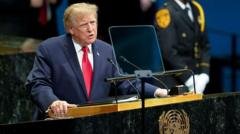
The green marble backdrop of the United Nations General Assembly has hosted decades of theatrical brinkmanship, but Tuesday’s session felt distinctively volatile. Delivering his highly anticipated Trump UN speech on Iran, the American president presented a stark, uncompromising ultimatum: a grand diplomatic bargain or absolute military destruction. “Do I drive them into hell?” he asked a stunned, standing-room-only crowd of world diplomats. It was classic Trump—unfiltered, aggressive, and designed to shock. Yet, just floors away in the quiet corridors of Manhattan, a parallel reality was unfolding.
The Trump UN speech on Iran delivered a dual-track ultimatum: the Islamic Republic faces total military annihilation unless a comprehensive nuclear and security deal is reached. This aggressive public rhetoric directly contrasted with quiet, high-level US-Iran sideline talks mediated by third parties at the UN General Assembly.<\/p>
- Coercive Diplomacy: Trump used his UNGA address to threaten the complete destruction of Iran while simultaneously keeping the door open for a post-election diplomatic breakthrough.
- Parallel Backchannels: Despite the fiery public rhetoric, US Special Envoy Steve Witkoff engaged in productive, mediated sideline talks with Iranian Foreign Minister Abbas Araghchi.
- Arctic Expansion: The US secured a major strategic foothold by signing a military presence agreement with Denmark and Greenland, granting broad airspace and territorial access.
- Sovereignty vs. Globalism: Trump openly rejected global governance, clashing with outgoing UN Secretary-General António Guterres' warnings about deepening global divisions.
While a lone Iranian delegate watched from the assembly floor, US and Iranian officials were quietly engaging in high-stakes, mediated negotiations. This dual-track approach of public terror and private diplomacy defines the administration’s current geopolitical playbook. It is a high-stakes gamble. The administration is attempting to leverage the threat of overwhelming force to extract concessions that have eluded Western diplomats for years.
The High-Stakes Calculus Behind the Trump UN Speech on Iran
To understand the fury of Tuesday’s address, one must look at the domestic and international pressures weighing on the administration. Since the US and Israel launched coordinated military actions against Iranian targets in February, global oil prices have surged. The conflict has dragged down domestic approval ratings. With the November midterm elections looming, the president used the global stage to pitch directly to voters back home, spending the opening minutes of his address touting domestic achievements in immigration, border security, and crime reduction.
But the core of his speech was a defense of his controversial military campaign. Trump argued that the strikes had successfully prevented Tehran from securing a nuclear weapon. He framed the conflict as a validation of his “peace through strength” doctrine—a philosophy that prioritizes ultimatums over traditional multilateral compromise.
“Will a deal be made with Iran that lets them rebuild and create a far greater country than it ever was before? Or do I annihilate the Islamic Republic and do it quickly, never giving them a chance to kill and destroy people and countries again?”
— President Donald Trump at the UN General Assembly
The rhetoric was designed to terrify, but the subtext was an invitation. Trump openly predicted that a comprehensive deal with Iran would materialize rapidly following the November elections. This suggests that the current escalation is a prelude to a grand bargain rather than an endless war.
The Green Marble vs. The Backrooms: US-Iran Sideline Talks
The real diplomatic action did not occur on the assembly stage. Behind closed doors, a three-hour meeting took place between US and Iranian representatives. This marked a significant moment in the ongoing crisis. US Special Envoy to the Middle East Steve Witkoff and Iranian Foreign Minister Abbas Araghchi engaged in intense discussions facilitated by international mediators.
The contrast between the public threats and the private talks was stark. Leaving the UN building, Witkoff gave reporters a thumbs-up. He later confirmed on social media that mediators had shuttled between the two sides throughout the day, completing a round of discussions that the administration hopes will prove constructive. Iranian state television also confirmed the meeting, signaling a mutual willingness to keep the communication lines open despite the hostile public posturing.
This is coercive diplomacy in its purest form. By keeping the threat of “annihilation” active on the global stage, the US hopes to force Iran’s leadership to accept highly restrictive terms regarding its nuclear program and regional influence. Whether Tehran will bend under this pressure or retaliate remains the central question hanging over the region.
A Comparative Look at UNGA Diplomatic Fronts
The diplomatic activity in New York extended far beyond the Middle East. The administration engaged in a flurry of bilateral meetings and strategic agreements, reshaping alliances across multiple theaters. The table below outlines the key diplomatic developments from this year’s assembly:
| Strategic Front | Key Players Involved | Primary Objective / Outcome | Diplomatic Status |
|---|---|---|---|
| Iran Conflict | US, Iran, Regional Mediators | De-escalation and nuclear containment via coercive diplomacy | Active backchannel negotiations; public threats of military action |
| Arctic Security | US, Denmark, Greenland | Secured broad airspace and territorial access; construction of two military bases | Agreement signed and finalized |
| Ukraine War | US, Ukraine, Russia (via backchannels) | Broker a rapid peace deal; upcoming Rubio-Lavrov meeting | Ongoing discussions; high skepticism from European allies |
| Latin America | US, Cuba | Containment of left-wing influence; Cuban delegation walked out | Highly adversarial; diplomatic freeze |
Rebranding the Future: From Artificial to ‘Super Intelligence’
In another characteristic pivot, Trump turned his attention to the global technology race. He rejected the term “Artificial Intelligence,” declaring that the technology should instead be known as “Super Intelligence.” The president argued that the word “artificial” diminishes the profound power of the technology, describing it as “amazing” but warning that the US must remain vigilant.
The rebranding is more than semantic. It signals a highly nationalistic approach to technological development. Trump vowed that the US would not cede its lead in AI to China. He dismissed international efforts to regulate the technology as a “globalist scheme” designed to restrict American innovation. This stance puts the US at odds with European allies who are pushing for strict, treaty-based guardrails on machine learning and autonomous systems. According to reports by Bloomberg, this unilateral approach to tech regulation could accelerate a fractured global tech ecosystem, forcing third-party nations to choose between American and Chinese technological standards.
The Arctic Frontier: Decoding the Greenland Military Base Deal
While the assembly’s attention was fixed on the Middle East, the US quietly executed a major geopolitical maneuver in the North Atlantic. Trump signed a sweeping defense agreement with Denmark and Greenland. This deal will significantly expand the American military footprint in the Arctic region.
The agreement respects the formal sovereignty of Greenland—an autonomous Danish territory—but grants the US military unprecedented access to its airspace and land. Under the terms of the deal, the US will construct two new military bases on the island. This move is designed to counter growing Russian and Chinese ambitions in the Arctic, where melting ice sheets are opening new shipping lanes and exposing vast, untapped natural resources. Industry analysts view this as a major strategic victory, securing a vital northern flank while the rest of the world remains focused on the conflicts in Europe and the Middle East.
A Clash of Worldviews: Guterres’ Farewell vs. Sovereign Might
The ideological divide at this year’s UNGA was highlighted by the contrast between Trump’s speech and the farewell address of UN Secretary-General António Guterres. Guterres delivered a somber warning to the assembly, declaring that global divisions are widening and urging superpowers to recognize “that their power isn’t so super.” He emphasized the fundamental interdependence of the modern world, pointing to climate change, inequality, and unregulated technology as threats that no single nation can conquer alone.
Trump’s address was a direct rebuttal to this multilateral philosophy. He openly attacked international institutions, accusing the UN of harboring a “far-left agenda of globalist bureaucrats who nobody ever elected.” He asserted that “there is no global government,” reinforcing his belief that national sovereignty and unmatched military power are the only reliable guarantors of peace and security.
This ideological friction was on display when the president turned his focus to Latin America. He accused Cuba’s communist government of cultivating ties with left-wing activist groups inside the US. As he labeled Cuba a “failed state,” the Cuban delegation staged a quiet, coordinated walkout from the assembly chamber. This moment highlighted the deep diplomatic rifts that define the current international landscape.
What Lies Ahead: The Post-Election Pivot
The coming months will test whether this aggressive foreign policy strategy can yield concrete results. The administration’s approach relies on a high-risk assumption: that adversaries like Iran and Russia are rational actors who will choose capitulation over conflict when faced with the credible threat of overwhelming force. According to analysis from Reuters, many veteran diplomats remain highly skeptical of this strategy, warning that extreme public pressure can backfire by forcing foreign leaders into a corner where compromise is politically impossible.
For now, the administration is moving forward with its dual-track strategy. The upcoming meeting between Secretary of State Marco Rubio and Russian Foreign Minister Sergei Lavrov will provide another test of whether the administration’s aggressive posture can translate into diplomatic breakthroughs. Whether these efforts lead to a new era of American-brokered stability or trigger a wider conflict remains to be seen. The answer will likely depend on the outcome of the November elections, which both Washington and its adversaries view as the ultimate pivot point for global diplomacy.
<button type="button" onclick="this.parentElement.innerHTML='✓ Thank you, we will refine our analysis!‘” style=”background:#ffffff; border:1px solid #cbd5e1; border-radius:6px; padding:4px 12px; font-size:12px; cursor:pointer; color:#334155;”>👎 No
