
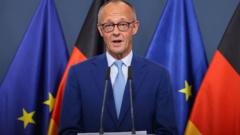
Friedrich Merz Election Crisis: Chancellor Vows to Stay
The mood inside Konrad-Adenauer-Haus on Sunday evening was less like a political headquarters and more like a forensic crime scene. As early exit polls flashed across large screens in Berlin, the full scale of the Friedrich Merz election crisis became impossible to ignore. In a catastrophic sequence of electoral defeats, Merz’s center-right Christian Democratic Union (CDU) suffered unprecedented losses in both Mecklenburg-Vorpommern and the capital city, plunging his sixteen-month-old government into deep instability and sparking immediate debate over his leadership viability.
The Friedrich Merz election crisis stems from severe state election losses in Mecklenburg-Vorpommern and Berlin, where his party fell below parliamentary thresholds or yielded top spots to populist rivals. Despite mounting internal pressure and record-low approval ratings, Merz refuses to resign, pledging structural economic reforms to stabilize his government.<\/p>
- Parliamentary Banishment: The CDU suffered a historic collapse in Mecklenburg-Vorpommern, dipping below the 5% electoral threshold.
- Populist Dominance: The far-right AfD claimed first place in Mecklenburg-Vorpommern, while Die Linke surged ahead in Berlin.
- Defiant Leadership: Chancellor Friedrich Merz insists he will not step down, framing upcoming economic reforms as the antidote to political extremism.
- Internal Discord: Rumors of a 'chancellor swap' are gaining traction in Berlin despite public backing from key regional party figures.
Barely two weeks after seeing its vote halved in Saxony-Anhalt, the CDU experienced a historic humiliation in northeastern Mecklenburg-Vorpommern. Initial projections indicated the party would barely squeeze through with its worst-ever showing. Hours later, as official tallies filtered in, the CDU fell beneath the mandatory 5% electoral threshold entirely, casting the party out of the state assembly. Merz did not mince words when addressing the media late Sunday evening, frankly describing the outcome as “a disaster” for his party. Yet, standing firm before a visibly shaken hall of supporters, he unequivocally rejected calls to resign.
A Fractured Map: Breaking Down the Numbers
The dual elections in Mecklenburg-Vorpommern and Berlin have fundamentally redrawn Germany’s political topography. In the northeast, the far-right Alternative for Germany (AfD) surged into first place, capitalizing on persistent economic discontent, rural neglect, and anti-immigration sentiment. Meanwhile, in Berlin, traditional political alliances splintered further as Die Linke (The Left) achieved a groundbreaking victory, leaving the ruling CDU trailing in second place.
To understand the depth of this political realignment, consider the state-by-state breakdown of the key electoral metrics compiled from public broadcasters ARD and ZDF:
| State / Region | Party | Projected Vote Share | Historical Context / Impact |
|---|---|---|---|
| Mecklenburg-Vorpommern | AfD | 38.0% | Strongest force; solidifies eastern dominance |
| Mecklenburg-Vorpommern | SPD | 36.0% | Resilient center-left holding second position |
| Mecklenburg-Vorpommern | CDU | < 5.0% | Disastrous drop; total loss of state parliament seats |
| Berlin | Die Linke | 26.0% | Historic victory; tops capital polls for first time |
| Berlin | CDU | 20.0% | Beaten out of ruling majority position |
| Berlin | AfD | 16.0% | Significant urban expansion into capital districts |
While the AfD’s 38% victory in Mecklenburg-Vorpommern represents an alarming high-water mark for the far-right party, its path to actual governance remains blocked. Germany’s established political entities maintain a strict cordon sanitaire, refusing to form coalitions with the party. Nevertheless, as AfD co-leader Alice Weidel triumphantly declared on election night, “We are the strongest force and have reached the mainstream of the population.” The sheer numerical weight of these AfD election gains Germany is witnessing makes forming stable state coalitions without them increasingly convoluted.
The Rightward Shift That Disappointed Centrists and Empowered Populists
For months, political analysts have tracked Merz’s strategy to neutralize the far-right threat. A former corporate attorney who returned to active politics to pull the CDU back to its conservative roots, Merz deliberately toughened his rhetoric on border security, asylum policy, and law enforcement. The goal was straightforward: win back disillusioned working-class voters who had migrated to the AfD.
The weekend’s brutal results demonstrate that this gamble backfired spectacularly. Rather than curbing populist appeal, the CDU’s rhetoric appears to have validated the AfD’s core arguments without persuading voters to trust the establishment alternative. At the same time, this ideological tilt alienated moderate urban voters in metropolitan centers like Berlin, who migrated toward Die Linke and green alternatives.
“Merz attempted to outflank the populists on their home turf while promising fiscal austerity to the center. Instead of securing either camp, he alienated centrist moderates while failing to convince true believers on the hard right,” notes a senior political researcher in Berlin.
The mathematical reality is stark: a strategy designed to reclaim the east has resulted in the CDU losing its parliamentary footing in Mecklenburg-Vorpommern altogether, compounding an ongoing CDU election defeat narrative across the federal republic.
Whisper Campaigns and the Threat of a “Chancellor Swap”
In the corridors of power in Berlin, patience is wearing thin. Rumors of a potential mid-term swap at the Federal Chancellery have transformed from backroom murmurs into open discussion among political commentators and party operatives. Speculation regarding alternative leaders—most notably popular state premiers who have managed to hold their ground—is gathering momentum.
Despite the growing disquiet, several prominent party figures rushed to defend the Chancellor publicly. Burkard Dregger, a leading CDU figure in Berlin, emphasized the need for continuity during an interview on election night, arguing that the electorate’s impatience should not derail broader federal governance.
“He has a lot of work to do, and we don’t have time to waste,” Dregger stated. Addressing the public’s frustration, he added that it was “not realistic to expect that every issue has been solved within one year. He has got four years, and we have to give him the four years.”
Simultaneously, eight state premiers issued a statement of support earlier in the week, attempting to project unity and shield Merz from an immediate leadership challenge. However, history demonstrates that support within German political parties can evaporate rapidly when state electoral failures threaten national parliamentarians’ reelection prospects in upcoming federal contests.
Reforms as an “Antidote to Authoritarian Poison”
Facing unprecedented pressure, Merz has opted for a strategy of double down rather than retreat. Rather than pivoting back to the political center or altering his cabinet, the Chancellor framed his survival around a uncompromising push to execute structural policy shifts.
Speaking to reporters at party headquarters while muted crowds monitored streaming screens in the lobby, Merz insisted that his coalition’s upcoming agenda is the only viable path forward. His proposed program includes deep structural overhauls to:
- Tax Policy: Sweeping rate adjustments aimed at stimulating stagnant corporate investment.
- Welfare Systems: Tightening eligibility criteria and reducing federal outlays to restore fiscal discipline.
- Economic Modernization: Slashing bureaucratic oversight to accelerate industrial projects and green transition infrastructure.
“The reforms have to come,” Merz insisted with noticeable intensity. “I am taking on this responsibility because I want to move our country forward. What needs to be done now requires backbone, steadfastness, and patience. I will demonstrate this as CDU party chairman and, above all, as chancellor of our country.”
Going further, Merz characterized his legislative package as an existential necessity against radicalism. “I would even go so far as to say that these reforms are the antidote to the authoritarian poison that, with the fascination of authoritarianism, is penetrating ever deeper into our society,” he remarked.
Whether a deeply divided electorate suffering from inflation and economic malaise will accept painful economic restructuring as a cure for political polarization remains highly uncertain. Further reporting on Germany’s economic performance can be tracked via Reuters Analysis and continuous financial metrics reported by Bloomberg Markets.
The Disappearing Center in German Politics
The dramatic shifts observed on Sunday highlight a broader structural transformation in German political life. The historic Volksparteien—the broad-church political parties like the CDU and the SPD that anchored West German democracy for decades—are losing their grip on the electorate.
In eastern Germany, economic disparities stemming from reunification, combined with demographic shifts and deep mistrust of federal institutions, have created a fertile environment for insurgent political forces. The regional strength of the AfD, coupled with localized surges for left-leaning movements, reflects a electorate that is increasingly polarized and immune to traditional political messaging.
In Berlin, where Die Linke candidate Elif Eralp celebrated unprecedented victory, local anxieties regarding housing affordability, gentrification, and public infrastructure outweighed national security concerns, delivering a mandate to progressive forces. This hyper-fragmentation creates a volatile political landscape where forming stable governing majorities requires unprecedented, unstable multi-party coalitions.
A Precarious Path Ahead
For Chancellor Merz, the immediate task is managing internal dissent while preserving his fragile coalition in Bundestag. With approval ratings hovering near historic lows, his ability to force difficult tax and welfare legislation through a skeptical parliament will test his political authority to its absolute limit.
The coming weeks will reveal whether his call for “backbone, steadfastness, and patience” will buy him the time needed to turn his political fortunes around—or whether these latest state-level disasters mark the beginning of the end for his presidency of the CDU and his chancellorship. For now, Friedrich Merz remains in office, governing a country whose political landscape is shifting beneath his feet faster than ever before.
<button type="button" onclick="this.parentElement.innerHTML='✓ Thank you, we will refine our analysis!‘” style=”background:#ffffff; border:1px solid #cbd5e1; border-radius:6px; padding:4px 12px; font-size:12px; cursor:pointer; color:#334155;”>👎 No
