
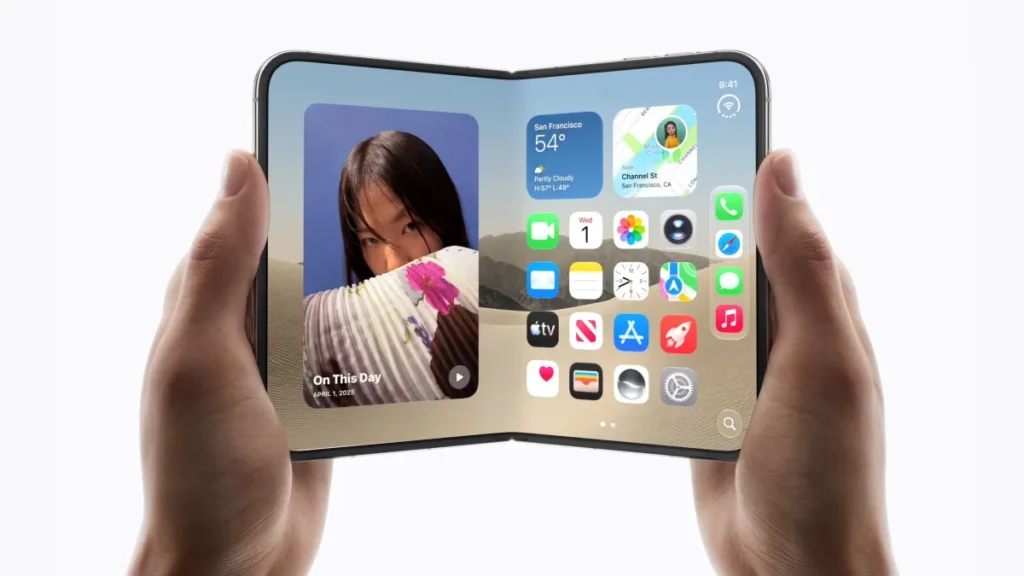
iPhone Duo Apps Surpass 100K as Apple Solves Foldable Tech
Initial hardware launches rarely escape software growing pains. When Cupertino released its flagship foldable, early reviews zeroed in on a glaring friction point: the relative scarcity of fully native iPhone Duo apps. Early adopters paying top dollar were left staring at awkward side-screen black bars on unoptimized software. Apple, however, insists the narrative has shifted completely. The tech giant confirmed on Friday that over 100,000 dedicated, dual-screen optimized titles are now active on the App Store, with thousands more pouring into the ingestion queue every single day.
iPhone Duo apps are software applications specifically built or adapted for Apple’s dual-screen foldable smartphone architecture. Optimized for iOS 27, these applications eliminate side-screen black bars, leverage expanded canvas layouts, support cross-hinge drag-and-drop multitasking, and reconfigure control schemes to utilize the hardware’s unique dual-display posture.<\/p>
- Rapid Ecosystem Expansion: Over 100,000 native and optimized iPhone Duo apps are now live on the App Store, backed by thousands of daily submissions.
- Hands-On Developer Push: Apple hosted more than 50 in-person engineering labs across 19 global cities to help over 2,000 developers transition away from pillarboxed legacy interfaces.
- Supply Constraints Persist: Despite its steep $1,999 starting price tag, the hardware sold out rapidly, pushing shipping estimates deep into next year.
This massive software surge coincides with a heavy wave of high-profile application updates. Enterprise and consumer powerhouses—including Microsoft Word, Outlook, Zoom, Goodnotes, Halide Mark III, and major sports networks—have officially adjusted their screen mechanics for the dual-canvas display. They join early adopters like Netflix, YouTube, Instagram, and WhatsApp. Yet behind this rapid ecosystem transformation lies a story of aggressive developer intervention, hardware shortages, and the architectural shifts required to make dual-screen computing actually work.
The Legacy Layout Bottleneck
Running legacy iOS applications on novel screen geometry has always been a compromises game. On the novel foldable chassis, unoptimized titles default to legacy aspect ratios. This results in heavy black pillarboxing along the screen edges, wasting critical display area. Worse yet, standard single-screen navigation menus often break across the physical hinge axis, burying vital tools inside overflow submenus.
Fixing these interface friction points requires more than standard responsive design tweaks. Developers must fundamentally rethink spatial navigation, state management, and multi-window workflows. According to coverage from Bloomberg detailing early developer reactions, migrating complex mobile software to dual-display hardware requires extensive refactoring of application view controllers.
“It’s been wonderful to see how quickly developers have embraced iPhone Duo, and we’re grateful for their creativity and innovation,” stated Susan Prescott, Apple’s Vice President of Worldwide Developer Relations. “The enthusiasm has been incredible, and we’re excited to see the pace of updates continue to accelerate.”
Apple did not leave this transition to chance. Recognizing that software engineers needed direct access to raw hardware prior to launch, the company established an unprecedented developer outreach campaign. Apple orchestrated over 50 intensive, in-person technical workshops spanning 19 cities globally. More than 2,000 developers attended these confidential sessions, coding alongside Apple framework engineers to refactor their app pipelines directly on hardware test benches.
Major Software Titans Re-Engineered for Dual Display
The latest wave of ecosystem updates brings substantial utility to the novel device format. Productivity suites have led the charge, transforming the dual-canvas architecture from a luxury experiment into a legit mobile workstation platform.
- Enterprise & Productivity: Microsoft’s core suite—Word, Outlook, Excel, and PowerPoint—now supports drag-and-drop document references across the center fold. PDF Expert, Documents by Readdle, Goodnotes, Extra, and monday.com have introduced split-canvas view states that separate active editing zones from preview panels.
- Creative & Imaging Tools: Lux’s Halide Mark III camera app utilizes the secondary screen real estate for dedicated manual exposure controls, waveform monitors, and RAW histogram displays, leaving the primary screen completely uncluttered for frame composition. Canva, Suno, and iA Writer have similarly separated editing toolbars from active workspaces.
- Finance & Real-Time Data: Platforms like Kalshi, Yahoo Finance, and SAP Concur leverage side-by-side data dashboards. Financial traders can monitor live ticker feeds on one panel while executing transactions or analyzing candlestick charts on the other.
- Media, Communications & Social: Zoom now isolates video grid feeds onto display panel A while keeping presentation decks or collaborative text chats open on display panel B. Substack, The Washington Post, Yahoo News, FOX News, Spotify, CBS, Tubi, and BBC iPlayer have integrated dual-page magazine layouts reminiscent of print media.
- Utility & Mobility: Next-generation transit and service apps—including Tesla Robotaxi, Citi Bike, Transit, ParkMobile, Strava, MyFitnessPal, Bevel, Kroger, Domino’s, Taco Bell, Untappd, and Viator—have split map interfaces and transactional steps across the physical divide.
The Staggered Rollout Reality
Despite the official announcements, end-user availability remains somewhat fragmented. Apple’s global App Store CDN propagates software releases in staged deployments. During our hands-on evaluation of review units, several listed apps—such as Spotify—continued to display pillarboxed black borders, with no updated binary available for immediate download. Apple clarified that while binaries are approved and indexed in the master directory, developer rollout toggles mean some builds will take days to reach every user region worldwide.
The Economics of a $1,999 Halo Device
Software velocity is heavily dictated by consumer adoption, and hardware demand for the novel form factor has far surpassed Wall Street estimates. The base model—configured with 256GB of storage—starts at a eye-watering $1,999. Despite this massive price point, inventory depleted within hours of pre-orders going live. Delivery timelines rapidly slipped deep into the following calendar year.
Financial reporting from Reuters highlights that supply chain bottlenecks are complicating Apple’s push to satisfy holiday demand. During this week’s quarterly earnings call, executive leadership admitted that production yield variables make it “hard to predict” precisely when supply-demand parity will be achieved.
Hardware & Ecosystem Metric Breakdown
To understand the scale of this launch transition compared to standard iOS product cycles, consider the following ecosystem rollout operational metrics:
| Metric / Parameter | Standard iPhone Launch Cycle | iPhone Duo Launch Cycle |
|---|---|---|
| Base Model Entry Price | $799 – $999 USD | $1,999 USD |
| Optimized Apps at Day 30 | ~15,000 – 25,000 updates | 100,000+ optimized apps |
| Developer Lab Outreach | Online WWDC sessions / Regional WWDC labs | 50+ in-person labs across 19 global cities |
| Engineers Attending Labs | ~500 – 800 participants | 2,000+ registered engineers |
| Initial Shipping Backlog | 2 – 4 weeks average backlog | Backordered into next calendar year |
Software Architecture Under the Hood: iOS 27 Mechanics
What makes a software title natively compliant with dual-screen parameters? Under iOS 27, Apple introduced dynamic viewport APIs that fundamentally change how the windowing engine interacts with hardware sensors.
Display Bridge and Canvas Postures
Rather than treating the dual panels as a single giant display, the OS exposes positional telemetry to developers. Apps can query whether the hinge is flat (180 degrees), tented, or held like an open book. When an app detects a posture change, layout controllers instantly break the interface into structural zones:
- Primary View Canvas: Dedicated exclusively to primary content ingestion—video playback, canvas painting, or document rendering.
- Secondary Control Surface: Automatically populates with contextual tools, software keyboards, scrubbers, or timeline tracks.
- Hinge Gap Management: The graphics layer automatically offsets pixel rendering across the center physical gap, ensuring text strings do not get clipped or distorted across the middle fold.
This architectural shift is precisely why early legacy ports felt subpar. Standard auto-layout rules simply centered UI elements, causing critical action buttons to fall directly over the hardware hinge gap. The newly updated titles specifically avoid this dead zone, anchoring interactive nodes to the outer left and right margins.
Developer Monetization: Why Engineers Are Rushing In
For independent developers, updating legacy codebases for novel hardware is a costly endeavor. Why are software teams moving so fast? The answer lies in demographic spending power.
Consumers willing to drop $1,999 on early-adopter hardware represent an extremely high-value user segment. Analytics data across the App Store suggests that users on premium hardware tiers exhibit a significantly higher conversion rate for in-app subscriptions, pro-tier software licenses, and digital transactions. Developers who capture screen real estate early on these devices establish brand loyalty before the market becomes saturated.
For instance, specialized photography app Halide Mark III converted its Duo launch update into a major subscription acquisition driver. By offering custom dual-screen workflows that mimic professional DSLR camera layouts, the app captured a massive wave of high-ARPU (Average Revenue Per User) mobile photographers seeking elite tools for their new hardware.
The Road Ahead: Overcoming Ecosystem Fragmentations
While reaching 100,000 optimized applications is a massive milestone for Apple, the road ahead remains filled with operational challenges. Android foldables have enjoyed a multi-year head start, but Google’s platform has historically struggled with inconsistent developer adoption for wide-canvas interfaces. Apple is attempting to bypass this historical friction through strict UI guidelines, aggressive engineering support, and direct platform incentives.
However, the real test will occur over the coming months as global supply catches up with consumer demand. As production lines scale and more units enter the market, developer focus will inevitably shift from simple layout adaptations to complex, dual-screen-first software concepts that have yet to be imagined.
For now, the message from Cupertino is clear: the hardware vision is set, the software ecosystem is scaling rapidly, and the early period of unoptimized software interfaces is coming to a swift close. Users holding out for a mature dual-screen app landscape finally have concrete evidence that the software foundation is catching up to Apple’s ambitious hardware hardware vision.
<button type="button" onclick="this.parentElement.innerHTML='✓ Thank you, we will refine our analysis!‘” style=”background:#ffffff; border:1px solid #cbd5e1; border-radius:6px; padding:4px 12px; font-size:12px; cursor:pointer; color:#334155;”>👎 No
