
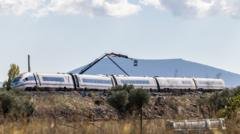
Spanish Rail Fraud Probe Opens After Deadly Urda Crash
European Union prosecutors have officially launched a high-stakes Spanish rail fraud probe into the alleged misuse of European funds designated for modernizing safety infrastructure along the nation’s premier high-speed rail corridor. The federal intervention follows last week’s horrific disaster outside the rural village of Urda, where a high-speed passenger train slammed into a disabled line-ahead train, leaving 69 dead and dozens critically wounded.
The Spanish rail fraud probe is an official investigation launched by the European Public Prosecutor's Office into whether EU funds allocated for signalling and safety upgrades on the Madrid-Seville high-speed line were misappropriated by infrastructure operator Adif and safety agency AESF, following two catastrophic crashes that killed 115 people.<\/p>
- EPPO Fraud Probe: European prosecutors and Guardia Civil officers are investigating rail authorities Adif and AESF over alleged misuse of EU infrastructure funds.
- Catastrophic Toll: The October 28 Urda train crash killed 69 people, marking the second fatal disaster on the Madrid-Seville high-speed line this year.
- Critical System Outage: Investigators revealed that the LZB automatic train protection system was offline during the Urda disaster, causing clear signals to be given to a speeding train.
- Political Fallout: Transport Minister Óscar Puente has resigned, pushing Prime Minister Pedro Sánchez into deep political turmoil ahead of national elections.
Armed agents from Spain’s Guardia Civil, acting under direct orders from the European Public Prosecutor’s Office (EPPO), raided the headquarters of state rail infrastructure manager Adif and the State Agency for Railway Safety (AESF). Investigators spent hours seizing procurement contracts, technical logs, and maintenance records related to the Madrid-Seville high-speed line. The inquiry threatens to unearth deep institutional corruption behind what was once celebrated as Europe’s most advanced high-speed transport network.
Disaster in Urda: Anatomy of a System Failure
The night of October 28 began like any other on the heavily traveled corridor linking Madrid to Andalusia. Around 130 kilometers south of the capital, a private high-speed train operated by Iryo suffered a sudden loss of power and ground to a complete halt just outside Urda. Minutes behind it came an intercity train operated by state carrier Renfe, traveling at speeds approaching 250 kilometers per hour.
Under normal operating conditions, an automated safety system should have instantly triggered warning stop signals for all trailing traffic. Instead, chaos unfolded in the control hub.
The line’s legacy LZB (Linienzugbeeinflussung) automatic continuous cab signalling and train control system had experienced a catastrophic blackout moments prior. Deprived of real-time telemetry, track dispatchers mistakenly believed the block ahead was clear. They issued verbal clearance to the trailing Renfe train to proceed at full speed. The result was pure carnage: the heavy Renfe locomotive ploughed straight into the rear carriages of the stationary Iryo train, ripping through metal and throwing carriages off the embankment.
“The LZB monitoring array didn’t just fail—it dropped out completely without triggering the fail-safe red-block protocols. The driver was running blind at 200 kilometers per hour on a green signal that should have been solid red.”
First responders described scenes of absolute devastation. Emergency crews worked through the night under floodlights to cut survivors out of twisted aluminum wreckage. The final death toll of 69 makes Urda one of the deadliest rail disasters in modern European history.
Two Disasters, 115 Lives: A Pattern of Neglect
The tragedy at Urda was not an isolated anomaly. It marked the second catastrophic accident on the exact same high-speed corridor in less than ten months. In January, an express train derailed near Adamuz, taking 46 lives after a faulty switch assembly failed under speed.
Together, the two incidents on the Madrid-Seville route have claimed 115 lives, shattering public confidence in a network long held up as a crown jewel of Spanish civil engineering. Spanish commuters, once fiercely proud of their high-speed trains, are now abandoning platforms. Ticket cancellations have surged nationwide, while major terminals in Madrid, Seville, and Valencia report unprecedented drop-offs in foot traffic.
Where Did the EU Millions Go?
The EPPO’s decision to launch the Spanish rail fraud probe focuses on financial audit trails rather than mere mechanical failure. Over the past decade, hundreds of millions of euros from the European Regional Development Fund (ERDF) and NextGenerationEU recovery grants were transferred to Spain specifically to upgrade signalling, install modern ERTMS Level 2 hardware, and replace aging LZB communications infrastructure along the historic Madrid-Seville route.
Prosecutors suspect that contracts awarded for these critical safety upgrades were systematically inflated, subcontracted to unqualified shell entities, or marked as completed when essential works had been bypassed.
According to sources close to the investigation, EPPO prosecutors are looking into whether safety compliance certificates were falsified by Adif executives to release milestone payments from Brussels before signal installations were actually fully tested or operational.
The table below summarizes the operational and financial profile of the two fatal crashes under scrutiny by European investigators:
| Metric / Event | Adamuz Disaster (January) | Urda Disaster (October) |
|---|---|---|
| Location | Adamuz (Cordoba Province) | Urda (Toledo Province) |
| Fatalities | 46 | 69 |
| Primary Technical Failure | Track switch mechanism fracture | LZB signal drop / false proceed order |
| Operators Involved | Renfe Express | Renfe / Iryo Collision |
| EU Grant Line Audited | ERDF Track Modernization Fund | NextGenerationEU Safety & Signalling |
| Investigative Focus | Substandard metal alloys & procurement | Phantom software upgrades & false sign-offs |
Political Fallout Shakes Madrid
The political shockwaves from the Urda train crash have struck at the heart of Spanish government. The disaster struck weeks before a high-stakes general election on November 29, putting immense pressure on Prime Minister Pedro Sánchez and his Socialist-led coalition.
Days after the crash, Transport Minister Óscar Puente tendered his resignation, unable to survive the political outrage of overseeing two historic rail disasters in a single calendar year. Yet opposition leaders insist that Puente’s departure does not clear the government’s ledger.
The conservative People’s Party (PP) and the far-right Vox party have launched fierce attacks in parliament, accusing the Sánchez administration of sacrificing public safety while mismanaging billions in European relief funds. PP leader Alberto Núñez Feijóo demanded that Prime Minister Sánchez immediately call an early vote or stand down.
Newly appointed Transport Minister Carlos Cuerpo faced an emotional grilling on Friday when he met with survivors and victim advocacy groups from the January Adamuz disaster. The survivors presented Cuerpo with an uncompromising 11-point manifesto demanding independent technical audits of every kilometer of high-speed track in Spain, complete financial transparency regarding EU safety contracts, and immediate criminal accountability for railway executives.
“We don’t want empty words or political sacrifices. We want to know why money meant to protect human lives ended up in corporate balance sheets while our family members died in twisted steel.”
Legal Safeguards and European Oversight
Under European law, the EPPO holds direct authority to prosecute crimes against the EU budget, but operational measures within member nations require judicial oversight. A Spanish federal judge has been assigned to coordinate with Luxembourg-based prosecutors, ensuring that wiretaps, financial freezes, and executive asset seizures strictly comply with constitutional guarantees.
Reports published by financial outlets such as Bloomberg suggest that EPPO auditors are already reviewing subcontracts signed between 2019 and 2023. Forensic accountants are tracking money flows from Adif’s central procurement accounts into third-party engineering consultancies that were supposed to oversee safety testing.
While EPPO officials confirmed the opening of investigative proceedings, they stressed that strict judicial secrecy remains in place due to high public interest and the sensitive political backdrop in Spain.
A Systemic Reckoning for European Rail
The tragedy at Urda and the ensuing EPPO rail investigation mark a watershed moment for European infrastructure governance. For decades, Spain’s AVE high-speed rail was marketed worldwide as a triumph of modernization and European integration. Today, it stands as a sobering case study in what happens when oversight fails, safety networks glitch, and financial accounting becomes opaque.
As Toledo Cathedral prepares to host a state funeral for the 69 victims of the Urda crash on Tuesday, the nation remains locked in grief and anger. For millions of citizens who rely on Spain’s tracks every day, restoring faith in the network will require far more than reshuffled cabinet posts. It will demand total accountability, transparent judicial prosecution, and structural reforms to guarantee that financial corruption never again overrides human safety on the rails.
<button type="button" onclick="this.parentElement.innerHTML='✓ Thank you, we will refine our analysis!‘” style=”background:#ffffff; border:1px solid #cbd5e1; border-radius:6px; padding:4px 12px; font-size:12px; cursor:pointer; color:#334155;”>👎 No
