
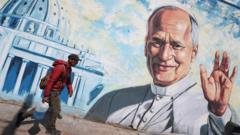
Pope’s Latin America Tour Begins After Lung Surgery
Three weeks. That is all the time Pope Leo XIV allowed between an operating table in Rome and the start of an exhausting multi-country journey across South America. As the papal aircraft cleared Italian airspace, the message from the Holy See was unmistakable: the 71-year-old pontiff is healthy, fully operational, and refusing to let a recent cancer diagnosis slow down his global agenda. This high-stakes Pope Latin America tour represents far more than a standard pastoral visit; it is an audacious demonstration of physical resilience and geopolitical strategy.
Pope Leo XIV has launched an ambitious 12-day Pope Latin America tour across Uruguay, Argentina, and Peru just three weeks following surgery to remove a lung tumor. Vatican officials insist the pontiff is in robust health, using the journey to reconnect with South American faithful, navigate political dynamics, and address past clerical abuse scandals.<\/p>
- Resilient Return: Pope Leo XIV begins a demanding 12-day journey just 21 days after undergoing surgery to remove a cancerous lung lobe.
- Three-Nation Itinerary: The tour spans Uruguay, Argentina, and Peru, combining geopolitical diplomacy, pastoral outreach, and personal history.
- Political Tensions: In Argentina, the Pope meets President Javier Milei amid ongoing debates over state economic austerity and social justice.
- Emotional Homecoming: The final leg highlights Leo's deep personal roots in Peru, where he held Peruvian citizenship and served as bishop in Chiclayo.
The trip spans 12 grueling days, covering thousands of flight miles from the humid banks of the Rio de la Plata to the dizzying altitudes of the Peruvian Andes and the dense canopy of the Amazon basin. For a leader who recently had the lower lobe of his right lung excised, the schedule would test a man half his age. Yet Vatican officials insist no special medical dispensations have been carved out for the journey.
Defying the Medical Odds in the Vatican
When the Vatican revealed last month that doctors had identified a malignant tumor during a routine medical examination, speculation swelled regarding the immediate future of Leo’s papacy. The surgical procedure moved swiftly. Surgeons successfully removed the localized growth alongside the affected lobe of his right lung, subsequently confirming that post-operative scans showed no lingering spread of the disease.
Rather than adopting a protracted convalescence behind the tranquil walls of the Domus Sanctae Marthae, Leo pushed straight back into public duties. Over the past fortnight, he has maintained an uninterrupted slate of general audiences, bilateral diplomatic briefings, and liturgical celebrations, including the solemn annual memorial Mass for deceased cardinals and bishops.
“The Vatican’s message with this trip is straightforward: that surgery was a brief interlude, and now we are back on track. We have seen him over these recent days presiding at length, delivering unscripted addresses, and engaging audiences. He is in remarkably strong shape, which was essential to prove before launching a trek of this magnitude.”
— Prof. Massimo Faggioli, Villanova University
Vatican press officers reinforced that perspective during pre-trip briefings in Rome, rejecting any framing of the Pope as a fragile patient navigating a chronic medical condition. Instead, spokespersons described him as an energetic leader with exceptional stamina who personally reviewed and confirmed every leg of the arduous international itinerary without requesting a single cancellation or time adjustment.
Uruguay: Rekindling Faith in a Secular Stronghold
The journey opens in Uruguay, a country that presents a distinct sociological backdrop compared to its deeply Catholic neighbors. Uruguay stands out as one of the most thoroughly secularized nations in the Western Hemisphere, having formally separated church and state back in 1919. Religious symbols are notably absent from public buildings, and holiday calendars officially reference Secular Tourism Week rather than Holy Week.
It has been four decades since a Roman Pontiff stepped foot in Montevideo. John Paul II visited in 1988, addressing a nation emerging from military rule. Today, local church attendance sits at historic lows, making Leo’s landing an exercise in spiritual re-engagement for a declining flock.
The Pope’s scheduled addresses in Montevideo focus on the erosion of communal solidarity, the challenges of youth mental health, and the role of ethical values in modern civil society. By starting in a secular environment, Leo signals that the church must engage directly with post-religious culture rather than remaining confined to traditional Catholic strongholds.
Navigating Political Friction in Argentina
From Montevideo, the papal entourage crosses the river into Argentina—a stop charged with profound emotional and political resonance. For over a decade, Argentines watched their native son, the late Pope Francis, travel the world while repeatedly bypassing his home country. Leo’s arrival is widely interpreted as a deliberate tribute to Francis’s legacy, fulfilling an unfinished promise to the Argentine people.
Across Buenos Aires, the atmosphere is electric. At Santa Maria Addolorata, Argentina’s national church in the heart of Rome, rector Father Fernando Laguna oversaw the installation of large viewing screens and banners declaring, “We’re waiting for you!”
“This visit serves as a beautiful homage to Francis, who was never able to return as pope. When Pope Leo’s visit was confirmed, our community was overcome with emotion. Despite his recent procedure, I never doubted he would make the trip. Canceling was simply not in his character.”
— Father Fernando Laguna, Rector of Santa Maria Addolorata
Yet behind the joyful street celebrations lies a tense political backdrop. The pontiff arrives amidst intense domestic debate over economic policy. President Javier Milei, an outspoken libertarian who previously leveled sharp ideological critiques at Pope Francis over social justice doctrines, has notably softened his tone. Milei issued warm public welcomes on social platform X, declaring that the republic awaits the holy father with great anticipation.
Nevertheless, the contrast in philosophy remains stark. Argentina’s Catholic bishops have voiced persistent criticism regarding the administration’s aggressive austerity policies, highlighting the heavy burden placed on low-income families by severe cuts to social programs. Leo’s planned addresses to political leaders in Casa Rosada are expected to emphasize economic justice, human dignity, and the protection of vulnerable populations, testing the delicate diplomatic reconciliation between the Holy See and the Argentine presidency.
Comparative Breakdown of the Papal Itinerary
To understand the sheer physical and logistical complexity of the journey, consider the contrasting conditions across the three host nations during this 12-day window:
| Destination | Primary Focus | Key Landscape & Climate | Core Significance |
|---|---|---|---|
| Uruguay (Montevideo) | Secular engagement & youth outreach | Coastal plains, temperate maritime | First papal visit in 40 years to South America’s most secular state. |
| Argentina (Buenos Aires) | State diplomacy & Francis tribute | Urban metropolitan, humid pampa | High-stakes dialogue with President Milei on poverty and austerity. |
| Peru (Chiclayo) | Pastoral reunion & personal roots | Arid northern coastal strip | Return to the diocese where Leo served as bishop for nearly a decade. |
| Peru (Cusco & Pucallpa) | Indigenous ministry & ecology | High Andes (>3,000m) & Amazon basin | Highlighting climate protection, Amazonian culture, and elevation tests. |
A Deeply Personal Homecoming to Peru
If Argentina represents diplomatic finesse, Peru is undeniably the emotional centerpiece of the tour. For Pope Leo XIV—born Robert Francis Prevost in Chicago—Peru is not merely another foreign stop on a long itinerary; it is a spiritual home where he spent nearly two decades of his life as an Augustinian missionary and church leader.
Holding dual American and Peruvian citizenship, Leo’s formative pastoral years were spent navigating the dusty streets of northern Peru. In 2014, Pope Francis appointed him Bishop of Chiclayo, a position he held until his call to Rome to head the influential Dicastery for Bishops. Local parishioners in Chiclayo remember him well, describing a accessible shepherd who knew the neighborhood streets intimately.
The Peruvian leg demands exceptional physical fortitude:
- Chiclayo: A return to his home cathedral to celebrate Mass with his former diocese.
- Cusco: A journey high into the Andes to lead outdoor liturgies more than 3,000 meters (10,000 feet) above sea level—a atmospheric test for anyone, let alone an individual recovering from partial lung resection.
- Pucallpa: A descent into the humid Amazonian interior to meet with indigenous leaders advocating for environmental preservation against illegal deforestation and mining operations.
By including both high-altitude Andean communities and isolated Amazonian populations, Leo emphasizes a central theme of his pontificate: placing peripheral and marginalized communities at the absolute center of church life.
Confronting Past Shadows: Abuse Survivor Meetings
Beyond broad public rallies and high-level political meetings, the Vatican confirmed that Pope Leo will conduct private, closed-door meetings with survivors of clerical sexual abuse in all three countries. This move directly addresses a painful chapter in the region’s ecclesiastical history.
A previous papal trip to Chile and Peru in 2018 was severely damaged by public anger over the handling of clergy misconduct allegations. By building dedicated time for victims into every stop on this itinerary, Leo aims to show that the Catholic hierarchy remains committed to transparency, accountability, and trauma-informed healing.
Church observers note that Leo’s background as a canon lawyer and former head of the Vatican’s episcopal oversight office gives him a direct, pragmatic grasp of administrative reform. Healing deep institutional wounds requires concrete actions rather than vague assurances, a reality the pontiff appears eager to confront head-on during his Latin American engagements.
The Broader Geopolitical Canvas
This journey also illuminates Leo’s vision for continental solidarity. Unlike his predecessors who often viewed the Americas through distinct northern and southern lenses, Leo views the Western Hemisphere as an interconnected ecosystem facing shared challenges regarding migration, democratic stability, and economic polarization.
With constitutional democracies facing institutional pressure across Latin America, experts see this tour as an opportunity for the papacy to serve as a stabilizing moral anchor. Dynamic reporting from outlets like Bloomberg News underscores the delicate economic balance throughout the region, where rising inflation and fiscal contraction continue to fuel social unrest.
Looking Ahead: The North American Context
Leo’s successful execution of this trip inevitably raises questions regarding his future travel calendar. As the first American-born pope, interest in a potential papal visit to the United States remains extraordinarily high.
Vatican strategists are quietly analyzing how and when such a trip could occur, particularly within a complex U.S. political landscape. Navigating papal visits during election cycles or under contentious presidential administrations requires delicate diplomatic maneuvering. If Leo can comfortably manage 12 days across the Andes and the Amazon just three weeks after cancer surgery, a comprehensive tour of North America is well within his operational reach.
A Papacy in Full Motion
As Pope Leo XIV steps onto the tarmac in Montevideo, he delivers a clear message to the world’s 1.3 billion Catholics. Physical illness may be an unexpected detour, but it does not define his vision or diminish his drive. By immersing himself directly in the social, political, and spiritual realities of South America, Leo establishes a confident momentum for his pontificate—one rooted in personal humility, pastoral proximity, and unyielding resolve.
<button type="button" onclick="this.parentElement.innerHTML='✓ Thank you, we will refine our analysis!‘” style=”background:#ffffff; border:1px solid #cbd5e1; border-radius:6px; padding:4px 12px; font-size:12px; cursor:pointer; color:#334155;”>👎 No
