
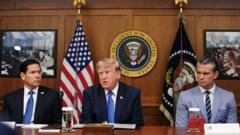
White House Denies Hegseth Exit Amid Midterm Fallout
The White House denies Hegseth exit rumors, pushing back aggressively against mounting political pressure following a devastating cycle of midterm election losses. Whispers of a sweeping administration shakeup dominated Washington corridors this week, centering heavily on the future of Defense Secretary Pete Hegseth and Secretary of State Marco Rubio. Yet, executive branch officials are drawing a hard line in the sand, dismissing the reports as little more than manufactured media noise.
The White House has officially denied rumors that Defense Secretary Pete Hegseth and Secretary of State Marco Rubio are stepping down, despite intense political fallout and heavy Republican losses in the midterm elections largely blamed on the ongoing conflict in Iran.<\/p>
- Political Fallout: Heavy Republican losses in the midterms have been openly blamed by Trump and Vance on the protracted war in Iran.
- Hegseth's Future: Defense Secretary Pete Hegseth faces an impending impeachment threat from outgoing GOP Representative Thomas Massie.
- Rubio Stays Put: Secretary of State Marco Rubio dismissed rumors of his departure, reaffirming his commitment to serve through the end of the term.
- Leadership Scrutiny: Reports suggest the administration may target high-ranking military leadership, including General Dan Caine and Admiral Brad Cooper, over war strategy.
It is no secret why the knives are out. The eight-month-old conflict in Iran has become an albatross for the Republican party, dragging down candidates across the board and handing Democrats control of both the House and the Senate. In politics, bloodletting always follows a defeat. For now, however, the administration is standing its ground.
The Crosshairs on Pete Hegseth
Defense Secretary Pete Hegseth finds himself in the eye of a political hurricane. While the White House insists his job is safe, Capitol Hill tells a different story. Outgoing Republican Representative Thomas Massie has openly threatened to force an impeachment vote against Hegseth as early as next week, urging leadership to make a change before a newly minted, Democratic-controlled Congress takes power in January.
Hegseth, defiant as ever, fired back with a pointed video statement denouncing what he termed “sham articles of impeachment.”
“You see, they attack me. They attack us because we are effective,” Hegseth declared. “It’s not going to work. We will not back down.”
Industry insiders note that Hegseth’s aggressive shakeups within the Pentagon—ranging from overhauling recruitment to dismantling diversity initiatives—have already alienated key institutional power brokers.
President Trump, for his part, has publicly backed his defense chief. Speaking with reporters at the White House, Trump insisted that Hegseth has done a “fantastic job,” highlighting high-profile operations like the January arrest of Venezuelan leader Nicolás Maduro. Even so, reports from outlets like The Washington Post suggest the administration may weigh ousting top military advisers, including General Dan Caine and Admiral Brad Cooper, whose strategic counsel on the Iran campaign is drawing heavy internal scrutiny.
Weighing the Political Cost
The fallout from the Iran campaign has fractured Republican unity. Vice-President JD Vance recently offered a scathing critique of the party’s electoral shortcomings, laying bare the domestic political cost of the foreign entanglement. When the architects of an administration’s strategy openly admit the electoral pain caused by a conflict, the margin for error shrinks dramatically.
Despite the turbulence, political analysts point out that replacing cabinet members during a lame-duck period fraught with congressional shifts is a high-risk maneuver. The confirmation battles alone could paralyze national security operations at a critical juncture.
Marco Rubio Clears the Air
While the Defense Department faces an existential political storm, the State Department is projecting absolute calm. Secretary of State Marco Rubio moved quickly to squash persistent rumors that he was considering an early exit to lay the groundwork for a potential 2028 presidential run.
In an interview with The New York Times, Rubio laughed off the speculation. Working alongside the president until the bitter end of the term has “always been my plan,” he stated firmly, emphasizing his deep satisfaction with his current diplomatic portfolio. Both the White House and State Department spokespeople echoed his sentiments, labeling the departure rumors as categorically false.
Administration Stability Matrix
| Official | Position | White House Stance | Current Political Threat Level |
|---|---|---|---|
| Pete Hegseth | Defense Secretary | Full Support / Denied Exit | High (Impeachment Threat) |
| Marco Rubio | Secretary of State | Full Support / “Fake News” | Low (Rumors Dismissed) |
| Gen. Dan Caine | Joint Chiefs Chairman | Under Review | Moderate (Strategy Scrutiny) |
The Road Ahead for the White House
The coming weeks will test the resilience of the administration’s inner circle. With a hostile Congress looming on the horizon and intra-party divisions widening over foreign policy, managing the fallout from the midterms requires immense political dexterity. The White House denies Hegseth exit narrative serves as a temporary shield, but the underlying pressures remain entirely real.
Whether Hegseth can weather the legislative onslaught from Representative Massie and hostile Democrats remains one of Washington’s most volatile unknowns. What is clear, however, is that the administration cannot afford many more self-inflicted wounds if it hopes to salvage its legislative and policy agenda before the next election cycle.
<button type="button" onclick="this.parentElement.innerHTML='✓ Thank you, we will refine our analysis!‘” style=”background:#ffffff; border:1px solid #cbd5e1; border-radius:6px; padding:4px 12px; font-size:12px; cursor:pointer; color:#334155;”>👎 No
