
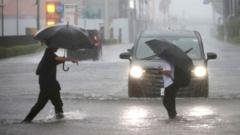
Typhoon Dujuan Hits Japan: Millions Evacuate Amid Disaster
When Typhoon Dujuan hits Japan during one of its busiest national holiday weekends, the result is not merely an environmental emergency—it is a cascading structural shock. On Monday, the 25th named storm of an extraordinary Pacific cyclone season tore through Japan’s eastern seaboard, packing sustained winds of 130 km/h (80.8 mph) and lethal gusts topping 194 km/h. What began as a ominous tropical low in the deep ocean quickly morphed into a terrifying assault on the nation’s most densely populated urban belts, forcing municipal authorities to issue urgent Japan evacuation orders to nearly two million citizens.
Typhoon Dujuan hits Japan as a destructive tropical cyclone packing sustained winds of 130 km/h and gusts up to 194 km/h. Driving widespread torrential rain, violent landslides, and massive power outages across Tokyo and surrounding prefectures, the storm triggered urgent evacuation orders for nearly two million residents.<\/p>
- Mass Evacuations: Nearly two million residents were urged to evacuate as Typhoon Dujuan barrelled across eastern and central Japan.
- Fatalities & Missing: At least two deaths confirmed in Kanagawa and Chiba prefectures, with multiple individuals reported missing following severe landslides.
- Transport Shutdown: Tokyo transport cancellations paralyzed holiday travel, grounding hundreds of flights at Haneda and halting major bullet train lines.
- El Niño Amplification: Meteorologists link the storm's exceptional moisture payload and strength directly to elevated sea surface temperatures driven by a Super El Niño.
The storm showed no mercy to holiday plans. The five-day Silver Week autumn break, usually defined by bustling tourism and outdoor cultural festivals, dissolved into widespread chaos. Rain fell in vertical sheets over Tokyo’s iconic Shibuya crossing, where commuters and tourists fought against violent atmospheric downdrafts that inverted umbrellas and shredded temporary structures. Beneath the surface level drama lies a grim human toll: localized fatalities, buried homes, catastrophic landslides, and a national transport grid brought to a near-total standstill.
A Anatomy of Destruction: The Storm’s Path Across Japan
Dujuan’s eye swept northward along the Pacific coastline, pinning heavy metropolitan zones in its western quadrant—the most dangerous zone for precipitation accumulation. As atmospheric pressure plummeted, coastal areas were hammered by storm surges that overwhelmed sea walls in Kanagawa and Shizuoka prefectures. According to reports compiled by national broadcaster NHK and verified by rescue agencies, the severe rainfall destabilized hillside neighborhoods that had already been saturated by late-summer downpours.
| Metric / Dynamic | Typhoon Dujuan (2024) | Typhoon Hagibis (2019 Comparison) | Historical Baseline Average |
|---|---|---|---|
| Peak Wind Gusts | 194 km/h (120.5 mph) | 240 km/h (149.1 mph) | 160 km/h (99.4 mph) |
| Evacuation Advisories | ~1.9 Million Residents | ~4.4 Million Residents | ~500,000 Residents |
| Power Infrastructure Outages | 50,000+ Households | 520,000 Households | 25,000 Households |
| Primary Climate Driver | Super El Niño + Marine Heatwave | Neutral Pacific Conditions | Seasonal Trade Wind Convergence |
In Yokosuka City, Kanagawa prefecture, emergency services fought mud-soaked soil in a race against time. A residential dwelling nestled against a steep slope collapsed when thousands of tons of earth gave way without warning. Local firefighters confirmed that a woman in her 60s was trapped beneath the debris inside her home. Despite a hours-long search and rescue operation, she was uncovered and pronounced dead shortly thereafter. Meanwhile, near Sodegaura City in Chiba prefecture, a man in his 50s operating heavy industrial machinery to clear early road blockages was swept down a steep ravine into a dense bamboo thicket alongside his equipment. He later died from traumatic injuries at a regional medical facility.
“The hillside didn’t just slide; it exploded downward. We had less than two minutes between the first rumbling sound and the mud crashing through the back walls of the residential street.”
— Yokosuka Emergency Response Coordinator
Multiple persons remain unaccounted for across Kanagawa, where rural valleys saw small streams transform into raging torrents in under twenty minutes. Rescue operations involving municipal police, disaster mobilization units, and the Japan Self-Defense Forces were severely hindered by ongoing high winds and hazardous lightning activity.
Gridlock in the Capital: Tokyo Transport Cancellations
As the core of the storm closed in on Greater Tokyo, the transportation arteries powering the world’s most populous metropolitan area began snapping one by one. The impact was amplified by timing: millions of city dwellers were either attempting to return from holiday trips or travel to regional destinations. The resulting urban gridlock demonstrated how fragile even world-class infrastructure can be when confronted by extreme atmospheric events.
A unprecedented wave of Tokyo transport cancellations disrupted regional and international transit networks:
- Aviation Disruption: More than 400 domestic and international flights were abruptly grounded at Haneda and Narita airports. Terminal corridors were turned into makeshift campsites as thousands of stranded travelers awaited updates on rescheduled departures.
- High-Speed Rail Suspensions: Central Japan Railway Company suspended operations on the Tokaido Shinkansen line between Tokyo and Shin-Osaka, freezing key economic transit across the nation’s primary industrial corridor.
- Local Commuter Lines: East Japan Railway Company (JR East) implemented widespread operational halts across the Yamanote, Chuo, and Tokaido local lines due to wind speeds exceeding safety limits.
- Power Grid Failures: Over 50,000 households were left without electricity across Tokyo, Chiba, and Saitama prefectures as wind-borne debris severed overhead power distribution lines.
The economic collateral damage extended quickly into the commercial sector. Organizers for the highly anticipated Rock in Japan music festival canceled all scheduled performances for Monday, leaving tens of thousands of fans stranded outside venues. Similarly, the Tokyo Game Show, an iconic showcase for global interactive media, was forced to shutter its Monday programming to safeguard attendees and international exhibitors.
Political Tension: Leadership Tested During Disaster
Natural disasters in Japan rarely exist in a vacuum, and Typhoon Dujuan’s timing created a high-wire political scenario for Japan’s leadership. Prime Minister Sanae Takaichi faced swift public debate after confirming that she would proceed with her scheduled flight to the United States despite the unfolding crisis at home.
Before boarding her aircraft for New York—where she is slated to address the United Nations General Assembly and hold critical bilateral talks with U.S. President Donald Trump—Takaichi posted a statement on X (formerly Twitter) expressing deep condolences to the families of those killed. She emphasized that she had delegated full crisis management authority to her cabinet officials.
“With a sense of urgency, I instructed Chief Cabinet Secretary Takehara and Minister Hosono to respond with utmost preparedness,” Takaichi posted prior to departure. Despite assurances that the emergency response center inside the Prime Minister’s Office was fully staffed and operating around the clock, political commentators and online critics questioned the optics of a executive departure while search-and-rescue teams were actively digging through landslide sites in Kanagawa.
“While diplomatic obligations at the United Nations carry undeniable strategic weight, domestic crisis response forms the bedrock of public trust. Departing the country during an active Level 4 evacuation scenario leaves a government vulnerable to sharp political critique.”
— Dr. Kenji Sato, Senior Political Analyst at Tokyo Policy Institute
Reporting by major international outlets like Reuters highlights that national governance during major weather events is scrutinized fiercely by Japanese voters, who expect visible executive oversight when public safety is threatened.
The Climate Factor: Super El Niño and Warming Seas
To understand why Typhoon Dujuan hit with such sudden intensity, meteorologists point to wider thermodynamic mechanisms shaping the Pacific Ocean basin this year. A major factor driving this atmospheric behavior is the active phase of a Super El Niño storms cycle, which has elevated water temperatures across vast stretches of the tropical and subtropical Pacific.
Climatologists from the Japan Meteorological Agency (JMA) and international climate bodies stress that while global warming may not dramatically increase the net global quantity of tropical cyclones each year, it fundamentally alters their behavior and destructive capacity. As sea surface temperatures rise, storms pull far more energy from the ocean surface. This thermodynamic boost results in two distinct phenomena: rapid intensification right before landfall and an increased capacity to carry water vapor.
How Ocean Warming Feeds Cyclone Violence
A warmer atmosphere holds approximately 7% more moisture for every 1 degree Celsius increase in temperature. When a system like Dujuan tracks over elevated marine heatwaves, the following environmental cascade occurs:
- Enhanced Heat Exchange: Unusually warm surface waters supply vast quantities of sensible and latent heat, accelerating the storm’s central pressure drop.
- Extreme Moisture Inflow: The cyclone acts as an atmospheric sponge, drawing vast plumes of saturated tropical air directly toward temperate landmasses.
- Torrential Landslide Triggers: Hyper-localized rainfall totals exceed the absorption threshold of mountain slopes, turning stable soil into viscous, fast-moving mudflows within minutes.
Analysis published via Bloomberg suggests that coastal infrastructure investments across Asia must be re-evaluated urgently to withstand these heavier, moisture-laden systems, which now bypass traditional seasonal expectations.
Aftermath and Recovery: The Long Road Ahead
As Typhoon Dujuan accelerates toward the northern reaches of Honshu and eventually out into the colder waters of the North Pacific, the full extent of the destruction will become clearer. Emergency crews across Chiba, Kanagawa, and Shizuoka prefectures face days of grueling clean-up operations. Agricultural sectors in eastern Japan are already assessing major losses to unharvested rice crops and fruit orchards flattened by wind gusts.
For municipal authorities, the immediate priority remains locating those reported missing in landslide zones and restoring stability to regional power grids. Yet, the broader lesson of Typhoon Dujuan is undeniable: as ocean temperatures continue to set historical records, the margin for error during extreme weather events is shrinking rapidly. Japan’s famous resilience is once again being put to the test—not just by the forces of nature, but by an changing climate system that renders historical disaster playbooks obsolete.
<button type="button" onclick="this.parentElement.innerHTML='✓ Thank you, we will refine our analysis!‘” style=”background:#ffffff; border:1px solid #cbd5e1; border-radius:6px; padding:4px 12px; font-size:12px; cursor:pointer; color:#334155;”>👎 No
