
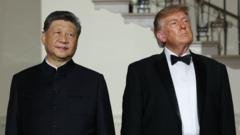
Trump-Xi Washington Summit: Inside the High-Stakes Diplomacy
The red carpets have been rolled up. The motorcades have departed. The highly anticipated Trump-Xi Washington summit has wrapped up, leaving behind a trail of diplomatic theater, a pair of giant pandas, and a fragile peace. For three days, Washington was the epicenter of global geopolitics as the world’s two most powerful men attempted to navigate a relationship defined by deep suspicion and economic codependency.
The Trump-Xi Washington summit yielded a temporary six-month tariff truce extension and symbolic diplomatic gestures, including the return of giant pandas to Washington. However, the meeting failed to produce structural breakthroughs on key issues like industrial subsidies, technology transfers, and national security, leaving the long-term trade relationship highly volatile.<\/p>
- Six-Month Tariff Truce: Both nations agreed to freeze new tariffs for half a year, preventing an immediate escalation of the trade conflict.
- Panda Diplomacy Returns: Beijing's gift of giant pandas served as a high-profile soft-power gesture to ease public tensions.
- No Structural Breakthroughs: Core disputes over state subsidies, intellectual property, and semiconductor export controls remain entirely unresolved.
- Domestic Pressures Dominate: Both leaders used the summit to project strength to their domestic audiences while avoiding economic disruption.
On the surface, the pageantry was flawless. There were handshakes, state dinners, and carefully choreographed photo opportunities designed to project stability to anxious global markets. Yet, beneath the diplomatic veneer, the reality is far more complicated. The meeting yielded few concrete policy shifts, save for one critical decision: a six-month tariff truce extension. It is a move that buys time, but solves almost nothing.
Decoding the Trump-Xi Washington Summit: Breakthrough or Illusion?
To understand how the trip panned out, one must look past the optics. Washington wanted structural changes to China’s state-led economic model. Beijing wanted relief from crippling economic pressures. In the end, both sides settled for a tactical pause.
The centerpiece of the summit’s tangible outcomes is the agreement to freeze tariff escalations for the next six months. This temporary halt prevents the immediate implementation of threatened 60% tariffs on Chinese goods, offering a brief sigh of relief for global supply chains. But make no mistake: this is not a peace treaty. It is a ceasefire.
“This wasn’t a breakthrough,” notes a senior trade analyst who spoke on the condition of anonymity. “It was a controlled pause. Both leaders are facing severe domestic headwinds and simply could not afford a market meltdown right now. They kicked the can down the road, but the road is getting shorter.”
For Donald Trump, the summit was an opportunity to showcase his deal-making prowess. He wanted to demonstrate to his base that his aggressive stance on trade could force Beijing to the negotiating table. For Xi Jinping, the goal was damage control. Facing a domestic property crisis and slowing growth, the Chinese president needed to secure economic breathing room without appearing weak.
The Soft Power Play: Pandas and Public Relations
Perhaps the most talked-about moment of the summit had nothing to do with trade deficits or semiconductor restrictions. It was the announcement that China would send new giant pandas to the National Zoo in Washington. This classic move, a staple of the Beijing diplomatic strategy, was designed to soften China’s image among the American public.
Pandas are more than just cute animals; they are highly effective diplomatic tools. By offering them, Xi signaled a desire to maintain cultural and civil ties, even as political relations remain icy. It was a low-cost concession that generated positive headlines, temporarily distracting from the thorny security issues that dominate the bilateral agenda.
However, seasoned observers are skeptical that soft power can bridge the deep ideological chasm between the two capitals. While the public cheered the return of the pandas, negotiators behind closed doors were locked in tense debates over technology transfers, maritime security, and the future of Taiwan.
The Tariff Truce: Six Months of Breathing Room
The decision to extend the tariff truce is the most economically significant outcome of the meeting. The ongoing US-China trade war has disrupted global commerce for years, forcing companies to restructure their supply chains and driving up costs for consumers. According to reports by Reuters, the temporary freeze prevents billions of dollars in new duties from taking effect.
But this six-month window is a double-edged sword. While it provides short-term predictability, it also creates a period of intense uncertainty. Businesses must now operate under the assumption that tariffs could return with a vengeance in half a year if negotiations stall.
Comparing the Pre-Summit and Post-Summit Landscape
To understand the current state of play, it is helpful to examine what changed—and what remained exactly the same—during the high-stakes meetings in Washington.
| Issue Area | Pre-Summit Status | Summit Outcome | Long-Term Outlook |
|---|---|---|---|
| Tariffs & Trade | Threat of immediate 60% tariffs on Chinese imports. | Six-month tariff truce extension agreed. | Highly volatile; tariffs remain a primary leverage tool. |
| Technology & Chips | Strict US export controls on advanced semiconductors. | No change; restrictions remain in place. | Continued decoupling of high-tech supply chains. |
| Diplomatic Communication | Strained, high-level military hotlines inactive. | Agreement to maintain open communication channels. | Fragile; subject to disruption by geopolitical incidents. |
| Soft Power / Culture | Panda diplomacy paused; cultural exchanges limited. | New pandas promised to Washington Zoo. | Positive public relations, but low strategic impact. |
As the table illustrates, the summit succeeded in pausing the escalation of conflict, but it did not resolve any of the underlying structural disputes. The fundamental contradictions between the US and Chinese economic models remain unaddressed.
Beijing’s Strategic Calculations
From the perspective of Zhongnanhai, the summit was a qualified success. Xi Jinping managed to avoid the worst-case scenario: an immediate, catastrophic escalation of the trade war that would have further damaged China’s fragile economic recovery. By securing the six-month extension, Beijing has bought valuable time to stabilize its domestic economy.
Furthermore, the summit allowed Xi to project the image of an equal global superpower. Standing alongside the US president in Washington, Xi demonstrated to his domestic audience that China remains a central player on the world stage, capable of managing relations with its primary rival on its own terms.
However, the long-term outlook for China’s export-driven economy remains challenging. The US consensus on China has shifted permanently toward containment and competition. Regardless of who occupies the White House, Washington is unlikely to abandon its efforts to restrict China’s access to critical technologies and reduce reliance on Chinese manufacturing.
The View from Washington: Leverage and Domestic Politics
For the US administration, the summit was about maintaining leverage. By keeping the threat of future tariffs active, Washington hopes to pressure Beijing into making structural reforms, such as reducing state subsidies for domestic industries and improving intellectual property protections.
But the administration also had to balance these long-term strategic goals with immediate economic realities. An all-out trade war would likely fuel inflation and disrupt financial markets—outcomes that would be politically damaging ahead of the upcoming election cycle. The six-month truce allows the administration to maintain a tough stance on China without triggering immediate economic pain at home.
This delicate balancing act is reflected in the cautious statements coming out of the White House. Officials have been quick to emphasize that the truce is conditional on China meeting certain benchmarks, though the specifics of these benchmarks remain vague.
Implications for Global Economic Stability
The outcome of the Washington summit has profound implications for global economic stability. For years, international organizations like the International Monetary Fund (Bloomberg) have warned that a fragmentation of the global economy into rival blocs could shave percentage points off global GDP.
The six-month truce prevents a worst-case fragmentation scenario for now, but it does little to restore long-term confidence. Multinational corporations are unlikely to halt their diversification strategies based on a temporary agreement. The trend of “friend-shoring”—moving manufacturing to politically aligned nations—is expected to continue as companies seek to insulate themselves from future geopolitical shocks.
Key Challenges Ahead for Global Supply Chains
- Persistent Uncertainty: The short duration of the truce makes long-term planning nearly impossible for manufacturers.
- Regulatory Divergence: Companies must navigate increasingly complex and conflicting regulatory environments in both the US and China.
- Tech Decoupling: The split in the global technology sector is accelerating, forcing businesses to choose between US and Chinese standards.
These challenges suggest that while the summit may have lowered the temperature, it did not change the climate. The era of hyper-globalization is giving way to an era of managed competition and economic nationalism.
The Road to the Next Crisis
What happens when the six months are up? This is the question now confronting policymakers and business leaders worldwide. If history is any guide, the truce will likely be followed by another round of tense negotiations, with both sides accusing the other of bad faith.
The fundamental issue is that the goals of the two nations are irreconcilable. The US seeks to preserve its global economic and technological leadership, while China seeks to ascend to the top of the value chain and establish regional hegemony in Asia. No amount of diplomatic pageantry or panda diplomacy can alter this structural rivalry.
For now, the world must content itself with a fragile peace. The Washington summit did not solve the defining geopolitical conflict of the twenty-first century, but it did prevent it from boiling over. In today’s volatile geopolitical landscape, perhaps that is the best we can hope for.
<button type="button" onclick="this.parentElement.innerHTML='✓ Thank you, we will refine our analysis!‘” style=”background:#ffffff; border:1px solid #cbd5e1; border-radius:6px; padding:4px 12px; font-size:12px; cursor:pointer; color:#334155;”>👎 No
Latest Analytical Follow-up: For continuous developments on this subject, read our full investigation on Trump-Xi Summit Outcomes: Pomp, Pandas, and Unresolved Trade Wars.
