
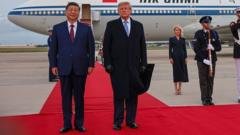
Trump-Xi Summit Outcomes: Pomp, Pandas, and Unresolved Trade Wars
Washington rolled out the red carpet, but the actual Trump-Xi summit outcomes reveal a much more sobering reality for Beijing. President Xi Jinping arrived in the US capital seeking a grand bargain—or at least a long-term reprieve. He left with a pocketful of symbolic victories, a couple of pandas, and a highly precarious short-term trade extension. It was a masterclass in diplomatic theater, but theater does not pay the bills in a stuttering domestic economy.
The Trump-Xi summit outcomes highlight a temporary trade truce extension until January, leaving major disputes over tariffs, semiconductor access, and rare earth elements unresolved. While Beijing secured high-profile diplomatic optics and resumed its panda diplomacy, structural economic tensions and disagreements over Taiwan's security remain deeply entrenched.<\/p>
- Short-Term Truce: The trade truce was extended only until January, keeping Beijing on a tight leash and leaving major tariff disputes unresolved.
- Taiwan as a Bargaining Chip: Trump continues to hold a delayed $14 billion arms package as leverage, despite Xi's warnings of potential conflict.
- AI Safeguards Stalled: Discussions on AI safety yielded no concrete agreements, with Trump dismissing existential tech fears as a hoax.
- Optics over Substance: While policy progress was minimal, the lavish reception and the return of panda diplomacy provided a major domestic propaganda victory for Xi.
The Structural Reality of the Trump-Xi Summit Outcomes
Let’s look at the numbers. Beijing wanted a one-year truce. They got a few months. The current pause on the US-China tariff war has been kicked down the road only until January. Why does this matter? Because Xi is trying to ride out the remainder of Trump’s term without facing another devastating economic shockwave. By keeping the leash short, Washington has signaled that it expects concrete actions, not just warm words, before offering any long-term concessions.
This short-term extension keeps Beijing on the defensive. Key disputes over rare earth metals, intellectual property, and access to advanced US semiconductor chips remain completely unresolved. They are simply being kicked forward into yet another grueling round of negotiations. According to reports by Bloomberg, this tactical delay keeps American leverage at an all-time high, forcing China to continuously negotiate from a position of vulnerability.
“The short extension of the trade truce is a clear signal that Washington is not ready to let China off the hook. It keeps the pressure on Beijing’s fragile domestic economy without triggering an immediate market panic.”
— Senior Trade Analyst, Washington D.C.
Xi’s Domestic Economic Headache
Why is Xi so desperate for stability? The uncomfortable truth is that China’s domestic economic engine is sputtering. For decades, the Chinese Communist Party relied on an unspoken social contract: economic growth in exchange for political compliance. Today, that contract is under immense strain. While China continues to export record volumes of goods globally, the domestic picture is bleak.
Chinese consumers are keeping their wallets firmly shut. The property market, which accounts for roughly 70% of household wealth in a country where 80% of citizens own their homes, is in a prolonged slump. Youth unemployment remains stubbornly high, leaving millions of university graduates overeducated and underemployed. Trade is no longer just a driver of growth; it is the primary life support system for the Chinese economy. Xi desperately needs to protect these export markets from the kind of crippling tariffs that characterized the previous year. A renewed tariff war right now could trigger a severe domestic crisis.
The Taiwan Chessboard and the $14 Billion Chip
On Taiwan, the rhetoric remains razor-sharp. Xi has repeatedly warned that US support for the self-governing island is an absolute red line. In May, he went so far as to warn Trump that mishandling the Taiwan issue could lead the two superpowers to “collide or even enter into conflict.” Yet, Trump has approached this existential geopolitical flashpoint with the mindset of a transactional negotiator.
He delayed a crucial Taiwan arms package worth $14 billion, openly describing it as a “very good negotiating chip” to extract concessions from Beijing. This approach to foreign policy creates both opportunities and immense risks for Xi. On one hand, Xi likely seized on this opening during their private talks, arguing that withholding arms sales to Taipei is the easiest way to prevent an accidental military escalation. On the other hand, Trump is facing intense, bipartisan pressure from Congress to maintain robust defense support for Taiwan. Trump’s silence on Xi’s latest warnings suggests that the “chip” remains firmly on the table, unplayed and highly volatile.
The Silicon Divide and the AI Mirage
Beyond traditional trade and territorial disputes, the battle for the future is being fought in the digital ether. Artificial intelligence was a major talking point at the summit, but the discussions yielded little of substance. The meeting occurred against the backdrop of growing global anxiety over AI safety. Anthropic CEO Dario Amodei recently published an essay calling for a coordinated slowdown in AI development to prevent catastrophic risks. This was echoed by a top safety researcher at the company who warned of a “greater than 10% chance” of human extinction due to unchecked AI.
Xi attempted to position China as a responsible global actor, emphasizing that AI must “always remain under human control.” Trump, however, has publicly dismissed these existential fears as a “hoax.” This philosophical divide makes any meaningful agreement on AI safety regulations highly unlikely. Instead, the US continues to tighten its grip on the export of advanced microchips, ensuring that China’s tech sector remains starved of the hardware needed to achieve AI dominance. According to reporting by Reuters, the technological decoupling between the two nations is accelerating despite the polite diplomatic rhetoric.
Panda Diplomacy and the Optics of Equality
If the policy outcomes were meager, the public relations victory for Beijing was substantial. China’s famous “panda diplomacy” is back in business. The announcement that Ping Ping and Fu Shuang will arrive at the Atlanta Zoo in a matter of days was a calculated charm offensive. It softens China’s global image at a time of heightened geopolitical tension. More importantly, the lavish reception Trump organized for Xi served a vital domestic purpose for the Chinese leader.
The state banquet, the personal airport greeting, and the carefully choreographed photo opportunities were designed to project an image of absolute equality. On Chinese social media, state-approved memes contrasted the two leaders, portraying Xi as a calm, impassive statesman in contrast to an animated Trump. For an audience at home, the message was clear: Xi is standing tall against the American hegemon, commanding respect on the world stage.
Comparing Expectations vs. Reality
To understand the true impact of the summit, we must look at what both sides wanted versus what was actually achieved. The table below outlines the stark contrast between the diplomatic theater and the policy outcomes.
| Issue Area | Beijing’s Objective | Washington’s Stance | Actual Outcome |
|---|---|---|---|
| Trade Truce | 1-year tariff freeze | Short-term leverage | Extended only until January |
| Taiwan Security | Halt the Taiwan arms package | Use arms sales as a negotiating chip | Decision delayed; status quo remains |
| AI Governance | Joint safety framework | Dismissive of existential risks | No concrete AI safety regulations established |
| Public Relations | Equal superpower status | Lavish hospitality, tough policy | Successful panda diplomacy Atlanta launch; strong domestic optics for Xi |
The Long-Term Geopolitical Reality
Strip away the pageantry, the sesame-crusted sea bass, and the cuddly pandas, and the fundamental dynamic remains unchanged. The United States and China are locked in a generational struggle for global supremacy. Washington remains committed to containing China’s rise, particularly in high-tech sectors and regional security. Beijing remains equally determined to carve out its own sphere of influence, free from Western interference.
Trump’s transactional diplomacy may offer temporary reprieves, but it does not resolve the structural contradictions between the two powers. As the tea is poured and the national archives are toured, both leaders know that the peace they have brokered is a fragile one. The clock is ticking toward January, and when the current trade truce expires, the real battle will resume. Xi may have survived this round with his dignity intact, but the structural challenges facing his nation are far from resolved.
<button type="button" onclick="this.parentElement.innerHTML='✓ Thank you, we will refine our analysis!‘” style=”background:#ffffff; border:1px solid #cbd5e1; border-radius:6px; padding:4px 12px; font-size:12px; cursor:pointer; color:#334155;”>👎 No
