
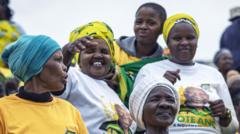
South Africa Local Elections: ANC Faces Historic Decline
Tension hangs thick in the narrow alleyways of Alexandra. Just a short drive across the highway from the gleaming glass towers of Sandton—Africa’s richest square mile—this historic township tells a radically different story about modern South Africa. Raw sewage trickles along unpaved edges, collecting in green stagnant pools around gut-strained potholes. Brightly colored political campaign posters adorn bent streetlight poles, promising jobs, clean water, and uncorrupt leadership. Yet, as citizens cast their ballots in the pivotal South Africa local elections, the mood on the street is less about revolutionary optimism and more about pure exhaustion.
The South Africa local elections represent a decisive reckoning for the African National Congress (ANC), which faces historically low voter support driven by collapsing municipal infrastructure, rampant corruption, and persistent service delivery failures across major urban metropolises like Johannesburg and Durban, accelerating the nation's transition toward multi-party coalition governance.<\/p>
- Electoral Freefall: Independent polling suggests the ANC's national vote share could plummet to 30% in municipal contests, a dramatic drop from its 70% peak in 2004.
- Infrastructure Collapse: Out of 257 municipalities, the Auditor-General awarded clean audits to just 39, leaving major hubs like Johannesburg financially crippled.
- Voter Apathy Crisis: Millions of young South Africans are opting out of registration altogether, citing deep cynicism over unfulfilled liberation promises.
- Rise of Coalitions: Unstable multi-party pacts are set to expand from Gauteng across the nation, mimicking national power-sharing setups but risking local governance gridlock.
The political stakes could not be higher. More than 500 political parties and thousands of independent candidates are battling for control of nearly 300 municipalities responsible for fundamental public necessities: electricity distribution, water reticulation, road maintenance, and refuse collection. For the ruling African National Congress (ANC), this vote is not merely a test of local support; it represents an existential fight to reverse a agonizing, decades-long political decline.
From Liberation Royalty to Electoral Fragility
Two decades ago, the ANC held near-invincible status in South African political life. Under Nelson Mandela and later Thabo Mbeki, the party transformed from a liberation movement into a formidable governing machine, capturing 70% of the national vote in 2004. Today, that hegemony has fractured. The party lost its absolute parliamentary majority in the last national election, tumbling to 40%. Now, analysts and pollsters predict a fresh wave of losses at the municipal level.
President Cyril Ramaphosa has repeatedly pushed back against the narrative of terminal decay. Addresses to stadium rallies feature defiance. “What I’m seeing here is that the ANC is going higher and higher, and we will show those naysayers,” he assured cheering supporters during a final campaign push. But behind the theatrical rallies lies a grim quantitative reality. Recent polling by Ipsos points to ANC support sinking as low as 30% nationally for these local contests—a steep drop from the 46% secured during the last municipal vote in 2021.
Voters are punishing the party for systemic decay. Decades of institutional mismanagement, endemic corruption, political patronage, and paralyzing load-shedding have broken local councils. Where the party once commanded automatic emotional loyalty as the architect of democracy, it now faces deep public cynicism.
South Africa Local Elections: Municipal Breakdown across Key Metros
The administrative breakdown is not isolated to rural outposts; it touches the highest-producing economic hubs in the country. Data compiled from recent financial disclosures and regional audit summaries illustrates the stark administrative contrast across South Africa’s primary urban battlegrounds:
| Metropolitan Area | Primary Governing Model | Latest Audit Status (AG SA) | Dominant Local Infrastructure Issue |
|---|---|---|---|
| City of Johannesburg | Unstable Multi-Party Coalition (ANC-led) | Qualified / Disclaimed (High Risk) | Financial insolvency, crumbling water lines, persistent power outages |
| City of Cape Town | Single-Party Majority (DA) | Clean Audit | Rapid urban migration, informal settlement infrastructure backlog |
| eThekwini (Durban) | Minority Coalition (ANC-backed) | Qualified Audit | Storm drainage failures, sewage contamination on beaches, port access decay |
| City of Tshwane (Pretoria) | Multi-Party Coalition (DA-led) | Adverse Opinion / High Stagnation | Water safety crises (Hammanskraal), municipal wage bill deficits |
The Auditor-General of South Africa, Tsakani Maluleke, has sounded alarms for years regarding this slide. Her office’s latest review of the country’s 257 municipalities revealed a shocking statistic: only 39 managed to achieve a clean audit. None of Gauteng’s major metropolitan engines—Johannesburg, Tshwane, or Ekurhuleni—made that elite list. Maluleke singled out Johannesburg specifically, noting that without structural intervention, the city will remain trapped in a destructive spiral where financial health collapses and daily service delivery is permanently compromised.
According to reports tracked by Reuters, Johannesburg is now routinely described by financial analysts as effectively bankrupt, struggling to service basic operational supplier debts while residents endure days without running tap water or functional grid connections.
Township Reality: Potholes, Sewage, and Abandoned Promises
Walk through the streets of Alexandra, and the abstract numbers on municipal balance sheets turn into immediate human frustration. Eighteen-year-old Sanele Ntombela stands on a dusty corner with his peers. Unlike his friends, Sanele was eager to register and cast his first ballot.
“We face many challenges in Alexandra,” Ntombela says, gesturing to an uncollected pile of rotting domestic waste sitting directly under a streetlamp covered in political posters. “There’s rubbish everywhere, and we struggle with electricity and water and many other issues. Voting is the only way to demand change.”
His optimism is an exception. Standing beside him, two friends admit they never bothered to register. They see the voting process as an empty ritual that rewards local politicians who vanish into air-conditioned council chambers the moment the final vote is tallied. A few houses away, 33-year-old Zandile Mncube expresses flat refusal to participate.
“It makes no difference whether I vote or not. Things have gotten worse over the years, not better. Why stand in line to validate people who ignore us?”
This apathy is not unique to Alexandra. Cross over to Soweto, the historical heartland of anti-apartheid resistance south of Johannesburg, and the story remains consistent. The streets may look marginally cleaner than Alex, but basic utility systems are collapsing.
Mduduzi Makhubo, 45, has spent his entire life in Soweto. He points out that water cuts have become predictable, scheduled indignities. “Every Monday we know we won’t have water after 2pm,” Makhubo says calmly. “It has become our normal. But we are tired of the arrogance from local leaders. I am voting specifically to break the status quo, to show them that power belongs to the people, not to a political party logo.”
Campaign Stunts, Gusheshes, and the Rise of Populism
Faced with a furious electorate, political leaders have resorted to increasingly bizarre tactics to capture public attention. Campaigning across South Africa’s municipal landscape has turned into theatrical political entertainment.
The Democratic Alliance (DA), the country’s main opposition party, has focused heavily on highlighting ANC governance failures in Gauteng while pointing to its own record running Cape Town. DA chairperson Helen Zille mounted a viral media campaign across Johannesburg to emphasize municipal decay. She was filmed swimming in crater-sized potholes, ziplining over urban sinkholes, and arriving at her party’s final rally inside a classic modified 1990s BMW 325i—affectionately known in township car culture as a “Gusheshe.”
“Towns and cities that work best are under DA governance,” Zille asserted during a live radio interview, emphasizing that professionalized civil service and strict financial management are the only cures for municipal rot. Polls project the DA’s support rising modestly to around 25% nationally, positioning it to claim stronger leverage in metro councils.
Simultaneously, the political math is complicated by the rise of former President Jacob Zuma’s uMkhonto weSizwe (MK) Party. Expanding rapidly beyond its strongholds in KwaZulu-Natal, the MK Party has capitalized on deep-seated disaffection among traditional ANC working-class voters. In Durban’s eThekwini metro, the MK Party threatens to completely shatter the ANC’s remaining dominance, though analysts caution that Zuma’s party lacks the institutional framework to rule without partners.
The Coalition Calculus: Governance or Gridlock?
As single-party majorities evaporate, South Africa is entering an era dominated by coalition politics. Yet, the track record of local coalitions thus far offers little comfort to residents seeking reliable garbage pickup or functional streetlights.
In major centers like Johannesburg and Tshwane, coalition governments over the past five years have produced instability. Parties have repeatedly swapped mayoral chains through endless motions of no confidence. Micro-parties holding just one or two council seats have frequently extracted cabinet positions in exchange for vote-buying alliances, leading to administrative paralysis.
Political analyst Melanie Verwoerd emphasizes that these municipal elections will serve as a definitive verdict on the ruling party’s administrative legacy. She notes that the country is witnessing an irreversible shift away from liberation-era dominance toward fragmented multi-party power dynamics.
“The expectation is that the ANC nationally is going to deliver its worst municipal performance in history. Coalition arrangements are no longer an exception—they are the permanent reality of South African local governance.”
Verwoerd suggests that the only realistic path to municipal stability in complex hubs like Johannesburg may lie in replicating the national power-sharing model—a formal local coalition between historic rivals, the ANC and the DA. However, personal rivalries, ideological divides, and local party infighting make such broad-church arrangements exceptionally fragile.
Dr. Levy Ndou, another prominent political scholar, agrees that localized coalition bargaining often neglects voter interests. “The key problem is the calibre of candidates and the invisibility of local councillors once elected,” Ndou explains. “When politicians spend 80% of their energy negotiating coalition survival strategies behind closed doors, basic municipal service delivery inevitably grinds to a complete halt.”
A Watershed Moment for African Democracy
The stakes extend far beyond damaged roads and political political drama. How South Africa navigates this transition away from single-party rule will send shockwaves across the continent. Foreign investors, closely monitoring municipal stability via business reporting from outlets like Bloomberg, view local governance performance as a primary proxy for national economic stability.
If coalition-led metros fail to maintain basic industrial power grids, clean water access, and logistical transport routes, economic growth will remain stagnated beneath 1%. Conversely, if local parties can establish mature, policy-driven coalitions that prioritize fiscal accountability, South Africa could forge a competitive model for multi-party democracy in sub-Saharan Africa.
Back on the quiet street corner in Alexandra, young Sanele Ntombela holds his stamped voter registration slip tightly. He understands little of high-level coalition mathematics or municipal audit balance sheets. For him, the objective of his vote remains intensely practical.
“I just want the lights to stay on,” Sanele says softly, looking out over the crowded township as dusk settles. “I want the water to flow from the tap every single morning, and I want the rubbish off our streets. Is that really too much to ask from the people who claim to lead us?”
<button type="button" onclick="this.parentElement.innerHTML='✓ Thank you, we will refine our analysis!‘” style=”background:#ffffff; border:1px solid #cbd5e1; border-radius:6px; padding:4px 12px; font-size:12px; cursor:pointer; color:#334155;”>👎 No
