
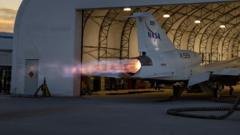
Future of Experimental Aircraft: Do We Still Need X-Planes?
There is a deeply unusual aircraft carving through the high-altitude skies of the United States. It sports a nose resembling an elongated anteater, a cockpit pushed so far back that the pilot has zero forward visibility, and a structural lineage cannibalized from legacy fighter jets. To the untrained eye, it looks like an expensive, retro-futuristic mistake. To aerospace engineers, however, this machine—the Lockheed Martin X-59—represents the absolute vanguard of the future of experimental aircraft.
The future of experimental aircraft relies on crewed X-planes like the NASA X-59 to validate complex aerodynamics, such as quiet supersonic flight, where simulation and uncrewed drones fail to provide the necessary regulatory certification, cost-effectiveness, and real-time pilot feedback required for commercial and military aviation breakthroughs.<\/p>
- The Acoustic Breakthrough: The Lockheed Martin X-59 is designed to transform the disruptive sonic boom into a quiet, acceptable background thump, potentially rewriting aviation laws for overland supersonic travel.
- The Drone Paradox: While uncrewed systems excel in combat, crewed flight testing remains more cost-effective and legally viable for testing large-scale commercial aviation technologies over populated areas.
- The Human Factor: Real-time feedback from test pilots provides qualitative aerodynamic data that computer simulations and remote sensors simply cannot replicate.
For nearly eighty years, the United States and its allies have relied on experimental “X-planes” to push the boundaries of what is aerodynamically possible. From the rocket-powered Bell X-1 that first shattered the sound barrier in 1947 to the hypersonic X-15 that touched the edge of space, these bespoke flying laboratories have defined modern aviation. Yet, we live in an era dominated by autonomous systems. Cheap, highly capable drones are rewriting the rules of warfare in Eastern Europe and redefining commercial logistics globally. This raises a fundamental, multi-billion-dollar question: In an age of digital twins, supercomputer simulations, and expendable drones, do we still need crewed X-planes?
The Sonic Boom Problem and the X-59 Solution
To understand why physical, crewed testbeds remain vital, one must look at the physics of speed. When an aircraft breaches the sound barrier, it compresses the air around it into massive shockwaves. These shockwaves merge as they radiate outward, hitting the ground as a thunderous double-crack known as a sonic boom. This acoustic violence was the death knell for Concorde. The legendary Anglo-French airliner was legally barred from flying lucrative overland routes across the United States and Europe, limiting its operations to oceanic corridors and severely damaging its commercial viability.
For decades, the aerospace industry accepted this acoustic barrier as an unalterable law of nature. NASA, however, is challenging this assumption using advanced supersonic flight technology. The X-59 is designed with a singular, hyper-focused objective: to prove that a supersonic aircraft can be shaped to prevent shockwaves from coalescing.
“Our approach is to pick small goals we aim to prove with flight data, and we construct an airframe for that one task,” explains Peter Coen, a 43-year NASA veteran who manages the quiet supersonic program. “The more goals you have, the more expensive it gets.”
The X-59’s bizarre geometry is a direct product of this philosophy. Its thirty-foot-long nose acts as a physical wedge, stretching out the shockwaves so they never combine into a loud boom. When the aircraft flies past Mach 1—roughly 660 mph at cruising altitude—the sound reaching the ground is projected to be nothing more than a dull thump. Coen likens it to “a car door being closed across the street.”
To achieve this shape, designers had to make a radical compromise: they removed the forward-facing cockpit window entirely. The pilot sits deep within the fuselage, relying on an External Vision System (XVS). This system uses a high-definition camera mounted on the nose, feeding real-time, computer-processed imagery to a monitor directly in front of the pilot. It is a complex, high-stakes solution to an aerodynamic problem, and it is currently being put to the test over selected American communities to gauge public perception.
The Drone Paradox: Why Robots Aren’t Always Cheaper
The rise of autonomous systems has led many commentators to argue that the era of the human test pilot is over. Why risk a human life and spend millions on life-support systems when a drone can do the job? The reality, as is often the case in cutting-edge engineering, is far more nuanced. The debate between crewed vs uncrewed flight testing is not merely about safety; it is about regulatory compliance, scale, and cold, hard economics.
During the development of the X-59, NASA seriously evaluated the prospect of making the aircraft uncrewed. The idea was ultimately rejected. Removing the pilot would have introduced a labyrinth of regulatory hurdles. The Federal Aviation Administration (FAA) and international aviation bodies maintain incredibly strict guidelines regarding the operation of large, uncrewed, high-performance aircraft over populated urban areas. Certifying an autonomous jet to fly at supersonic speeds over American towns would have taken years and cost millions in redundant safety systems.
Furthermore, size matters. To accurately simulate how a full-sized commercial airliner behaves when breaking the sound barrier, the X-59 had to be a substantial aircraft. Once an airframe reaches a certain size, the cost of installing a cockpit, an ejector seat, and life-support systems is often lower than the cost of developing the ultra-reliable, redundant remote-telemetry and autonomous flight-termination systems required for a drone of equivalent scale.
NASA is certainly no stranger to uncrewed X-planes. In 2007, the agency successfully flew the X-48, a sub-scale, uncrewed model designed to test a blended wing-body concept. The X-48 was tiny, sporting a modest 20-foot wingspan. This small scale kept the program within budget and allowed for safe testing without risking a pilot. However, sub-scale models have physical limitations. They cannot fully replicate the complex, full-scale aerodynamic interactions that occur at supersonic speeds.
“It’s likely that future X-planes will be uncrewed,” Coen admits, “unless the technology we’re researching relates to piloting, or if crewing it is more cost-effective.”
The Irreplaceable Human in the Loop
Beyond the financial and regulatory arguments, there is a qualitative aspect of flight testing that machines cannot replicate. Guy Gratton, a professor of Aircraft Test and Evaluation at Cranfield University, expresses deep skepticism toward the notion that drones are a universal panacea for aerospace development.
“There’s a belief in certain quarters that drones can do everything,” Gratton notes. “In Ukraine, they’ve done amazing things with drones, but if you want to carry people, you can’t take short-cuts.” Gratton, who has spent decades testing light aircraft, emphasizes the immense value of having a human pilot physically experiencing the flight envelope. “You lose a huge amount without pilots. You miss qualitative lessons that a pilot would identify instantly. Furthermore, it can take four times as many people on the ground to safely test and monitor a complex drone as it does to fly a crewed aircraft.”
This ground-support footprint is a hidden cost of uncrewed aviation. While a drone does not put a pilot in harm’s way, it requires a massive team of telemetry engineers, data analysts, and safety officers on the ground, all monitoring real-time feeds. For many experimental programs, keeping a human in the cockpit remains the most streamlined, cost-effective path to obtaining reliable flight data.
A Global Renaissance in Flight Demonstrators
The continued relevance of the X-plane philosophy is not unique to the United States. Across the Atlantic, the United Kingdom is currently embarking on its most ambitious flight-testing program in a generation. This initiative serves as a direct bridge to the legacy of the Experimental Aircraft Programme (EAP), which flew in 1986 and laid the technological foundation for the Eurofighter Typhoon.
Chris Yeo, the legendary test pilot who sat in the cockpit of the EAP, understands the profound connection between physical testing and theoretical design. “They all research some facet of flight, and demonstrate the design is working correctly,” Yeo says. “A lot of people say they can do something, but you only know it works when the design has been tested and certified.”
Now, forty years after Yeo’s historic flights, BAE Systems is spearheading the development of a new crewed technology demonstrator. This aircraft, described by project director Tony Godbold as “the X-plane of our generation,” is designed to test systems for the Global Combat Air Programme (GCAP)—a joint effort between the UK, Italy, and Japan to field a sixth-generation fighter by the 2030s.
This new British machine, scheduled to fly by 2028, is one of several high-profile military aviation demonstrators currently under development globally. It will utilize existing Typhoon engines but will feature an entirely new, aerodynamically advanced airframe. The project has galvanized the UK’s aerospace sector, pulling together over 100 suppliers, including propulsion giant Rolls-Royce.
For the UK’s elite community of fast-jet test pilots—numbering only about 14 individuals—this project represents the pinnacle of their careers. Almost every one of them has already flown the aircraft in advanced simulators. Yet, as Godbold freely admits, the simulator is only a prelude to the real thing.
“You can model a lot on computers and simulators, but the experience of test pilots is when stuff gets real,” Godbold says. “We only really learn things when we get their physical feedback in a real-world environment.”
There is also a powerful geopolitical dimension to these aircraft. In international defense partnerships, building a physical, high-performance flight demonstrator is the ultimate statement of intent. It signals to international partners and adversaries alike that a nation possesses the industrial capacity, financial resources, and engineering prowess to operate at the absolute limit of technology. “This proves we are serious in this space,” Godbold states flatly.
Comparing Legacy and Modern Flight Demonstrators
To understand how the philosophy of experimental flight has evolved, it is useful to compare the key parameters of historical X-planes with modern demonstrators. The table below illustrates this technological journey:
| Aircraft | First Flight | Crewed / Uncrewed | Primary Objective | Key Technological Legacy |
|---|---|---|---|---|
| Bell X-1 | 1947 | Crewed | Break the sound barrier in level flight | Validated thin-wing aerodynamics; proved supersonic flight was survivable. |
| North American X-15 | 1959 | Crewed | Explore hypersonic flight and space boundary | Paved the way for heat-resistant alloys and reaction control systems used in the Space Shuttle. |
| Boeing X-48 | 2007 | Uncrewed | Evaluate Blended Wing Body (BWB) design | Proved high aerodynamic efficiency for future eco-friendly commercial transport. |
| Lockheed Martin X-59 | 2025 (Est. Supersonic) | Crewed | Suppress sonic boom for overland flight | Developing quiet supersonic flight technology; testing community noise acceptability. |
| BAE Systems Demonstrator | 2028 (Planned) | Crewed | Test sixth-generation combat systems | Validating digital design threads, stealth integration, and advanced power systems for GCAP. |
The Verdict: A Complementary Future
The debate should not be framed as a binary choice between crewed X-planes and autonomous drones. Instead, the future of aerospace development lies in a highly integrated, complementary ecosystem.
Drones are exceptional for high-risk, high-endurance, and highly repetitive testing profiles. They allow engineers to push airframes to the point of structural failure without risking human life. Computer simulations and digital twins have drastically reduced the time required to design an aircraft, allowing engineers to discard thousands of unviable designs before a single piece of metal is cut. Reports from global aerospace hubs, including coverage by Reuters, highlight how digital engineering has streamlined defense procurement timelines.
However, as the development of the X-59 and the BAE Systems demonstrator proves, the physical world is infinitely complex. Atmospheric turbulence, boundary-layer transitions, and human-machine interfaces cannot be perfectly modeled in a virtual environment. When the stakes are high—whether it is rewriting international aviation laws to allow supersonic overland travel, or designing a sixth-generation fighter jet to secure sovereign airspace—the physical, crewed X-plane remains an irreplaceable asset.
Ultimately, the human element is not a relic of the past; it is the very anchor of our aviation future. As long as we build aircraft to carry human passengers and defend human lives, we will need brave individuals willing to climb into weird, wonderful, and unproven machines to find out exactly what happens when theory meets reality.
<button type="button" onclick="this.parentElement.innerHTML='✓ Thank you, we will refine our analysis!‘” style=”background:#ffffff; border:1px solid #cbd5e1; border-radius:6px; padding:4px 12px; font-size:12px; cursor:pointer; color:#334155;”>👎 No
Latest Analytical Follow-up: For continuous developments on this subject, read our full investigation on Meta Attorney Client Privilege Abuse Exposed in Teen Safety Suit.
