
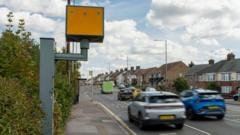
UK Speed Camera Faults Allow Drivers to Slip Through
Confidence in automated traffic enforcement took another sharp hit this week. When UK speed camera faults are exposed on a national scale, the ripples are felt far beyond Whitehall. Motorists already skeptical of digital policing on major thoroughfares have fresh ammunition.
Persistent technical issues with UK speed camera faults on smart motorways and major routes have led the Home Office to revoke legal approval for the equipment. National Highways has subsequently terminated its contract with US firm Verra Mobility after discovering multiple system anomalies.<\/p>
- Contract Termination: National Highways is ending its relationship with Verra Mobility after the Home Office revoked legal approval for their speed camera systems.
- Widespread Impact: The faults affected all variable speed cameras on smart motorways, sections of the A14, and the A1 approach junction.
- Historical Errors: A previous anomaly led to 2,650 wrongful speed camera activations and subsequent driver reimbursements between 2021 and late last year.
It turns out that hundreds of units monitoring our busiest arteries simply could not be trusted to get the math right. Systems meant to catch reckless driving were instead misfiring.
The Anatomy of a Technological Breakdown
Trust is fragile. Once broken, rebuilding it takes years. The latest chapter in this unfolding saga involves US-based firm Verra Mobility. They were tasked with keeping drivers honest across complex networks. Instead, they handed authorities a regulatory nightmare.
National Highways initially flagged issues late last year. Out of roughly 400 monitored points, 154 were compromised. But a deeper dive uncovered an even more alarming reality. Units monitoring key economic corridors—including the critical stretch between Huntingdon and Cambridge—were fundamentally flawed.
The Home Office acted decisively. Officials revoked the crucial type approval required for the footage to stand up in court. Without that legal backing, the cameras are essentially expensive electronic paperweights. Consequently, National Highways is severing ties. The message from transport ministers leaves zero room for ambiguity:
“We can’t take chances with this. If we’re going to prosecute people, we need to be confident the system is working as it should. That’s why we’ve taken the action we have.”
According to transport analysts at Bloomberg, supply chain and software verification in public infrastructure projects continue to face immense regulatory scrutiny across Europe.
Smart Motorways Under the Microscope
The timing could hardly be worse for advocates of intelligent transport systems. Smart motorway speed cameras have long faced fierce public pushback. Critics argue they trade safety for capacity. Now, technical unreliability adds fuel to an already blazing fire.
The fault impacted every single variable speed camera on these controversial stretches. Drivers passing through dynamic limit zones experienced equipment that lagged behind actual signage. When limits shifted upward, cameras occasionally held onto lower historical thresholds.
A History of Glitches
This is not an isolated administrative hiccup. In December 2025, National Highways pointed fingers at an internal “anomaly.” Variable speed cameras were failing to talk properly to roadside limit indicators. That specific bug generated 2,650 wrongful activations between 2021 and late last year. Affected motorists eventually saw refunds hit their bank accounts, but the reputational damage was done.
Industry insiders note that software integration across legacy road hardware remains notoriously difficult. “When you patch modern algorithms onto aging physical infrastructure, edge cases inevitably slip through,” explains one senior traffic systems engineer who spoke on condition of anonymity.
Comparing the Enforcement Landscape
To understand the sheer scale of the network, consider the operational footprint:
| Metric | Details |
|---|---|
| Total Cameras Nationwide | Approximately 4,000 units across the English road network |
| Units Impacted by Previous Glitch | 154 out of 400 inspected smart motorway cameras |
| Wrongful Fines (2021–Late Last Year) | 2,650 activations successfully reimbursed |
| Estimated Fix Timeline | Sometime next year for full system restoration |
As Reuters reported on parallel infrastructure challenges, government agencies are increasingly pivoting away from automated vendors when compliance metrics fail.
What Happens to Drivers Now?
Motorists caught in the crossfire may wonder if they can escape prosecution. The short answer is yes, because the Home Office stripped away evidentiary approval. Footage captured by the faulty units cannot legally support court proceedings.
However, the government is not leaving the roads completely unmonitored. Authorities are redeploying traditional tactics. Expect a visible surge in mobile speed vans alongside marked and unmarked police patrols.
Rod Dennis, senior policy officer at the RAC, minced no words regarding the fallout:
“Malfunctioning speed cameras on smart motorways do more than just let speeding drivers get away with breaking the law and endangering lives – they further undermine confidence in the very types of road we know drivers already have serious misgivings about.”
Fixing this mess will not happen overnight. Officials concede that a complete overhaul and reinstatement of reliable automated enforcement will stretch well into next year. Until then, human eyes and traditional patrols will bear the brunt of keeping English motorways safe.
<button type="button" onclick="this.parentElement.innerHTML='✓ Thank you, we will refine our analysis!‘” style=”background:#ffffff; border:1px solid #cbd5e1; border-radius:6px; padding:4px 12px; font-size:12px; cursor:pointer; color:#334155;”>👎 No
