
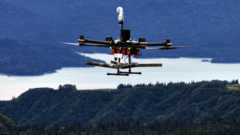
Drones Used to Seed Clouds: Inside the New Weather War
On August 23, the residents of Homer, Alaska, went about their daily routines under a slate-gray sky, entirely unaware that a private, venture-backed startup from San Francisco was altering the atmosphere above their heads. Using advanced drones used to seed clouds, the company, Rainmaker, conducted a quiet experiment to force precipitation over the region. The operation was a technical success, allegedly squeezing 19 million gallons of water out of the atmosphere in just three hours. However, the stealth nature of the flight has ignited a fierce debate over who controls the sky, the safety of chemical dispersants, and the ethics of privatizing the weather.
Drones used to seed clouds are unmanned aerial systems that fly directly into moisture-rich atmospheric formations to disperse nucleating agents like silver iodide or biological proteins. This targeted delivery triggers ice crystal formation, accelerating condensation and forcing clouds to release precipitation as rain or snow over specific, drought-prone geographic regions.<\/p>
- Unannounced Experiments: Startups are conducting cloud-seeding operations over populated areas without prior public notification, sparking local backlash and transparency concerns.
- The Drone Shift: Autonomous drones are replacing traditional piloted aircraft, offering a highly targeted, cost-effective, and safer method for atmospheric intervention.
- Environmental Questions: The long-term ecological impact of silver iodide accumulation remains heavily debated, driving research into biodegradable, protein-based alternatives.
- Marginal Gains: Climatologists emphasize that weather modification only yields a 5% to 10% increase in precipitation, meaning it cannot serve as a standalone solution to systemic water scarcity.
As global temperatures rise and historic droughts threaten agriculture, municipal water supplies, and ecosystems, the race to secure freshwater has moved from the ground to the upper atmosphere. What was once the stuff of science fiction is now a highly competitive commercial frontier. But as private companies deploy autonomous aircraft to manipulate the clouds, they are running headfirst into a wall of public skepticism, regulatory gray areas, and deep ecological concerns.
The Silent Rain of Homer, Alaska
Cooper Freeman, the Alaska director of the Center for Biological Diversity, was among the thousands of local residents who had no idea the experiment was taking place. He only learned of the operation after the drones had landed and the data was published. For Freeman, the lack of public notification is not just a bureaucratic oversight; it is a fundamental breach of public trust.
“It doesn’t appear that there was any downstream monitoring to verify that this silver iodide didn’t impact the environment. Having a company come in to do this seeding isn’t going to solve our water woes, and it feels like a distraction from solving the urgent issues related to water conservation.”
The frustration in Homer highlights a growing tension in the field of weather modification technology. While tech founders view their work as a heroic response to a warming planet, local communities often feel like involuntary test subjects in a giant, unmonitored laboratory. The lack of federal oversight in the United States means that startups can often conduct these flights with minimal public disclosure, leaving residents to wonder what, exactly, is falling from the sky alongside the rain.
The Rise of Drones Used to Seed Clouds
Cloud seeding itself is not a novel concept. The practice dates back to 1946, when researchers at the General Electric Research Laboratory discovered that dropping dry ice into supercooled clouds could trigger ice crystal formation. Shortly after, silver iodide was identified as a far more stable and effective nucleating agent. For decades, however, the industry relied on piloted, twin-engine turboprop planes or ground-based generators to shoot these chemicals into the air. Both methods were expensive, imprecise, and dangerous, requiring pilots to fly directly into turbulent, freezing storm systems.
The integration of autonomous aviation has completely transformed this landscape. Modern commercial cloud seeding startups are bypassing traditional aircraft in favor of custom-built drones. These unmanned aerial vehicles (UAVs) can fly in weather conditions that would ground human pilots, operating at a fraction of the cost. Equipped with specialized sensors and automated flare racks, these drones can pinpoint the exact thermal updrafts within a cloud system, releasing their payloads with surgical precision.
By targeting the most responsive pockets of a cloud, drone operators claim they can maximize precipitation while minimizing the volume of chemical agents released. It is a high-tech upgrade to an old science, turning a blunt atmospheric instrument into a highly targeted digital tool.
The Chemistry of the Sky: Silver Iodide vs. Organic Proteins
The primary agent used in modern cloud seeding is silver iodide, a inorganic compound with a crystalline structure highly similar to natural ice. When burned via drone-mounted flares, silver iodide particles act as “seeds” around which supercooled water droplets can freeze. Once these crystals grow heavy enough, gravity pulls them down as snow or rain.
Despite its widespread use, the silver iodide environmental impact remains a highly contentious topic. While industry representatives point to studies suggesting the chemical is insoluble and poses minimal risk in low concentrations, environmental advocates remain deeply skeptical. The long-term cumulative effects of silver iodide accumulating in pristine alpine watersheds, soil systems, and aquatic food chains have never been comprehensively mapped.
Augustus Doricko, the founder and CEO of Rainmaker, is highly defensive of his company’s chemical footprint. He notes that Rainmaker releases only about 20 grams of silver iodide per flight, distributed across thousands of square kilometers.
“The resultant increase in concentration on the ground is in the parts per quadrillion, way below the threshold laid out by the FDA on what is allowable,” Doricko explains. He argues that the immediate benefits of generating millions of gallons of water in drought-stricken regions far outweigh the theoretical risks of such minute chemical exposure.
Nevertheless, the pushback has driven some innovators to look for cleaner alternatives. In San Francisco, a rival startup called Recast Systems is developing a radically different approach. Led by CEO Olivia Li, the company is experimenting with a biodegradable protein derived from natural soil amino acids.
Currently undergoing rigorous testing at Texas A&M University, this organic seeding agent could completely bypass the environmental concerns associated with heavy metals. “It’s safe, biodegradable, and nucleates ice at a higher efficiency than silver iodide,” Li says. If successful, this biological alternative could defuse much of the public opposition to atmospheric modification.
Comparing Modern Cloud Seeding Agents
To understand the shifting dynamics of the industry, it is helpful to compare the primary materials currently used or under development for weather modification:
| Seeding Agent | Primary Mechanism | Environmental Footprint | Efficiency Temp Range | Key Advantage |
|---|---|---|---|---|
| Silver Iodide | Inorganic crystal nucleation | Debated; heavy metal accumulation concerns | Below -5°C | Highly stable, industry standard |
| Dry Ice (Solid CO2) | Thermal cooling of water vapor | Negligible, but contributes to carbon emissions | Below 0°C | Cheap, historical track record |
| Amino-Acid Proteins | Biological ice nucleation | Biodegradable, zero toxic residue | Higher temperatures (up to -2°C) | Eco-friendly, highly efficient |
A Drop in the Bucket for Global Water Security
The sudden surge of interest in weather modification is born out of sheer desperation. According to a recent Reuters report on global water scarcity, the world is consuming freshwater at a rate faster than natural systems can replenish it. United Nations Secretary-General António Guterres has repeatedly warned of a looming global crisis, pointing to data showing that the past five years have seen the lowest river flows worldwide in over three decades.
In this context, governments and private entities are desperate for viable water security solutions. More than 50 countries, including China, the United Arab Emirates, and the United States, have established formal, state-funded weather modification programs. In parched regions like Jordan, where municipal water is often only available for a few hours a week, cloud seeding is viewed not as a luxury, but as a survival strategy.
Yet, climatologists urge caution. Cloud seeding is not a magic wand that can end droughts. It cannot create clouds out of dry air; it can only squeeze extra moisture out of storm systems that are already forming. Jon Meyer, an assistant state climatologist with the Utah Climate Center, emphasizes that the technology’s impact is marginal at best.
“With the right conditions, cloud seeding squeezes out about an extra five to 10% of precipitation,” Meyer notes. While a 10% bump in snowpack is incredibly valuable to water managers in the American West, it is a incremental gain, not a cure for systemic over-allocation of water resources.
Furthermore, critics argue that focusing on weather modification diverts attention and funding away from more difficult, structural reforms. Investing millions in drone fleets can feel like an easy technological fix, allowing politicians to avoid the politically painful work of reforming agricultural water rights, upgrading leaky infrastructure, and enforcing strict conservation measures.
The Geopolitical and Regulatory Vacuum
As commercial cloud seeding startups expand their operations, they are entering a legal and geopolitical wild west. Atmospheric moisture does not respect state or national borders. If a drone fleet in Idaho successfully seeds a cloud system, does it rob the downwind state of Wyoming of rain that would have fallen naturally? Who owns the water vapor floating in the sky?
These are no longer academic questions. In the western United States, where water rights are fiercely litigated, the potential for conflict is high. A Bloomberg coverage of western water rights highlights how interstate disputes are already brewing over atmospheric manipulation. Without a clear federal framework to govern who can seed, when they can seed, and who owns the resulting runoff, the industry is operating in a regulatory vacuum.
On an international scale, the stakes are even higher. If a country like India aggressively seeds clouds near its northern border, neighboring Pakistan could view the action as “cloud theft” or an act of environmental aggression. The potential for weather modification to be weaponized, or at least perceived as a hostile act, is a growing concern for defense analysts.
Bridging the Gap to a Wetter Future
Despite the controversies, the momentum behind drones used to seed clouds is unlikely to slow down. The technology is simply too promising, and the water crisis too acute, for governments to ignore. Climatologists like Jon Meyer believe that as the technology matures and alternative, eco-friendly seeding agents become commercially viable, weather modification will become a standard tool in municipal water management.
The key to public acceptance will be transparency and rigorous regulation. If startups continue to conduct unannounced flights over populated areas like Homer, they will face a wall of public resistance that could shut down operations entirely. Establishing clear protocols for public notification, independent environmental monitoring, and equitable water-sharing agreements is essential.
Ultimately, cloud-seeding drones are not a silver bullet for a warming planet. They are a bridge—a high-tech, highly targeted tool designed to help communities squeeze every last drop of utility out of an increasingly erratic atmosphere. But as we begin to actively manage the sky, we must remember that manipulating nature always comes with a cost, and the true price of our engineered rain may not be known for decades to come.
<button type="button" onclick="this.parentElement.innerHTML='✓ Thank you, we will refine our analysis!‘” style=”background:#ffffff; border:1px solid #cbd5e1; border-radius:6px; padding:4px 12px; font-size:12px; cursor:pointer; color:#334155;”>👎 No
