
Inside Britain’s National Supercomputer Facility
Stepping into the main server hall of a national supercomputer facility is an auditory and visual assault. The air hums with the relentless, vibrating roar of thousands of industrial fans. Rows upon rows of towering black racks stretch into the distance, blinking with rapid-fire indicator lights. This is the heavy artillery of the digital age. It is where complex scientific hypotheses go to be tested, proven, or shattered.
A national supercomputer is an elite high-performance computing facility capable of executing quadrillions of floating-point operations per second. It works by networking thousands of specialized CPU and GPU nodes together with ultra-low latency interconnects, allowing researchers to simulate complex physical phenomena, model climate systems, and accelerate drug discovery at scales impossible on standard hardware.<\/p>
- Massive Parallelism: Modern supercomputers utilize tens of thousands of individual processing nodes linked by fiber optics to execute complex calculations simultaneously.
- Real-World Impact: Access to a national supercomputer allows researchers to compress decades of pharmacological or meteorological simulation into mere hours.
- Infrastructure Demands: Maintaining these systems requires industrial-scale cooling solutions, dedicated power substations, and meticulous environmental controls.
For decades, the inner sanctums of these high-performance temples remained shrouded in mystery. People knew they existed. They read headlines about exascale computing milestones or breakthroughs in molecular modeling. Yet, very few outsiders ever crossed the threshold. Recently, the BBC’s Tech Life podcast, produced and presented by Imran Rahman-Jones, gained rare behind-the-scenes access to the UK’s premier national supercomputer facility. The goal? To demystify the machine, understand its architecture, and meet the researchers who wield this immense digital power.
Decoding the Iron Beast: How High-Performance Computing Works
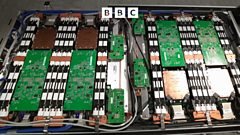
Forget everything you know about desktop hardware. A supercomputer is not just a beefed-up gaming rig. It is a sprawling ecosystem of computational muscle. Inside each metallic blade, dense webs of circuit boards, multi-core processors, and high-density memory sticks are crammed together with zero wasted space.
Industry insiders note that the true magic does not lie solely in raw processing power, but in the interconnects. How do you stop thousands of processors from tripping over each other? You weave an ultra-low latency fiber-optic network. This allows every node to communicate with its neighbors instantaneously. The system functions less like a single isolated brain and more like a massive, highly synchronized digital hive mind.
The Cooling Challenge
Power brings heat. Lots of it. If you turned off the cooling infrastructure for even a few minutes, the silicon would literally melt. That is why facilities housing a high-performance computing UK asset require specialized liquid cooling loops and massive air-handling units that pull ambient air from the outside, conditioning it before it sweeps across the sensitive blades.
“When you stand next to these racks, you realize you aren’t just looking at computers. You’re looking at lifelines for modern science. Every blade is a window into a problem we couldn’t solve yesterday.”
Who Gets the Keys to the Kingdom?
You cannot simply log in and run a script. Demand for national supercomputing cycles vastly outstrips supply. A rigorous vetting process stands between a scientist and the machine. Allocation committees review proposals based on merit, urgency, and whether the research genuinely requires exascale-level simulation.
Researchers working on everything from aerospace engineering to astrophysics rely on these allocations. For instance, aerodynamicists use the facility to simulate airflow over experimental aircraft wings at supersonic speeds, bypassing the need for expensive physical wind-tunnel prototypes. Similarly, pharmaceutical researchers map protein folding interactions to design targeted therapeutics in fractions of the time it would take in a traditional wet lab.
Comparing Computational Scale
| Metric | High-End Workstation | National Supercomputer |
|---|---|---|
| Processor Cores | 16 to 64 cores | Tens to hundreds of thousands of cores |
| Storage Capacity | Terabytes (TB) | Exabytes of high-speed parallel file systems |
| Primary Use Case | Video editing, local CAD, gaming | Climate modeling, molecular simulation, AI training |
| Power Consumption | 500 Watts | Megawatts (requiring dedicated substations) |
As computational demands grow, institutions like those covered by BBC Technology News continue to highlight how these machines evolve. Quantum integration and AI-driven simulation frameworks are already beginning to reshape the landscape. The supercomputer of tomorrow will look vastly different from the blade systems humming away today.
The Human Element Behind the Silicon
Behind every terabyte of simulation data is a team of dedicated specialists. System administrators, data engineers, and applied mathematicians work around the clock to keep the cluster healthy. If a node fails—and at this scale, hardware failure is a daily certainty—automated diagnostic tools flag the issue, allowing engineers to hot-swap the faulty component without taking down the wider network.
Ultimately, a supercomputer is only as good as the questions we ask it. The hardware provides the raw velocity, but human curiosity provides the trajectory. Whether modeling the future of our climate or discovering new materials to store clean energy, these machines serve as the ultimate engine for human progress.
<button type="button" onclick="this.parentElement.innerHTML='✓ Thank you, we will refine our analysis!‘” style=”background:#ffffff; border:1px solid #cbd5e1; border-radius:6px; padding:4px 12px; font-size:12px; cursor:pointer; color:#334155;”>👎 No
Latest Analytical Follow-up: For continuous developments on this subject, read our full investigation on Trump’s National Medal of Science Awards Spark Big Tech Debate.
