
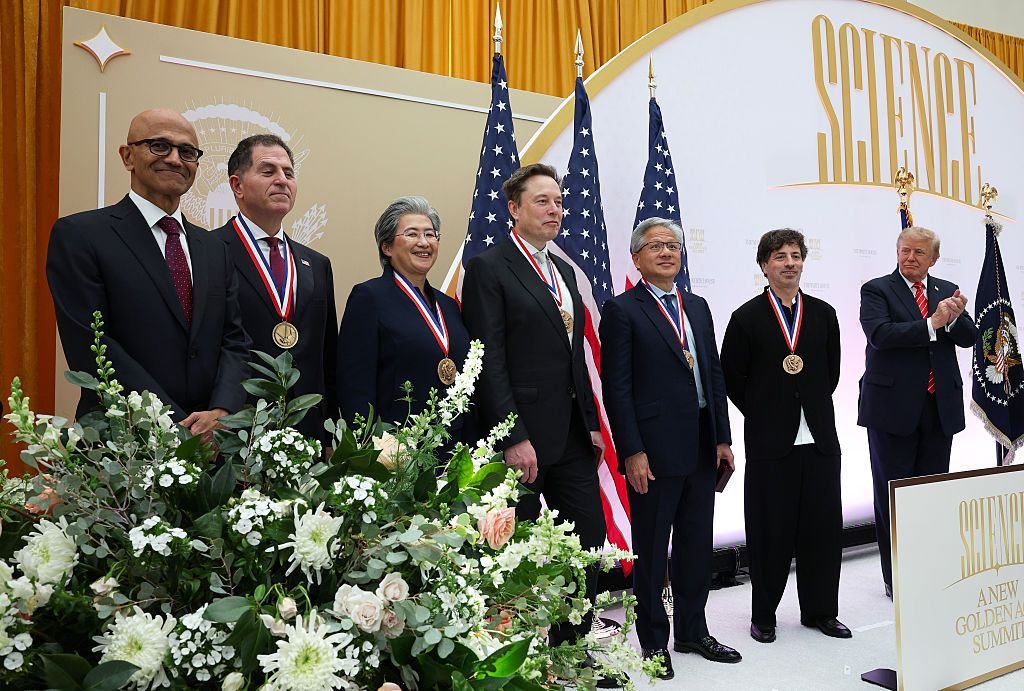
Trump’s National Medal of Science Awards Spark Big Tech Debate
The East Room was packed. Gold leaf gleamed under the heavy chandeliers. On Thursday, at the Golden Age of American Innovation Summit, President Trump presented the prestigious National Medal of Science awards to a handpicked group of Silicon Valley’s elite. The atmosphere was thick with a mix of triumphalism and transactional reality. Among those stepping up to receive the nation’s highest scientific honors were Elon Musk, Nvidia’s Jensen Huang, Google co-founder Sergey Brin, and AMD’s Lisa Su. Simultaneously, Dell Technologies’ Michael Dell and Microsoft’s Satya Nadella walked away with the National Medal of Technology and Innovation.
The recent National Medal of Science awards, presented by President Trump to prominent tech leaders like Elon Musk and Jensen Huang, have sparked intense debate due to the recipients' collective $6 billion in political contributions to Trump-aligned initiatives, contrasting sharply with simultaneous regulatory crackdowns on the tech sector.<\/p>
- Political Influence: Award recipients and their companies contributed nearly $6 billion to Trump-aligned initiatives, raising questions about the intersection of political donations and national honors.
- The H-1B Paradox: Microsoft CEO Satya Nadella received his medal immediately after his company was indefinitely suspended from the H-1B visa program.
- Shift in Silicon Valley: The awards highlight a broader transition in Silicon Valley lobbying, moving from ideological alignment to pragmatic, transactional diplomacy.
It was a glittering showcase of American technological supremacy. Yet, beneath the polite applause lay a complex web of financial influence, regulatory pressure, and strategic alignment that defines the modern relationship between Washington and the tech sector.
The Six-Billion-Dollar Handshake: Big Tech Political Donations
Let’s talk numbers. They are staggering. According to investigative reporting by The New Republic, the individuals and corporations honored on Thursday have collectively funneled nearly $6 billion into political efforts tied directly to Trump and his administration. This isn’t traditional, quiet Silicon Valley lobbying. It is a wholesale realignment of tech capital.
Alphabet and Microsoft, for instance, directed substantial funds toward the president’s inauguration committee and the construction of the new White House ballroom. AMD directed capital to a prominent pro-Trump Super PAC. Meanwhile, Michael and Susan Dell committed a staggering $6.25 billion to help seed the “Trump Accounts”—the administration’s highly publicized savings program designed for American children.
“We are seeing a transition from ideological alignment to raw transactional diplomacy,” says Dr. Aris Vance, a technology policy analyst. “Musk paved the way by embedding himself directly within the administration’s advisory circles. Now, others are realizing they must pay to play, or risk being left out in the cold.”
Is this merit, or is it the ultimate pay-to-play? The administration insists the awards recognize pure innovation. Critics, however, point to the timing and scale of the financial contributions as evidence of a transactional presidency where even the highest scientific honors are up for negotiation.
The H-1B Paradox: Nadella’s Bitter Pill
The most jarring moment of the summit belonged to Microsoft CEO Satya Nadella. He smiled, shook the president’s hand, and accepted his medal. But the backdrop was brutal. Just days prior, the administration indefinitely suspended Microsoft from the H-1B program.
This program is the lifeblood of Redmond’s engineering pipeline. The sudden H-1B visa suspension sent shockwaves through the tech corridor, leaving thousands of highly skilled foreign workers in limbo. The contrast could not have been more stark: honored with a medal for innovation on Thursday, yet crippled by immigration policy on Monday.
“It’s a classic carrot-and-stick routine,” notes an industry insider who spoke on the condition of anonymity. “You get the medal on Thursday, but your talent pipeline gets choked on Monday. It forces these tech giants to remain subservient to executive whim.”
This juxtaposition highlights the transactional nature of modern tech policy. The administration demands domestic investment and political loyalty, even while squeezing the global talent pools that built these companies in the first place. For Nadella, the medal was a public victory, but the policy shift represents a quiet, systemic challenge to Microsoft’s operational model.
A Comparative Look at the Honorees and Their Ties
To understand the full scope of this event, we must look at the specific relationships between these tech leaders, their companies, and the administration. The table below outlines the key players, their awards, and the political or regulatory context surrounding their recognition.
| Recipient | Company | Award Received | Political / Financial Connection | Recent Regulatory Context |
|---|---|---|---|---|
| Elon Musk | Tesla / SpaceX | National Medal of Science | Major campaign surrogate; advisory role | Secured massive federal defense contracts |
| Jensen Huang | Nvidia | National Medal of Science | Corporate alignment on domestic manufacturing | Navigating strict AI chip export controls |
| Sergey Brin | Alphabet (Google) | National Medal of Science | Inauguration & White House ballroom funding | Facing ongoing DOJ antitrust lawsuits |
| Lisa Su | AMD | National Medal of Science | Contributions to pro-Trump Super PAC | Expanding domestic semiconductor fabrication |
| Michael Dell | Dell Technologies | National Medal of Tech | Pledged $6.25B to “Trump Accounts” | Securing federal enterprise IT contracts |
| Satya Nadella | Microsoft | National Medal of Tech | Inauguration funding; infrastructure support | Hit with indefinite H-1B visa suspension |
The New Rules of Silicon Valley Lobbying
For decades, Silicon Valley cultivated a carefully manicured image of progressive utopianism. That era is dead. Today, pragmatic survivalism reigns supreme. The sheer scale of Big Tech political donations during this cycle demonstrates a clear shift. Tech executives have realized that ideological purity does not protect their balance sheets from antitrust scrutiny, tariff threats, or immigration crackdowns.
By securing a seat at the table—and a medal around their neck—these executives are attempting to insulate their companies from the unpredictable winds of executive orders. It is a defensive maneuver dressed up as national celebration.
Trump’s speech at the summit was vintage. He praised the honorees for helping to “pioneer an incredible future for America.” He declared that because of their genius—and, implicitly, their alignment with his vision—”we will always be on top. No one else can compete with us.”
The Erosion of Scientific Independence
Historically, the National Medal of Science awards were insulated from partisan politics. They were designed to honor pure research—the quiet, unglamorous work of physicists, biologists, and mathematicians whose discoveries laid the groundwork for modern computing. By shifting the focus to high-profile CEOs and major political donors, critics argue the administration is devaluing the award’s prestige.
“These medals used to go to the people in lab coats who spent forty years solving a single mathematical equation,” says a retired National Science Foundation director. “Now, they are being handed out to billionaires. It changes the entire meaning of scientific achievement in this country.”
Navigating the Regulatory Minefield
The tech sector is facing unprecedented regulatory pressure. From antitrust lawsuits targeting Google’s search monopoly to executive orders restricting AI development, the stakes have never been higher. For leaders like Sergey Brin and Jensen Huang, maintaining a cordial relationship with the White House is a fiduciary duty.
Google is fighting for its life against DOJ-mandated breakups. Nvidia is trying to navigate strict export controls on its H100 and Blackwell chips to China. In this environment, a massive donation or a seat at a White House summit is viewed by boards as a necessary cost of doing business.
What happens next remains to be seen. The administration has made it clear that support is conditional. The H-1B visa suspension applied to Microsoft is a warning shot to the rest of the industry: play ball on domestic manufacturing and political support, or face immediate operational disruption. As the line between private tech enterprise and state-directed industrial policy continues to blur, the winners will not necessarily be those with the best technology, but those who navigate the political corridors of Washington with the greatest skill.
<button type="button" onclick="this.parentElement.innerHTML='✓ Thank you, we will refine our analysis!‘” style=”background:#ffffff; border:1px solid #cbd5e1; border-radius:6px; padding:4px 12px; font-size:12px; cursor:pointer; color:#334155;”>👎 No
Latest Analytical Follow-up: For continuous developments on this subject, read our full investigation on How Scientific Photography AI Generation Shook Nikon Small World.
