
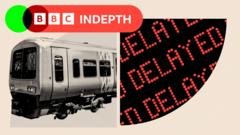
Can Railway Nationalization Fix Britain’s Rail Crisis?
The early afternoon of a standard Wednesday in August offered an unsettling preview of Britain’s commuter reality. Shortly before 14:00, a minor power failure brought the rail network across the north-west of England to a grinding halt. Passengers were stranded on roasting platforms for hours, forcing some to book impromptu hotel rooms. It was an unusual point of failure, traced directly to a short power cut at Network Rail’s operating centre in Manchester. Yet, it neatly capped off a brutal summer for train travelers.
Railway nationalization is the systematic transition of private passenger train operators back into state ownership as their operating contracts expire. While hugely popular with the public, experts caution that structural improvements to punctuality and infrastructure will take years to materialize due to deeply entrenched system constraints.<\/p>
- Public Backing: Nearly two-thirds of the British public support bringing passenger rail services back into public ownership.
- Early Hurdles: Recently nationalized operators like South Western Railway have experienced early data fluctuations and high cancellation rates.
- Structural Reform: The proposed Great British Railways aims to unify track and train operations, eliminating the fragmented 'compensation merry-go-round'.
Repeated heatwaves triggered mandatory risk-control measures, including sudden speed reductions to protect warping tracks, while high-profile derailments near Lewes and Wickford further dented confidence. Set against a backdrop of stubbornly high cancellation rates and steep, rising fares compared with previous decades, everyday commuters could easily form a singular impression: the system is fundamentally broken.
The Political Shift Toward Public Control
Something significant is shifting beneath the surface. Labour is steadily executing a sweeping transition, bringing nearly all passenger rail services back into public hands as private contracts naturally expire. It is an overwhelmingly popular political maneuver; recent YouGov tracking data indicates that nearly two-thirds of the British public strongly support public ownership.
Yet, reality remains stubbornly ahead of ambition. These nationalization plans are still in their infancy. Major structural overhauls have yet to fully take root, and transport economists caution that making definitive proclamations about their long-term success is premature at best.
Can this sweeping wave of railway nationalization genuinely meet skyrocketing public expectations? Or are the ongoing delays, cancellations, and infrastructure bottlenecks currently plaguing the network a glaring warning sign that state control will struggle to deliver real, tangible improvements?
The South Western Railway Test Case
South Western Railway (SWR) was absorbed into public control in May 2025, marking the vanguard of six operators brought under public stewardship so far. Standing on the platforms at Woking station, regular commuter Leo shares a sentiment echoed by many: he initially felt optimistic about public ownership, but simply hasn’t noticed any operational shift.
“I think the phrase ’emperor’s new clothes’ comes to mind… it’s still unreliable.”
During its initial months under state management, SWR logged a clear increase in cancellations. Critics from the Conservative opposition immediately seized on these figures as proof that public control is a hollow fix for deep-seated systemic problems. Conversely, government defenders argue that SWR’s rocky early phase was heavily compounded by severe summer heatwaves, persistent signal failures, and frequent trespass incidents.
Rail Minister Lord Hendy points out that behind-the-scenes turnaround efforts have involved introducing long-delayed modern rolling stock on key suburban commuter routes and aggressively recruiting new drivers. These targeted measures have already driven a measurable drop in cancellations explicitly caused by staff shortages.
Weighing the Data: What Performance Metrics Really Tell Us
Raw operational data only reveals part of the complex puzzle. Performance is dictated by a web of compounding variables: the underlying state of aging infrastructure, unpredictable weather volatility, and the baseline functionality of an operator before the state stepped in.
Furthermore, of the operators nationalized under the current administration, only a handful have completed a full calendar year in public hands. Even for those transitioned earlier, the data remains heavily clouded by the lingering structural shocks of the pandemic era, which saw passenger volumes plummet.
Alex Hynes, chief executive of DfT Operator Limited (DfTO)—the government entity managing these publicly run franchises—argues that short-term operational victories are already visible. Crucially, the government has begun unifying teams to jointly manage both infrastructure and passenger train operations in key regions, such as the south-west of England.
“The railway is a system: track, train, people. By putting one person in charge, they can fix all elements of the system to deliver a better service to customers.”
Despite these early structural realignments, veteran transport analysts urge caution. Stephen Glaister, former chair of the Office of Rail and Road and emeritus professor at Imperial College London, is blunt about timelines.
“I think it’s completely hopeless to try and do that assessment over such a short period,” Glaister notes, arguing that a full decade is realistically required to accurately gauge the impact of nationalization.
Decoding What Nationalization Actually Entails
It is vital to clarify what modern state ownership actually means in practice. The railways inherited by the government were never entirely free-market enterprises, nor does current policy mark a wholesale return to the centralized structure of historic British Rail.
Infrastructure manager Network Rail has operated under total public control for over twenty years. Prominent franchises like LNER and Northern were already nationalized under previous administrations, while systems like ScotRail and Transport for Wales answer to devolved national governments.
Even private operators running under Department for Transport (DfT) contracts have faced intense state micromanagement for years. Throughout the pandemic, private firms shifted to a fixed-management fee model while the taxpayer absorbed all financial risk—a dynamic where operators required ministerial sign-off for basic administrative decisions.
Meanwhile, highly profitable rolling stock companies (ROSCOS) continue to own the actual trains, and freight operations remain entirely commercial. A small cohort of independent open-access operators like Lumo and Hull Trains also compete on the network, though industry insiders harbor growing concerns that these agile newcomers could eventually be squeezed out.
An Overview of Current UK Rail Governance Models
To understand the modern landscape, consider how different entities manage the railway:
| Entity Type | Primary Responsibility | Control Level |
|---|---|---|
| Network Rail | Tracks, signals, and national infrastructure | 100% Publicly Owned |
| State-Run Operators (e.g., SWR, TransPennine) | Passenger train service delivery | Brought into public hands as contracts expire |
| ROSCOs | Ownership and leasing of train carriages | Private Commercial Entities |
| Open Access Operators (e.g., Lumo) | Commercial passenger routes | Fully Private |
The Promise of Great British Railways (GBR)
Beyond merely switching operator badges, the government is betting heavily on structural reorganization through a proposed overarching body: Great British Railways (GBR). This initiative seeks to bridge the historic chasm between track management and train operations, finally healing a chronically fragmented industry.
The concept was originally sparked by a botched timetable rollout in 2018. While legislative work to establish GBR winds through parliament, transport experts are cautiously optimistic about its potential to establish a “single guiding mind.”
Professor Jon Shaw of the University of Plymouth suggests that GBR could eliminate the toxic “compensation merry-go-round,” where train operating companies and infrastructure managers endlessly point fingers at one another over who bears financial liability for chronic delays.
However, risks loom large. Professor Shaw warns that severe fiscal constraints and political interference from the Treasury remain massive vulnerabilities. If ministers cannot maintain an arms-length approach, political anxieties surrounding ticket pricing and service levels could paralyze independent rail executives.
Balancing Growth, Subsidies, and Public Expectations
The British rail network currently commands an annual state subsidy hovering around £12 billion, excluding colossal capital outlays like HS2. Transport Secretary Heidi Alexander has stated a clear desire to see overall subsidy levels drop over time.
Critics argue that public expectations of lower fares and pristine reliability directly conflict with fiscal realities. Professor Glaister summarizes the underlying tension:
“When the public is hoping for a better level of service, more reliability, fewer breakdowns and lower fares, what they’re really asking for is more money to be put into the railway. I don’t think it’s likely the government is going to be able to find more money… and so I think there’s a real problem with ministers raising expectations.”
Conversely, executives like Alex Hynes view financial sustainability and service excellence as mutually reinforcing goals rather than opposing forces. By boosting performance and driving passenger volume growth in an industry characterized by massive fixed costs, the network can generate the revenue needed to ease the burden on taxpayers.
Ultimately, transforming a sprawling transit network requires altering more than thirty years of deeply ingrained operational behaviors. Whether public ownership can successfully navigate these complex hurdles to deliver the dependable railway passengers demand remains the ultimate test for modern transport policy.
<button type="button" onclick="this.parentElement.innerHTML='✓ Thank you, we will refine our analysis!‘” style=”background:#ffffff; border:1px solid #cbd5e1; border-radius:6px; padding:4px 12px; font-size:12px; cursor:pointer; color:#334155;”>👎 No
