
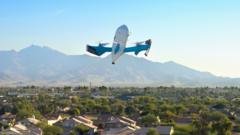
The Search for Stealthier Drones in Suburban Skies
In the suburban quiet of North Garland, Texas, outdoor peace has turned into an ongoing skirmish against airborne noise. As logistics companies scramble to deploy stealthier drones across American neighborhoods, local residents like Ashley Schmidt have reached their breaking point. Schmidt no longer spends peaceful mornings tending to her garden. She has abandoned her favorite pastime—cycling through nearby nature parks to photograph local wildlife—because the steady background hum of her neighborhood has been broken by sharp, overhead whine.
Stealthier drones utilize advanced acoustic engineering, toroidal blade geometry, and shrouded rotor pods to suppress psychoacoustic annoyance. By shifting rotor pitch, enclosing propeller tips, and slowing tip speeds, tech developers aim to reduce airborne acoustic footprints by up to 66 percent while maintaining commercial payload efficiency.<\/p>
- Suburban Noise Pressure: Escalating commercial drone flights in residential neighborhoods are driving psychoacoustic stress and surging citizen complaints.
- Acoustic Hardware Breakthroughs: Startups like Greenjets and Sharrow Engineering are replacing open spinning blades with enclosed pods and tipless loop designs.
- Multi-Sector Demand: The push for whisper-quiet aerial flight extends beyond retail delivery to defense tactical surveillance, anti-poaching operations, and municipal security.
The disruption stems from doorstep delivery flight pathways passing directly over her rooftop. “They emit this very annoying buzz. It triggers my fight or flight response,” says the 44-year-old administrative assistant. “You can hear the drones on approach, you can hear them inside your home when they pass directly overhead, and then you hear them as they leave.”
Schmidt is hardly alone. Across suburban America, the steady expansion of corporate logistics networks operated by retail giants has turned residential airspace into a live testing ground for rapid fulfillment. What was pitched as a futuristic convenience is quickly running into a wall of human auditory tolerance.
The Psychoacoustics of Suburban Noise Pollution
Commercial airspace is descending into backyards. Amazon Prime Air delivery systems are rapidly moving toward a footprint covering nearly 500 US cities and towns, dispatching shoe-box-sized parcels directly to driveways. In the UK, test corridors in Darlington are already active. Simultaneously, secondary operators are blanketing neighborhoods with quick-turn flights carrying hot pizzas, ice cream, and prescriptions.
Why does the sound of an eight-pound quadcopter irk people far more than a passing diesel delivery truck? The answer lies in psychoacoustics—the study of how the human brain processes sound.
“They can expose communities that have not previously experienced significant aircraft noise, and who may therefore be more sensitive to changes in their local soundscape.” — Dr. Antonio Torija Martinez, University of Salford
While urban street noise presents as a continuous, low-frequency hum, open drone rotors slice open air at thousands of revolutions per minute. This generates high-frequency tonal whines that pierce right through residential insulation. Dr. Antonio Torija Martinez, professor in acoustic engineering at the University of Salford, notes that human auditory systems respond aggressively when acoustic sources are perceived as novel, intrusive, or unpredictable.
Unlike commercial airliners cruising at 30,000 feet, low-altitude multirotor aircraft operate directly above residential rooftops. When an operator switches flight paths over quiet cul-de-sacs, ambient noise spikes instantly. Acoustic researchers warn that while citizens who utilize the services show higher tolerance, non-users experience elevated stress response levels, compounding neighborhood friction.
Engineering Silence: Pods, Toroids, and Tip Elimination
Faced with growing public backlash and pending municipal noise challenges, aerospace engineers are rethinking multirotor physics. The standard open-blade plastic propeller, virtually unchanged since early consumer quadcopters debuted, is being overhauled in favor of advanced quiet propulsion technology.
London-based startup Greenjets is taking aim at both sound amplitude and wave pitch. Rather than deploying exposed spinning blades, Greenjets encloses the propulsion dynamic inside a sculpted aerodynamic pod. This structural enclosure physically muffles mechanical noise while directing acoustic energy upward and outward, away from ground-level ears.
“We set out to tackle both the noise level and the frequency,” explains Darren James, future technologies lead at Greenjets. By combining shrouded blades with vibration-damping composite materials and slower rotor speeds, the company claims an acoustic signature reduction of at least 66 percent compared to conventional open-propeller layouts.
In Detroit, entrepreneur Greg Sharrow approached the acoustic problem from a fundamentally different mechanical angle. In 2012, while attempting to capture silent, close-quarters aerial footage of a classical violinist, Sharrow realized that standard drone propellers create their most intense acoustic turbulence at the blade tips, where high-velocity vortexes tear through open air.
His question was deceptively simple: What would a tipless propeller look like, and how would it function?
The resulting innovation—a continuous, twisted loop-shaped blade with no sharp points—eliminates tip-vortex cavitation. Originally proven in marine applications where it reduced boat motor drag and chatter, Sharrow Engineering is now adapting these toroidal loops for multirotor aviation. Acoustic validation tests demonstrate dramatic reductions in low-frequency airborne vibration without compromising aerodynamic lift thrust.
Comparing Next-Generation Drone Noise Suppression Systems
As hardware manufacturers race to quiet their platforms, clear trade-offs emerge between acoustic performance, structural weight, and manufacturing complexity.
| Propulsion Architecture | Acoustic Reduction Target | Key Structural Mechanism | Primary Industry Application |
|---|---|---|---|
| Standard Open Propeller | Baseline (0 dB shift) | Exposed spinning blades slicing open air | Legacy delivery & consumer platforms |
| Shrouded Pod System (Greenjets) | Up to 66% Noise Reduction | Enclosed ducting, sound-absorbing pods, lower tip speeds | Commercial urban logistics, police, harbor security |
| Toroidal Loop Propeller (Sharrow) | Dramatic Tonal Suppression | Continuous tipless blade geometry eliminating tip vortexes | Last-mile logistics, silent media production |
| Variable Pitch & Symmetrical Rotors | 30% to 50% Sound Mitigation | Software-managed motor pitch and dynamic flight path shifting | Enterprise delivery networks (Amazon, Wing) |
The Dual-Use Dilemma: From Suburban Yards to the Battlefield
The push for quieter skies isn’t just about preserving suburban serenity. The technology driving silent civilian platforms shares deep mechanical roots with defense and environmental monitoring sectors.
According to Bloomberg business reporting, defense procurement teams are closely analyzing commercial acoustic engineering developments. In non-military settings, Greenjets’ dampened propulsion designs have been deployed by conservation groups tracking poachers across African wildlife preserves without triggering animal stampedes or alerting illegal hunting teams. German harbor security and municipal police forces are testing similar muted units for discreet perimeter surveillance.
On military front lines, however, acoustic priorities diverge based on tactical scale. Robert Tollast, research fellow at the Royal United Services Institute (RUSI), notes that while special operations units actively experiment with stealthy recon micro-drones, large-scale attrition warfare operates on different math.
“There are clear efforts to reduce the sound signature for stealth operations,” Tollast explains. “But in major battles, speed and electronic warfare survivability frequently take priority over absolute acoustic stealth. Make it faster, not quieter, often remains the combat operational reality.”
Regulatory Vacuums and the Suburban Frontier
For citizens caught underneath daily flight corridors, regulatory protections remain elusive. In the United States, the Federal Aviation Administration (FAA) exercises jurisdiction over flight safety and national airspace integration, yet it has faced mounting criticism for lacking strict, modern acoustic standards tailored to low-altitude commercial drones.
The FAA currently maintains that operators and local municipal leaders share responsibility for managing neighborhood noise concerns. In response, major operators are implementing self-policing flight controls:
- Path Diversification: Alphabet’s Wing service varies its transit corridors so no single residential home experiences repeated daily flyovers.
- Propeller Redesign: Amazon states its newest Prime Air drones feature custom-engineered propulsion profiles producing nearly half the perceived acoustic signature of earlier models.
- Dynamic Altitude Adjustments: Automated flight control algorithms elevate cruising altitudes until final payload drop-off, minimizing ground sound exposure time.
For frustrated residents like Ashley Schmidt, software tweaks and partial noise reductions fall short. “I would like them to completely stop until they figure out how their services stop being a nuisance,” she emphasizes.
As commercial operators eye expansion into hundreds of additional towns, the industry faces a sharp ultimatum: master the physics of silent flight or prepare for a rising tide of local ordinances, legal challenges, and suburban pushback.
<button type="button" onclick="this.parentElement.innerHTML='✓ Thank you, we will refine our analysis!‘” style=”background:#ffffff; border:1px solid #cbd5e1; border-radius:6px; padding:4px 12px; font-size:12px; cursor:pointer; color:#334155;”>👎 No
