
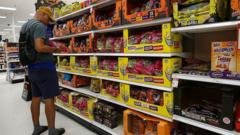
Why Halloween candy prices are surging this spooky season
For shoppers seeking sweet relief this spooky season, the reality lining retail aisles has been downright terrifying. Across the United States, consumers hunting for seasonal treats have been met with sticker shock, as the soaring cost of Halloween candy prices collides head-on with persistent household budget constraints. It is an economic fright night that extends far beyond a simple seasonal spike.
Halloween candy prices have surged due to historic cocoa market highs driven by climate change, coupled with persistent broader inflation and rising operational logistics costs. Confectionery prices are up over 15% year-over-year, forcing shoppers to scale back basket sizes and rethink seasonal spending.<\/p>
- Soaring Cocoa Costs: Extreme weather events and supply disruptions pushed cocoa prices past historic highs, directly inflating chocolate production costs.
- Substantial Price Hikes: Research shows popular Halloween treats have jumped significantly in price over a five-year period, outpacing standard inflation.
- Shifting Consumer Behavior: NielsenIQ data reveals that while shoppers still celebrate Halloween, they are opting for smaller package sizes and buying later in the season.
- Creative Alternatives: Industry experts suggest focusing on presentation, DIY treats, and memorable experiences to counter high retail confectionery costs.
Consider Demetrio Beltres. The 33-year-old financial adviser was browsing rows of colorful packaging at a Manhattan Target, searching for bargains to hand out to neighborhood trick-or-treaters. Traditionally, Beltres allocates a modest $15 to $20 for the occasion. This year, reality forced him to adjust.
“I’m trying to spend at least $20 to $30 just to make sure that I get the kids something,” Beltres noted, echoing a sentiment felt by millions of American households.
He is far from alone. Across the country, consumers are realizing their holiday budgets simply do not stretch as far as they used to. When basic utilities, groceries, and housing consume an ever-larger share of monthly income, discretionary spending on holidays naturally takes a hit. Stephen Zagor, an adjunct associate professor at Columbia Business School, points out that the fundamental mathematics of household finances leaves little room for extravagance.
“I think the holiday’s gotten scary, more from an economic perspective, than it might be for scuring people at the door.” — Stephen Zagor, Columbia Business School
The Anatomy of a Confectionery Crisis
Why are shelves commanding such steep prices? The answer lies in a toxic mix of commodity market shocks and macroeconomic pressures. Recent analysis from economic watchdogs found that popular chocolate and confectionery items are roughly 15% more expensive this year than they were just twelve months prior. Zoom out further, and the numbers are staggering. Research from personal finance firm Finance Buzz indicates that the price of Halloween treats has soared by a massive 71% over a five-year span—outpacing the general pace of consumer price inflation by a wide margin.
Much of this upward trajectory traces directly back to the global supply chain for raw cocoa. Climate change-driven weather anomalies wreaked havoc on harvests in key growing regions, sending the cost of a metric ton of cocoa skyrocketing to an astonishing peak of more than $10,700, according to historical economic data tracked via the Federal Reserve Bank of St. Louis.
“The cocoa that is now being consumed was bought when the prices were high,” explains Zagor, who specializes in food businesses. Because large food manufacturers locked into expensive raw material contracts months prior, those costs are inevitably filtered down to the retail consumer standing in the checkout line.
Compounding the problem are lingering macroeconomic pressures. With inflation running hot and fuel prices remaining stubbornly elevated—diesel prices hovering near record highs—the logistical cost of transporting boxes of chocolate from manufacturing plants to suburban superstores has become increasingly expensive.
How Shoppers Are Adapting Their Baskets
Naturally, shoppers are noticing. In New York and beyond, the general consensus among consumers is one of weary acceptance.
“Everything is expensive, so it does not surprise me that Halloween candy is expensive too,” shrugged Mallory, a shopper who declined to give her last name while navigating crowded seasonal displays.
Market research firm NielsenIQ captures this cautious mood in its tracking data. Sales of Halloween treats dipped significantly by the middle of September, trailing previous years by double-digit margins. While sales typically recover as October 31 approaches, consumer behavior has fundamentally shifted.
Chris Costagli, NielsenIQ’s vice-president of US food thought leadership, notes that shoppers remain eager to partake in traditional festivities, albeit with strict financial guardrails in place.
“Sales have improved considerably from where we started in September, with smaller packs gaining ground while larger sizes continue to struggle,” Costagli observes. “This feels like a consumer who still wants the occasion, but is paying much closer attention to what goes into the basket.”
Key Market Data Comparison
| Metric / Indicator | Historical Reference | Current Status |
|---|---|---|
| Cocoa Peak Price | Historical baseline | Exceeded $10,700 per tonne |
| Confectionery Price Growth (1-Yr) | Standard baseline | Up 15.3% year-over-year |
| Confectionery Price Growth (5-Yr) | Pre-pandemic baseline | Up 71% over five years |
| Early Season Sales Drop | Prior year comparison | Down 11.7% by mid-September |
Turning Economic Constraints Into Creative Opportunities
For purists who view October as a sacred cultural touchstone, trimming holiday budgets does not necessarily mean ruining the magic. In fact, industry experts suggest that financial constraints can serve as a catalyst for more imaginative, community-focused celebrations. When buying bulk quantities of premium brand-name candy becomes cost-prohibitive, hosts can pivot toward presentation and interactive experiences.
“It could be how you present the candy when kids come to your house as much as the one piece of candy that you’re going to give,” Zagor suggests. Instead of letting children casually reach into an ordinary plastic bowl, homeowners can introduce theatrical elements—such as using a spooky fake skeleton hand to distribute treats or going all-in on elaborate costumes to greet local families.
Another viable path forward is leaning into homemade alternatives. Organizing a weekend gathering to bake or craft treats with friends and family shifts the value proposition from commercial consumption to shared human connection.
“You could certainly do something slightly magical, slightly interesting,” Zagor concludes. In an era where corporate price tags threaten to dampen festive spirits, the trick, it turns out, just might be as important as the treat.
<button type="button" onclick="this.parentElement.innerHTML='✓ Thank you, we will refine our analysis!‘” style=”background:#ffffff; border:1px solid #cbd5e1; border-radius:6px; padding:4px 12px; font-size:12px; cursor:pointer; color:#334155;”>👎 No
