
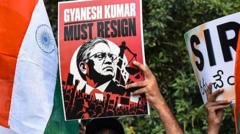
India Opposition Rally Demands Election Chief Resignation
A high-stakes political showdown reached a fever pitch in the capital as a historic India opposition rally convened at Delhi’s iconic Ramlila Maidan. Organized by the Indian National Congress and supported by the broader INDIA alliance, the demonstration has brought tens of thousands of citizens into the streets. At the core of the uproar is a singular, unyielding demand: the immediate resignation of Chief Election Commissioner (CEC) Gyanesh Kumar and sweeping structural reforms to the nation’s polling apparatus.
The India opposition rally at Delhi's Ramlila Maidan is a massive political demonstration organized by the INDIA alliance and youth groups. Protesters demand Chief Election Commissioner Gyanesh Kumar's resignation following the controversial removal of 130 million names from voter rolls under the Special Intensive Revision, alleging systematic voter disenfranchisement.<\/p>
- Massive Electoral Protest: Tens of thousands of demonstrators gathered at Ramlila Maidan to demand Chief Election Commissioner Gyanesh Kumar's resignation.
- Controversial Voter Purge: The Special Intensive Revision (SIR) removed 130 million names, sparking accusations of 'vote chori' (vote theft).
- Institutional Discord: An investigative report revealed CEC Gyanesh Kumar overruled internal objections from two election commissioners on over a dozen occasions.
- Youth & Political Coalition: The opposition INDIA bloc joined forces with the Gen Z-led Cockroach Janta Party despite recent police crackdowns.
The atmosphere surrounding the protest site is electric. Organizers insist that attendance could scale toward a million people before the day closes. Buses, trains, and private vehicles packed with activists have poured into the national capital from neighboring states, defying heavy security checkpoints and intense municipal surveillance.
The 130-Million Voter Purge: Housekeeping or Targeted Disenfranchisement?
The immediate spark for this unprecedented mobilization is the Election Commission of India’s (ECI) nationwide voter-list update, formally known as the Special Intensive Revision voter list (SIR) exercise. Official figures reveal that a staggering 130 million names were excised from draft rolls across multiple states during the process.
According to official declarations from the ECI, the purge is nothing more than standard administrative maintenance designed to clean up electoral records. Bureaucrats insist the process removes deceased citizens and individuals who have permanently relocated without updating their registration details. However, political opponents frame the initiative in far more sinister terms.
Leaders across the opposition spectrum accuse Prime Minister Narendra Modi’s Bharatiya Janata Party (BJP) of colluding with top election authorities to execute deliberate voter suppression. They allege that legitimate, eligible voters—particularly those in demographics historically unfavorable to the ruling party—have been systematically erased from the franchise.
“There is huge anger, huge emotional pain because millions are being disenfranchised. We are all standing together because we are defending the Constitution. We are defending the idea of India. We are defending the vote, which is the expression of all Indians.”
— Rahul Gandhi, Leader of the Opposition
The phrase “vote chori” (vote theft) has become the rallying cry for the movement. While both the ECI and the ruling BJP have repeatedly denied all charges of bias or wrongdoing, independent civil society organizations have voiced growing alarm over the unprecedented scale of the deletions.
Institutional Discord: Internal Objections Exposed
Public skepticism deepened significantly following a major investigative report published in September by The Indian Express. According to the reporting, CEC Gyanesh Kumar unilaterally pushed through critical administrative decisions regarding the SIR exercise despite explicit, recorded dissent from within his own agency.
The investigation detailed how the two other serving election commissioners raised formal objections on more than a dozen occasions regarding procedural irregularities and the speed of the draft roll revisions. Their concerns were reportedly bypassed to maintain the expedited timeline for the roll purges.
In response to the fallout, the Election Commission issued statements framing internal friction as routine operational debate:
- ECI Official Position: Differences of opinion are normal in any constitutional institution and do not impede core operational integrity.
- Opposition Counter-Position: The suppression of dissent within the commission confirms institutional capture and erosion of neutral oversight.
- Civil Society Assessment: The lack of consensus on a 130-million voter audit undermines public confidence ahead of upcoming electoral cycles.
Global democratic watchdogs and global political observers have noted that when regulatory bodies display internal fractures of this magnitude, public trust in election outcomes inevitably deteriorates.
Gen Z Enters the Fray: The CJP Alliance
A notable feature of the current movement is its cross-generational composition. Joining the established political machinery of the Congress-led INDIA bloc is the influential, youth-driven pressure group known as the Cockroach Janta Party (CJP). Spearheaded by Gen Z activists and student organizers, the CJP has brought a volatile energy and digital fluency to the campaign.
The group’s involvement follows weeks of escalating clashes with law enforcement. On October 10, security forces executed a massive clampdown in central Delhi to thwart a youth rally targeting the ECI headquarters. Thousands of police personnel locked down major arteries, detaining senior CJP organizers and forcibly clearing street occupations.
Despite documented instances of police using batons to disperse non-violent assemblies, student participation has only expanded. The INDIA alliance Gen Z CJP support dynamic has transformed what might have been a routine parliamentary protest into a broad-based social movement.
“The march from Connaught Place to the Supreme Court last month was just the trailer. This demonstration represents the full force of a public that refuses to watch its democratic rights erased.”
— Senior Congress Party Strategist
Addressing crowd anxieties regarding potential security crackdowns ahead of the Ramlila Maidan gathering, Rahul Gandhi issued an explicit message on social media platforms encouraging unhesitating participation.
“Don’t worry about the police, don’t worry about lathis [batons]—the BJP will not have the guts to try any of their antics,” Gandhi posted on X, directly challenging the government’s security posture.
Comparing Political & Institutional Positions
To understand the depth of the impasse, it is necessary to examine how key stakeholders view the contested voter roll revision and the surrounding protests:
| Stakeholder Group | Primary Position | Key Allegation or Justification | Action Demanded / Taken |
|---|---|---|---|
| INDIA Opposition Bloc | Rejects SIR execution | Systematic voter deletion amounting to “vote chori” | Resignation of CEC Gyanesh Kumar & full roll reinstatement |
| Election Commission (ECI) | Defends administrative validity | Routine purging of deceased or relocated electors | Continuation of roll updates; internal disagreement dismissed as routine |
| Ruling BJP | Denies opposition claims | Accuses opposition of undermining democratic institutions | Counter-marches conducted in commercial hubs like Chandni Chowk |
| Cockroach Janta Party (CJP) | Demands total electoral transparency | Disenfranchisement of young voters and vulnerable communities | Mass civil disobedience and youth mobilization |
Local Impact and Commercial Division in Old Delhi
The geopolitical tension in the nation’s capital has triggered immediate economic friction on the ground, particularly in Chandni Chowk—one of Delhi’s oldest and most vital trading hubs, situated less than a kilometer from the Ramlila Maidan electoral reform protest site.
With the major festive season of Diwali rapidly approaching, commercial interests in the district find themselves sharply divided:
- Business Disruption Concerns: A prominent association of local traders voiced intense frustration earlier in the week, warning that massive crowd congestion, street closures, and heavy security cordons would paralyze retail foot traffic during their peak sales window.
- Backlash Against Government Counter-Protests: Conversely, a rival faction of merchants publicly backed the opposition gathering while directing sharp criticism toward the ruling BJP. They pointed out that a political march staged by the BJP through Chandni Chowk’s narrow avenues on Thursday caused severe commercial paralysis during business hours.
Local merchant sentiment reflects broader societal polarization, as small business owners weigh immediate seasonal revenue against larger constitutional arguments unfolding on their doorstep.
Market analysts monitored by regional financial analysis outlets suggest that repeated urban disruptions in high-density wholesale sectors create cascading supply chain delays across North India during high-consumption periods.
State Security and Municipal Constraints
In response to the sheer scale of the mobilization, Delhi Police and central paramilitary forces have implemented strict security measures. Thousands of armed personnel have established multi-layered barricades along all primary arteries leading into Ramlila Maidan.
While official permission for the demonstration was granted, municipal authorities imposed explicit operational boundaries:
- Mandatory Hard Cutoff: All rally proceedings and public address systems must cease promptly at 5:00 PM local time.
- Surveillance Protocols: Event organizers were required to install extensive high-definition CCTV coverage throughout the venue, fed directly to police monitoring stations.
- Prohibition of Off-Site Marches: Law enforcement strictly banned secondary processions or foot marches extending beyond the designated footprint of Ramlila Maidan.
Despite these restrictive conditions, organizers maintain that the sheer volume of humanity gathering in Delhi sends an unmistakable message to the ruling establishment. As thousands continue to file into the historic grounds under the watchful gaze of armed security details, the battle over India’s electoral integrity faces a pivotal moment of truth.
<button type="button" onclick="this.parentElement.innerHTML='✓ Thank you, we will refine our analysis!‘” style=”background:#ffffff; border:1px solid #cbd5e1; border-radius:6px; padding:4px 12px; font-size:12px; cursor:pointer; color:#334155;”>👎 No
Latest Analytical Follow-up: For continuous developments on this subject, read our full investigation on Downfall of Serbia’s Vucic Mirrors Orban’s Fall.
Latest Analytical Follow-up: For continuous developments on this subject, read our full investigation on US Midterm Election Polls: Can Democrats Trust the Numbers?.
