
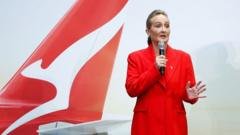
Qantas Job Cuts: Airline Outsources 850 Corporate Roles
Australia’s national carrier is preparing for another profound structural overhaul. In an internal message delivered to employees, Chief Executive Officer Vanessa Hudson confirmed that incoming Qantas job cuts will eliminate approximately 850 corporate roles across Australia. The positions—spanning finance, procurement, human resources, and marketing—will be outsourced to global consulting powerhouse Accenture, with the vast majority of operational responsibility transferred overseas to India.
Recent Qantas job cuts will eliminate 850 local corporate roles across finance, procurement, HR, and marketing starting in mid-2027. The carrier is outsourcing operations to Accenture, relocating the majority of functions to India while leveraging artificial intelligence and automation to replace complex legacy systems.<\/p>
- Mass Workforce Shift: Qantas is cutting 850 Australian corporate positions and transitioning the duties mostly to Accenture teams in India by mid-2027.
- Tackling Technical Debt: The airline spends over AU$1 billion annually on technology, burdened by more than 1,000 legacy applications that lack interoperability.
- AI-Driven Restructuring: Management explicitly framing the transition around rapid artificial intelligence adoption and operational automation.
- Industrial Friction: The move arrives alongside passenger fare hikes, fleet adjustments, and active union negotiations with the Australian Services Union.
The announcement underscores an aggressive push by executive leadership to untangle decades of accumulated technical debt. Qantas currently spends upwards of AU$1 billion ($691 million) annually maintaining a deeply fragmented digital infrastructure. As fuel costs climb and market pressures mount, the airline is placing its long-term operational efficiency squarely on automated workflows, enterprise cloud modernization, and offshore labor arbitrage.
The High Price of Legacy Code: Inside Qantas’s Tech Overhaul
For modern airlines, back-end stability is just as vital as jet fuel. Yet, like many legacy carriers that expanded rapidly during the late 20th century, Qantas operates on a patchwork of software systems designed in entirely different technological eras. According to internal briefings, the airline relies on more than 1,000 separate legacy applications. Crucially, most of these applications were never designed to exchange data seamlessly.
Addressing staff in an internal memorandum, Hudson characterized the shift as a painful but unavoidable necessity. “Like every airline, we run on technology built up over decades for a different era,” Hudson stated. She emphasized that the multi-year deal with Accenture aims to drastically simplify corporate workflows, eliminate operational duplication, and allow remaining staff to focus on customer-facing value.
Technology analysts suggest that airlines worldwide are grappling with similar digital bottlenecks. According to market data tracked by Bloomberg, enterprise carriers spend up to 70 percent of their dedicated IT budgets simply keeping legacy databases online rather than innovating. By transferring corporate administration to an external managed-service provider, Qantas hopes to rapidly decommission obsolete software while shifting baseline capital expenses into flexible operational expenditures.
From Sydney to Bengaluru: The Logistics of Qantas Outsourcing to India
The operational pivot will not happen overnight. The planned reduction of 850 local corporate roles is scheduled to begin in mid-2027, providing a multi-year window for transition management, system integration, and knowledge transfer. Under the framework of the Accenture IT modernization deal, the bulk of everyday accounting, vendor procurement, HR administration, and routine marketing analytics will move to Accenture’s established delivery hubs in India, alongside a smaller remnant retained in Australia.
“This is hard news for some and I’m sorry for the uncertainty it brings,” Hudson acknowledged in her communication to staff, noting the scale and speed of technological change hitting the aviation sector is unprecedented.
The strategic migration of back-office services to low-cost jurisdictions remains a battle-tested corporate playbook, yet its execution in aviation carries distinct operational risks. Corporate operations handle sensitive vendor negotiations, payroll systems for thousands of flight crew members, and complex regulatory compliance frameworks across multiple geographic regions.
Departmental Breakdown of Restructuring Impact
- Finance & Accounting: Migration of routine auditing, ledger management, account reconciliation, and expense processing to offshore digital centers.
- Procurement: Centralization of vendor contracts, global supply chain tracking, and material acquisition under Accenture’s managed services.
- People & Culture (HR): Automation of onboarding, internal query resolution, and administrative benefits management.
- Marketing: Streamlining of campaign collateral production, data analytics, and routine content management.
Generative AI as a Corporate Scapegoat or Strategic Necessity?
While offshore outsourcing provides immediate labor cost relief, management has explicitly tied the initiative to an accelerating airline AI transformation strategy. Qantas confirmed that while Accenture will initially manage the transition using human teams abroad, those very processes will gradually be replaced by programmatic automation, machine learning algorithms, and generative AI agents over time.
Qantas already employs roughly 28,000 workers in Australia and another 4,000 across international outposts. Thousands of these employees currently utilize basic AI productivity tools in their day-to-day duties. However, the new partnership with Accenture represents a fundamental shift: moving AI from an auxiliary employee tool to a direct replacement for corporate administrative headcount.
Industry observers remain skeptical about how quickly enterprise AI can seamlessly manage legacy airline software. Programmatic automation frequently runs aground when confronted with non-standard edge cases—such as severe weather disruptions requiring rapid, non-linear adjustments to crew rosters, vendor pay, and passenger compensation. Insiders note that relying heavily on automated enterprise systems during operational crises can create blind spots if institutional knowledge is purged alongside corporate staff.
Union Resistance and the Human Toll of Corporate Restructuring
The announcements have drawn immediate criticism from organized labor. Representatives from the Australian Services Union (ASU) and allied labor groups have entered formal discussions with Qantas management to challenge the scale of the redundancy program. Unions argue that domestic corporate roles provide vital operational stability and represent a core component of Australia’s skilled service economy.
The timing of the announcement is particularly sensitive. It arrives just days after Qantas issued a commercial market update warning investors and passengers alike of imminent fare increases and selective route trimming, citing sustained pressure from elevated jet fuel prices and international supply chain bottlenecks. Critics point to the optics of raising ticket prices on consumers while simultaneously shipping domestic support jobs overseas.
Comparing Corporate Restructuring Strategies Across Global Carriers
| Airline Carrier | Primary Restructuring Mechanism | Targeted Business Functions | Primary Offshore/Tech Partner | Estimated Timeline |
|---|---|---|---|---|
| Qantas | Offshore Outsourcing & AI Integration | Finance, Procurement, HR, Marketing | Accenture (India / Australia) | 2027 – 2029 |
| Lufthansa Group | Internal Digital Hub Standardization | IT Operations, Administration | In-House Systems (Europe) | Ongoing |
| British Airways | Hybrid Cloud Modernization | Booking Systems, Customer Support | Multiple Third-Party Vendors | 2024 – 2026 |
| Delta Air Lines | In-House Tech Scaling & Automation | Analytics, Crew Dispatch, Finance | Proprietary / AWS Infrastructure | 2023 – 2027 |
Market Pressures: Rising Fuel Costs, Fare Hikes, and Margin Chasing
To understand why Qantas is moving so decisively on corporate overhead, one must look at the broader macro-economic backdrop defining post-pandemic aviation. According to global industry coverage by Reuters, jet fuel prices remain volatile, eroding operational margins even as passenger travel demand stabilizes near historical highs.
Airlines face a narrow margin for error. Jet fuel represents anywhere from 25 to 35 percent of an airline’s total operating costs. When fuel prices spike, carriers must either absorb the margin erosion, pass costs directly to consumers via ticket surcharges, or aggressively trim controllable fixed overhead. For Qantas, corporate payroll represents one of the few levers directly under executive control.
By executing these Qantas job cuts over a phased multi-year window, the company aims to protect its operating margins without causing immediate disruption to flight schedules or passenger-facing operations. However, the strategy risks damaging internal corporate morale during an era when the airline is simultaneously attempting to rebuild public trust following years of post-pandemic flight cancellations, baggage delays, and regulatory scrutiny.
The Broader Horizon for Australian Aviation Trends
The structural changes underway at Qantas reflect broader Australian aviation industry trends. As domestic companies confront elevated inflation, rising labor costs, and rapid technological innovation, the traditional model of maintaining large, centralized corporate offices in Sydney or Melbourne is being aggressively re-evaluated.
For Qantas, outsourcing corporate administration to Accenture is a high-stakes gamble. If successful, the airline will modernize its IT architecture, drastically cut its AU$1 billion annual tech expenditures, and build an agile, AI-driven corporate structure capable of responding dynamically to market shifts. If the transition falters, however, the carrier risks exacerbating operational bottlenecks, alienating its domestic workforce, and trading short-term financial savings for long-term administrative friction.
As union negotiations continue and implementation plans progress toward 2027, the broader business community will be watching Qantas closely. The airline’s ability to balance human capital, legacy tech modernization, and aggressive offshore outsourcing will serve as a definitive case study for legacy enterprises navigating the disruptive age of artificial intelligence.
<button type="button" onclick="this.parentElement.innerHTML='✓ Thank you, we will refine our analysis!‘” style=”background:#ffffff; border:1px solid #cbd5e1; border-radius:6px; padding:4px 12px; font-size:12px; cursor:pointer; color:#334155;”>👎 No
Latest Analytical Follow-up: For continuous developments on this subject, read our full investigation on UK toy sales surge ahead of Christmas amid brick and sticker boom.
