
BepiColombo’s Final Approach: Europe and Japan’s Historic Mercury Mission Reaches Decisive Milestone
1. Executive Summary & Strategic Importance
After an arduous, nearly eight-year interplanetary odyssey spanning millions of miles through the inner solar system, the BepiColombo mission has cleared a decisive milestone in its final stretch toward Mercury. Jointly led by the European Space Agency (ESA) and the Japan Aerospace Exploration Agency (JAXA), with critical technological contributions from international partners including NASA, this $2 billion robotic science initiative represents one of the most complex planetary exploration endeavors in the history of spaceflight. The spacecraft’s recent navigational maneuvers mark the beginning of the end for its long cruise phase, setting the stage for a dramatic orbital insertion that will unlock the deepest mysteries of the solar system’s innermost and most extreme terrestrial planet.
To fully grasp the magnitude of this achievement, one must consider the extreme astrodynamic challenges of reaching Mercury. Unlike outer planet missions that can leverage gravity assists away from the sun, probes bound for Mercury must constantly fight the immense gravitational pull of our star. As the sun pulls objects inward, they accelerate violently, making it extraordinarily difficult to match orbits with Mercury without expending prohibitively massive quantities of propellant. BepiColombo has navigated this celestial paradox by executing a carefully orchestrated choreography of solar-electric propulsion—commonly known as ion propulsion—combined with a precise series of planetary gravity assists. Since its launch in October 2018, the spacecraft has utilized flybys of Earth, Venus, and Mercury itself to shed momentum, alter its velocity vector, and shape its trajectory for its final rendezvous.
The strategic importance of BepiColombo extends far beyond academic curiosity. Mercury is a planetary anomaly: an iron-rich world possessing a disproportionately massive core, a remnant global magnetic field despite its small size, and permanently shadowed craters at its poles that harbor unexpected reservoirs of water ice despite blistering surface temperatures reaching 430 degrees Celsius. Understanding Mercury is crucial for planetology, as it serves as an extreme laboratory for testing theories of planetary formation, solar-stellar interactions, and magnetospheric physics. Furthermore, the engineering breakthroughs achieved during the BepiColombo mission—ranging from advanced thermal protection systems to high-efficiency ion thrusters—establish a new technological baseline for future inner-solar-system and deep-space missions, cementing international scientific cooperation as the gold standard for twenty-first-century space exploration.
2. Historical Context & Industry Evolution
Humanity’s exploration of Mercury has historically been a tale of extreme difficulty and sparse data. For decades, the innermost planet remained largely obscured, sitting stubbornly in the blinding glare of the sun. The first spacecraft to visit Mercury was NASA’s Mariner 10, which performed three flybys between 1974 and 1975. Mariner 10 revolutionized our understanding by mapping roughly 45 percent of the mercurian surface, discovering a weak planetary magnetic field, and revealing a heavily cratered, moon-like terrain scarred by massive tectonic cliffs known as lobate scarps. However, Mariner 10 was strictly a flyby mission; it could not linger, nor could it observe the same hemisphere twice under changing illumination conditions, leaving vast swathes of the planet shrouded in mystery.
More than three decades elapsed before humanity returned to Mercury. NASA’s MESSENGER (MErcury Surface, Space ENvironment, GEochemistry, and Ranging) spacecraft achieved orbit in March 2011, spending four years mapping the entire planet, discovering volatile-rich deposits in polar shadows, and detailing the planet’s dynamic exosphere and magnetosphere. Yet, MESSENGER’s highly elliptical orbit and eventual controlled crash into the mercurian surface in 2015 left lingering questions that required a more advanced, multi-faceted observational platform. Enter BepiColombo, conceived not as a single spacecraft, but as an extraordinarily sophisticated dual-orbiter architecture designed to simultaneously study the planet’s surface, interior, and exosphere from complementary orbital planes.
The evolution of missions to Mercury reflects a broader paradigm shift in aerospace engineering and international collaboration. Early planetary exploration was defined by single-agency, high-risk flagships driven by Cold War geopolitics. In contrast, BepiColombo represents the modern era of transnational synergy, blending ESA’s systems engineering and payload integration with JAXA’s specialized expertise in planetary magnetospheric and plasma science. Moreover, the mission pushed the boundaries of propulsion technology. While chemical rockets remain essential for impulsive maneuvers, the heavy reliance on continuous low-thrust ion propulsion throughout BepiColombo’s cruise phase mirrors the broader industry migration toward electric propulsion for deep-space and commercial satellite architectures alike. As we stand on the precipice of BepiColombo’s orbital insertion, we bear witness to the culmination of decades of iterative engineering lessons learned from Mariner 10, MESSENGER, and various inner-planet gravity-assist precursors.
3. Deep-Dive Architectural & Technical Mechanics
Spacecraft Architecture and Modular Design
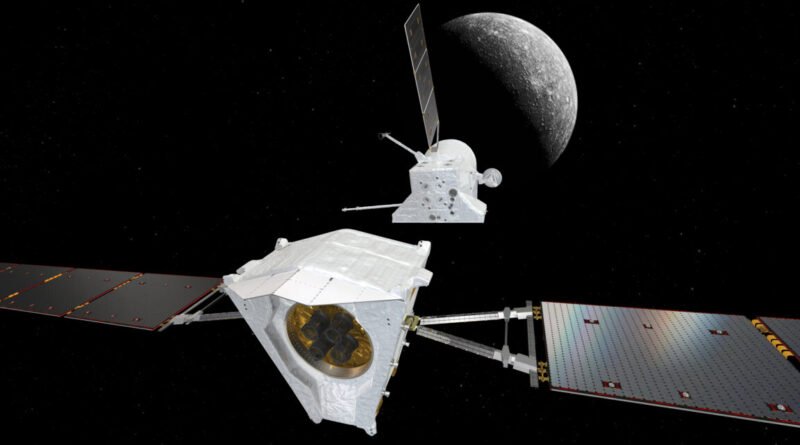
The BepiColombo spacecraft stack is an engineering marvel designed to survive the hostile thermal and radiation environment of the inner solar system. Because no single vehicle could carry all scientific instruments while withstanding temperatures exceeding 400 degrees Celsius and simultaneously operating in the freezing vacuum of deep space, ESA and JAXA adopted a modular, multi-component architecture. During the seven-year cruise phase, the stack consists of four distinct modules: the Mercury Transfer Module (MTM), the Mercury Planet Orbiter (MPO), the Mercury Magnetospheric Orbiter (MMO, known scientifically as Mio), and the Sunshield/Interface Structure.
The MTM, contributed by ESA, provides solar-electric propulsion and power generation during the journey to Mercury. It features large, specially tilted solar arrays designed to avoid overheating while harvesting abundant solar energy. The Mio orbiter, contributed by JAXA, is a spin-stabilized spacecraft optimized to study Mercury’s magnetic field, plasma environment, and exosphere. To protect Mio from the intense solar glare, it is housed within a protective sunshield during the cruise phase. Finally, the MPO, also built by ESA, is a three-axis stabilized spacecraft packed with a suite of eleven scientific instruments dedicated to global mapping, internal gravity field measurement, surface mineralogy, and elemental composition analysis.
Propulsion and Trajectory Dynamics
Achieving orbit around Mercury requires an immense expenditure of delta-v—the measure of change in velocity needed to perform orbital maneuvers. In astrodynamics, falling inward toward the sun accelerates a spacecraft to extreme speeds. To be captured by Mercury’s gravity rather than slingshotting past it, the spacecraft must brake heavily. BepiColombo achieves this through a hybrid propulsion strategy combining state-of-the-art ion engines with continuous gravitational braking via planetary flybys.
- Solar-Electric Propulsion (SEP): The MTM utilizes four Kaufman-type ion thrusters that expel ionized xenon propellant at exceptionally high exhaust velocities, providing continuous, highly efficient low-thrust acceleration and deceleration.
- Planetary Gravity Assists: The spacecraft executed a total of nine planetary flybys—one of Earth, two of Venus, and six of Mercury—systematically bleeding off orbital energy through gravitational interactions.
- Differential Orbital Insertion: Upon final arrival, the transfer module will be jettisoned, and the remaining MPO and Mio orbiters will use their own chemical propulsion systems to insert themselves into distinct, highly optimized polar orbits around Mercury.
Thermal Control and Radiation Mitigation
Operating in orbit around Mercury exposes hardware to solar radiation up to ten times intense as that experienced in Earth orbit. To prevent critical avionics and scientific payloads from melting, BepiColombo employs advanced passive and active thermal control systems. The MPO is covered in specially developed high-temperature multi-layer insulation (MLI) blankets made of quartz and ceramic cloth, designed to reflect the blinding infrared radiation radiating from the sun-baked mercurian surface. Furthermore, radiator panels painted with high-emissivity optical coatings dump excess internal heat into the cold void of space, ensuring that sensitive instruments operate within strict thermal thresholds.
4. Comparative Market Framework & Benchmarking
To fully understand the technological and scientific leaps represented by BepiColombo, it is instructive to compare it against previous and contemporary inner-planet missions. The table below benchmarks BepiColombo against NASA’s historical Mariner 10 and MESSENGER missions, as well as the conceptual parameters of potential future solar system explorers.
| Mission Parameter | Mariner 10 (NASA) | MESSENGER (NASA) | BepiColombo (ESA/JAXA) | Future Mercury Lander (Conceptual) |
|---|---|---|---|---|
| Launch Year | 1973 | 2004 | 2018 | 2035+ (Projected) |
| Mission Architecture | Single Flyby Probe | Single Orbiter | Dual Orbiters (MPO + Mio) | Orbiter + Surface Lander |
| Propulsion Type | Chemical Monopropellant | Chemical Bipropellant | Solar-Electric Ion + Chemical | Advanced Nuclear / Chemical |
| Scientific Focus | Atmosphere & Basic Topography | Global Mapping & Geochemistry | Simultaneous Magnetosphere & Surface Analysis | In-Situ Seismic & Regolith Analysis |
| Target Orbit Configuration | Heliocentric Flybys | Elliptical Polar Orbit | Complementary Optimized Polar Orbits | Direct Surface Touchdown |
The comparative data highlights a clear evolutionary trajectory in inner-planet exploration. While Mariner 10 provided humanity’s first fleeting glimpse of Mercury through three rapid flybys, and MESSENGER successfully broke new ground by placing a single spacecraft into a high-altitude elliptical orbit, BepiColombo shatters previous observational paradigms. By deploying two specialized orbiters into distinct polar orbits simultaneously, the mission solves a fundamental observational dilemma in planetary science: the inability to decouple spatial variations from temporal changes in a dynamic space environment. For instance, while Mio measures the mercurian magnetosphere’s rapid plasma fluctuations from a higher orbit, the MPO simultaneously measures surface mineralogy and topography from a lower vantage point. This coordinated, multi-point dataset will provide researchers with an unprecedented, holistic understanding of a world caught in a perpetual tug-of-war with our sun.
5. Enterprise, Geopolitical & Socio-Economic Ramifications
International Collaboration and Geopolitical Soft Power
The BepiColombo mission stands as a monumental triumph of international scientific diplomacy. By pooling the technological resources, financial capital, and intellectual talent of the European Space Agency and the Japan Aerospace Exploration Agency—alongside critical hardware contributions from NASA, the Russian space agency (historical tracking support), and various academic institutions worldwide—the project exemplifies how complex space exploration transcends national boundaries. In an era occasionally characterized by geopolitical fragmentation and terrestrial rivalry, collaborative megaprojects like BepiColombo serve as vital conduits for peaceful technological exchange and shared human achievement.
From an industrial perspective, the development of BepiColombo catalyzed significant advancements across the European and Japanese aerospace supply chains. Prime contractors and subcontractors were forced to innovate within extreme constraints, leading to proprietary advancements in high-temperature materials, radiation-hardened microelectronics, ceramic matrix composites, and high-efficiency ion thrusters. These innovations do not remain confined to planetary science; they cascade into commercial satellite manufacturing, terrestrial energy systems, and advanced materials science, reinforcing the economic vitality of the participating aerospace sectors.
Socio-Economic Value and Public Engagement
Beyond tangible engineering spin-offs, missions of this caliber play a vital role in inspiring the next generation of scientists, engineers, and technologists—collectively known as the STEM workforce pipeline. The narrative of an iron-rich planet hurtling through the searing heat of the inner solar system captures the public imagination, driving widespread educational engagement. Furthermore, planetary science offers profound philosophical and existential perspectives. By understanding the formation, evolution, and climatic fate of Mercury—the planet closest to our parent star—humanity gains critical insights into the fragility and stability of our own terrestrial biosphere, reinforcing the urgency of planetary stewardship in an increasingly interconnected global economy.
6. Strategic Implementation Roadmap & Future Outlook
As BepiColombo enters the final phase of its interplanetary cruise, the mission operations team faces a highly compressed, high-stakes timeline leading up to orbital insertion. The upcoming months represent the culmination of over a decade of meticulous planning, simulation, and hardware testing.
- Final Cruise Adjustments (Months 1–3): Fine-tuning trajectory vectors using remaining xenon propellant reserves and executing final optical navigation checks against background star fields.
- Final Mercury Flyby & Brake Maneuver (Month 4): Executing the final gravitational flyby of Mercury to shed remaining excess velocity, perfectly matching the planet’s orbital velocity vector.
- Transfer Module Separation (Month 5): Jettisoning the Mercury Transfer Module after its historic service life, transitioning power and propulsion reliance entirely to the internal systems of the MPO and Mio orbiters.
- Orbital Insertion & Commissioning (Months 6–12): Firing chemical thrusters to enter capture orbits, followed by a rigorous multi-month commissioning phase where all eleven scientific payloads are powered up, calibrated, and validated in the harsh mercurian environment.
- Primary Science Phase (Years 1–2+): Conducting continuous global mapping, magnetospheric sampling, and gravitational profiling to unlock the secrets of the innermost planet.
Risk mitigation has been woven into every layer of this roadmap. Redundant communication channels, fault-tolerant onboard autonomy software, and rigorous thermal simulation testing ensure that the spacecraft can autonomously handle unexpected solar flare events or thermal anomalies. Looking beyond the primary mission timeline, extended mission scenarios are already being evaluated by ESA and JAXA science working groups, potentially allowing researchers to observe Mercury across varying phases of solar activity and solar cycle extremes.
7. Frequently Asked Questions (FAQ) & Expert Insights
Why is Mercury so difficult to reach compared to other planets?
Reaching Mercury requires immense amounts of energy (delta-v) because the spacecraft must actively fight the sun’s immense gravitational pull. As a spacecraft travels inward toward the sun, it accelerates rapidly. To enter orbit around Mercury rather than flying past it, the probe must shed massive amounts of velocity, requiring heavy propellant loads, ion propulsion, and multiple planetary gravity assists.
What makes BepiColombo different from previous Mercury missions?
Unlike Mariner 10, which only performed flybys, or MESSENGER, which operated a single spacecraft in an elliptical orbit, BepiColombo utilizes a dual-spacecraft architecture. It deploys two specialized orbiters—the Mercury Planet Orbiter (MPO) and the Mercury Magnetospheric Orbiter (Mio)—simultaneously into complementary polar orbits, enabling concurrent observations of the planet’s surface, interior, and surrounding space environment.
How does the spacecraft survive the extreme heat of Mercury?
BepiColombo employs advanced thermal protection systems, including specialized ceramic and quartz multi-layer insulation blankets, high-emissivity optical radiator coatings, and an intentional tilt of its solar arrays during the cruise phase to prevent overheating. The design actively reflects intense infrared radiation and radiates excess heat into deep space.
What are the primary scientific goals of the BepiColombo mission?
Key scientific objectives include mapping Mercury’s surface composition, studying its unusually large iron core, investigating the origins of its internal magnetic field, exploring volatile deposits in permanently shadowed polar craters, and analyzing the dynamics of its thin exosphere and magnetosphere in response to solar wind interaction.
Who funds and manages the BepiColombo mission?
BepiColombo is a joint undertaking between the European Space Agency (ESA) and the Japan Aerospace Exploration Agency (JAXA). It represents a multi-billion-dollar international collaboration involving contributions from numerous space agencies, industrial contractors, and academic research institutions across Europe, Japan, and the United States.
