
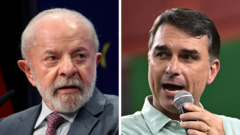
Brazil election heads to tense run-off vote
The political landscape of South America’s largest democracy has shifted dramatically. The Brazil election has officially gone to a tense, high-stakes run-off after a first round that routinely defied conventional polling models. Right-wing challenger Flávio Bolsonaro pulled ahead of incumbent leftist President Lula da Silva, setting up a ferocious electoral showdown on October 25 that will ultimately dictate the future trajectory of the region’s dominant economic powerhouse.
The Brazil election has advanced to a high-stakes run-off vote scheduled for October 25, after right-wing candidate Flávio Bolsonaro secured 47.24% of the vote, narrowly defeating incumbent left-wing President Lula da Silva, who garnered 44.91% in a deeply polarized first-round contest.<\/p>
- Narrow First-Round Margin: With 98.81% of votes counted, Flávio Bolsonaro led with 47.24% against Lula's 44.91%, falling short of the 50% majority needed for an outright win.
- Dynastic Politics: Flávio Bolsonaro, running in place of his jailed father Jair Bolsonaro, has promised controversial amnesties for political allies and January 8th rioters.
- Geopolitical Shift: A right-wing victory could align Latin America's largest economy closely with Washington, while navigating complex trade dependencies with China.
With 98.81% of the ballots tallied, Bolsonaro captured 47.24% of the vote, comfortably outpacing expectations and pushing Lula into second place with 44.91%. Because neither candidate cleared the elusive 50% threshold required to secure an outright victory, the campaign enters an aggressive, compressed final stretch. Global market observers and diplomatic corps are watching closely, recognizing that the outcome carries massive ripple effects far beyond Brasília.
Shadows of a Dynastic Legacy
To understand the current momentum of the Flávio Bolsonaro campaign, one must look directly at the heavy historical baggage accompanying his surname. The 45-year-old candidate is stepping into the void left by his father, former president Jair Bolsonaro. The elder Bolsonaro is currently serving a staggering 27-year prison sentence after being convicted of orchestrating a failed coup attempt following his narrow defeat in the historic 2022 general election.
Despite his father’s incarceration and ban from public office, the Bolsonaro brand remains potent. Political analysts note that the younger Bolsonaro has successfully consolidated the conservative base in Brazil’s wealthier southern states, evangelical communities, and urban centers weary of rising street crime. His platform explicitly promises sweeping pardons—pledging to grant amnesty to his father and to the thousands of supporters who participated in the violent January 8th riots targeting government buildings in the capital.
“The choice before the Brazilian electorate is no longer merely administrative; it is a fundamental referendum on democratic institutions versus a drift toward institutional rupture.” — Senior Political Analyst, São Paulo
Conversely, 80-year-old President Lula da Silva continues to draw fierce loyalty from the poorer northeast, low-income urban workers, and organized labor unions. Lula has framed the impending run-off in existential terms, warning voters that the choice is strictly between democratic preservation and “barbarism.” Having narrowly clinched the presidency in 2022 by the slimmest margin in the nation’s democratic history, Lula is fighting to preserve his social welfare legacy, most notably the landmark Bolsa Família program credited with lifting millions out of poverty.
The Corruption Scandal and Economic Pressures
Voter sentiment has been heavily roiled by a massive financial fraud scandal involving jailed banker Daniel Vorcaro. The scandal has managed to touch high-ranking figures across the entire political spectrum, upending traditional narratives of clean governance. Audio leaks revealed Flávio Bolsonaro soliciting substantial funding for a cinematic biopic about his father, while investigators have scrutinized indirect links touching figures close to the Supreme Court.
Economic anxiety remains the silent engine driving voter dissatisfaction. While inflation has cooled in certain sectors, persistent household debt, sluggish national growth, and visible street-level crime have left everyday citizens feeling squeezed. Flávio Bolsonaro has leaned heavily into a law-and-order rhetoric, promising to build maximum-security penitentiaries modeled after El Salvador’s controversial facilities and to formally classify major domestic gangs as terrorist organizations.
Lula’s campaign, meanwhile, highlights targeted investments in green energy, critical minerals, and digital infrastructure, while grappling with the environmental contradictions of permitting offshore oil exploration near the mouth of the Amazon River.
Geopolitical Realignment at Stake
Beyond domestic policy, the Brazil presidential election run-off holds immense strategic weight for international relations. Much of Latin America has recently gravitated toward right-wing administrations closely aligned with Washington’s current diplomatic posture. A victory for Bolsonaro would likely cement Brazil’s entry into the United States’ “Shield of Americas” counter-narcotics initiative, pivoting the country sharply toward the West.
At the same time, economic pragmatism looms large. China remains Brazil’s largest trading partner and an insatiable consumer of Brazilian agricultural exports, including beef and soybeans. Bolsonaro has insisted that trade relations with Beijing will remain untouched, attempting to reassure agricultural exporters who fear diplomatic friction.
| Candidate | Political Alignment | First Round Vote Share | Core Voter Demographic |
|---|---|---|---|
| Flávio Bolsonaro | Right-wing / Conservative | 47.24% | Southern voters, Evangelicals, Wealthy urbanites |
| Luiz Inácio Lula da Silva | Left-wing / Labor | 44.91% | Northeastern voters, Low-income families, Unions |
As the clock ticks down to October 25, both camps are aggressively courting the minor-party voters whose candidates failed to make the cut. With conservative alternatives largely throwing their weight behind Bolsonaro, the incumbent faces an uphill battle to mobilize a decisive majority. For now, Brazil holds its breath, waiting to see whether the nation will embrace a dramatic conservative resurgence or double down on Lula’s established leftist vision.
<button type="button" onclick="this.parentElement.innerHTML='✓ Thank you, we will refine our analysis!‘” style=”background:#ffffff; border:1px solid #cbd5e1; border-radius:6px; padding:4px 12px; font-size:12px; cursor:pointer; color:#334155;”>👎 No
Latest Analytical Follow-up: For continuous developments on this subject, read our full investigation on Search for survivors suspended after medical plane goes missing.
Latest Analytical Follow-up: For continuous developments on this subject, read our full investigation on Brazil Election: Lula and Flávio Bolsonaro Face Off.
