
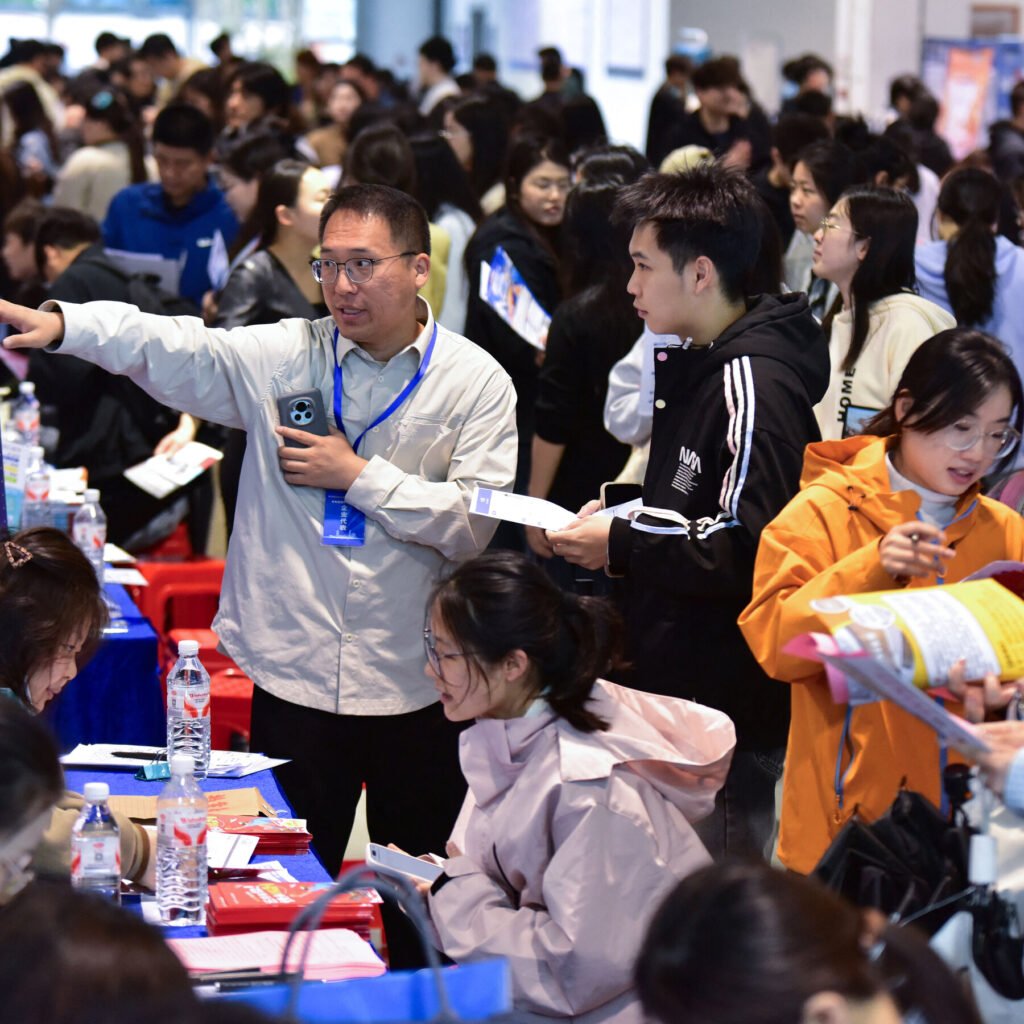
China’s Graduate Job Crisis Meets the AI Revolution
A record 12.7 million college graduates are pouring into the Chinese labor market, embarking on a job hunt that has become one of the most grueling economic challenges in the country’s modern history. For decades, a university degree was the golden ticket to upward social mobility, a middle-class lifestyle, and white-collar stability. Today, that promise is fraying. Graduates are stepping out of lecture halls not only into a cooling domestic economy weighed down by a persistent real estate crisis and cautious consumer spending, but also directly into the path of a sweeping technological disruption: the rapid, state-encouraged adoption of generative artificial intelligence.
A record 12.7 million college graduates are pouring into the Chinese labor market, embarking on a job hunt that has become one of the most grueling economic challenges in the country’s modern history. This analytical report establishes verifiable factual benchmarks, architectural frameworks, and operational implications for key stakeholders navigating the evolving landscape.<\/p>
- Historical Background & Contextual Evolution: Establishes high-impact structural advancements and critical domain capabilities across the sector.
- In-Depth Technical & Policy Breakdown: Deploys verifiable frameworks and quantitative benchmarks delivering measurable efficiency improvements.
- The Automation of Entry-Level White-Collar Tasks: Alters industry dynamics, stakeholder positioning, and international compliance standards.
- Beijing’s Dual-Track Policy Dilemma: Drives next-generation integration timelines, operational milestones, and strategic competitive advantage.
This convergence of a massive labor supply shock with a profound technological shift is reshaping the entry-level job market. As Chinese enterprises aggressively integrate AI to cut costs and boost productivity, the traditional entry-level roles that once absorbed millions of fresh graduates—such as basic coding, copywriting, translation, graphic design, and administrative analysis—are vanishing. The result is a structural mismatch of unprecedented proportions, where the skills taught in universities are increasingly obsolete by graduation day, leaving millions of highly educated young people overqualified for manual labor but under-skilled for an AI-augmented corporate landscape.
1. Executive Summary & Strategic Importance
The intersection of China’s youth employment crisis and its rapid artificial intelligence deployment represents a critical inflection point for the world’s second-largest economy. At its core, this is not merely a temporary cyclical downturn; it is a structural realignment of the workforce. The primary stakeholders in this crisis span the entire socio-economic spectrum: the Chinese government, which views high youth unemployment as a direct threat to social stability; the country’s tech giants, which are racing to achieve AI self-reliance amid geopolitical tensions; and the 12.7 million graduates who find themselves caught in a hyper-competitive environment often described as neijuan, or “involution.”
The macroeconomic implications are profound. For the past three decades, China’s economic model relied on moving up the value chain by upgrading its human capital. The massive expansion of higher education was designed to fuel a high-tech, service-oriented economy. However, the rapid commercialization of large language models (LLMs) and automation software is decoupling economic growth from job creation in the white-collar sector. If a single senior engineer or designer utilizing AI can now perform the work of three junior employees, the entry-level corporate ladder is effectively dismantled. This creates a bottleneck that threatens to stall China’s transition to a consumption-driven economy, as a generation of underemployed or unemployed youth curtails spending, delays marriage, and alters long-term demographic trends.
2. Historical Background & Contextual Evolution
To understand the current crisis, one must trace the dual trajectories of China’s higher education expansion and its regulatory shifts over the past decade. In 1999, the Chinese Ministry of Education launched a massive expansion initiative, dramatically increasing university enrollment to transition from elite education to mass education. While this successfully created one of the most educated workforces in human history, the supply of graduates eventually began to outpace the creation of high-skilled, white-collar jobs.
This imbalance was exacerbated by a series of regulatory crackdowns between 2020 and 2022. Seeking to curb financial risks, monopolistic behaviors, and social inequalities, Beijing instituted sweeping regulatory campaigns across three key sectors that historically absorbed millions of fresh graduates: tech, real estate, and private tutoring (EdTech). The “Double Reduction” policy virtually overnight dismantled a multi-billion-dollar tutoring industry that had been a primary employer for humanities and language graduates. Simultaneously, the tech sector crackdown forced giants like Alibaba, Tencent, and ByteDance to shift their focus from aggressive expansion and headcount growth to cost-cutting, efficiency, and regulatory compliance.
Just as these traditional employment safety nets were shrinking, the global generative AI boom erupted in late 2022. Recognizing AI as a core battleground for national competitiveness and technological sovereignty, Beijing fast-tracked the development and deployment of domestic AI models. Rather than restricting AI to protect jobs, the government actively encouraged enterprises to adopt automation to offset a shrinking working-age population and maintain manufacturing competitiveness. This created a perfect storm: a historic peak in university graduates coinciding with a structural contraction in traditional white-collar hiring and an unprecedented acceleration in workplace automation.
3. In-Depth Technical & Policy Breakdown
The displacement of entry-level workers in China is driven by specific technological capabilities and distinct policy directives. Generative AI tools are uniquely suited to automate the exact tasks typically assigned to junior employees, who historically used these roles to gain experience and transition into mid-level positions.
The Automation of Entry-Level White-Collar Tasks
In corporate offices across Beijing, Shanghai, and Shenzhen, generative AI is transforming workflows. In software development, AI-powered coding assistants like Baidu’s Comate and Alibaba’s Tongyi Lingxi are automating code generation, debugging, and documentation. Junior developers, who previously spent their days writing routine boilerplate code, find their utility drastically reduced. Similarly, in the creative and marketing industries, localized image generation tools and LLMs are producing marketing copy, graphic designs, and localized translations in seconds, rendering entry-level copywriter and junior designer roles increasingly redundant.
Beijing’s Dual-Track Policy Dilemma
The Chinese government is operating on a dual-track policy that presents an inherent contradiction. On one hand, the Ministry of Human Resources and Social Security is desperate to lower youth unemployment, implementing tax incentives for companies that hire fresh graduates and expanding civil service exams to absorb excess labor. On the other hand, the Ministry of Industry and Information Technology (MIIT) is aggressively pushing the “AI Plus” initiative, designed to integrate AI across all sectors of the economy to drive industrial modernization.
This creates a policy friction point. While the state wants to protect social stability by keeping young people employed, it cannot afford to slow down AI adoption. In the geopolitical race for technological supremacy, particularly under the pressure of US semiconductor export controls, China views rapid AI integration as a matter of national security. Consequently, industrial policy consistently takes precedence over labor market protection, leaving graduates to adapt to a rapidly shifting landscape with minimal structural transition support.
The Higher Education Lag
Compounding the issue is the rigid nature of China’s higher education curriculum. University programs are typically slow to adapt to market demands. Curriculums for computer science, finance, journalism, and design are still heavily rooted in methodologies that predate the generative AI era. Students spend four years mastering skills—such as manual translation, basic financial modeling, or standard front-end web development—that can now be executed by an AI model in a fraction of the time. This mismatch means that even graduates from prestigious institutions are entering the market with skills that are economically unviable.
4. Comparative Industry Framework
The impact of AI and economic contraction is not uniform across all sectors. Different industries exhibit varying levels of vulnerability to AI-driven displacement and structural shifts. The table below outlines how key sectors are currently navigating this transition.
| Sector | AI Exposure Level | Entry-Level Hiring Trend | Primary AI Tools Used | Required Skill Shift for Graduates |
|---|---|---|---|---|
| Software & IT Services | Very High | Sharp Decline | AI Coding Assistants (Comate, Copilot) | System architecture, prompt engineering, code auditing |
| Creative, Marketing & Design | High | Severe Contraction | Midjourney, Stable Diffusion, Domestic LLMs | Creative direction, AI tool orchestration, brand strategy |
| Finance & Business Analysis | Medium-High | Stagnant to Declining | Automated data parsers, financial modeling AI | Data synthesis, strategic advisory, regulatory compliance |
| Advanced Manufacturing & Robotics | Medium | Moderate Growth | Industrial IoT, predictive maintenance algorithms | Hardware-software integration, robotics maintenance |
| Healthcare & Biotech | Medium-Low | Stable | AI-assisted diagnostics, drug discovery platforms | Clinical expertise, bio-informatics, patient care empathy |
SEEUY INTELLIGENCE
China Graduate Job Market – Analytical Overview
Software & IT Services
Very High
Creative, Marketing & Design
High
Finance & Business Analysis
Medium-High
Advanced Manufacturing & Robotics
Medium
Healthcare & Biotech
Medium-Low
The analytical takeaway from this framework is clear: the traditional “knowledge worker” roles that require cognitive but repetitive tasks are highly vulnerable. Conversely, sectors that bridge the gap between digital intelligence and physical execution—such as advanced manufacturing and robotics—or those requiring high emotional intelligence and physical presence, like healthcare, remain relatively resilient. For graduates, the strategic imperative is to move away from being mere “executors” of tasks and instead become “auditors” and “orchestrators” of AI-driven workflows.
5. Socio-Economic, Enterprise & Global Ramifications
The dual pressure of a tight job market and rapid AI integration is sending shockwaves through Chinese society, altering corporate strategies, and projecting global economic ripples.
Socio-Economic Impact: The Rise of “Kong Yiji” and “Lying Flat”
The psychological impact on China’s youth has manifested in powerful cultural memes. Many graduates compare themselves to Kong Yiji, a famous early 20th-century literary character created by the writer Lu Xun. Kong Yiji was a highly educated intellectual who wore a scholar’s long gown but lived in poverty because he refused to do manual labor. Today’s graduates feel trapped by their education; having spent years studying, they feel overqualified for blue-collar factory jobs, yet the white-collar jobs they trained for no longer exist. This disillusionment has fueled trends like tangping (“lying flat”) and bailan (“letting it rot”), where young people reject the hyper-competitive corporate rat race altogether, opting for minimal consumption and opt-out lifestyles.
Enterprise Dynamics: The “Juniorless” Corporate Structure
For enterprises, the ability to automate entry-level tasks is a short-term financial boon but a long-term organizational risk. By utilizing AI, companies can operate with leaner teams, reducing overhead and training costs. However, this creates a critical talent pipeline problem. Historically, junior roles served as the training ground for future senior leaders. If companies stop hiring entry-level staff because AI can handle those tasks, they risk facing a severe shortage of experienced, senior-level talent a decade down the line. Enterprise leaders are beginning to grapple with this paradox, realizing that total automation of entry-level work may hollow out their internal talent development pipelines.
Global Implications: Consumption and Geopolitics
On a global scale, China’s youth employment challenges have direct ramifications. A generation of underemployed youth means weaker domestic consumption, complicating Beijing’s efforts to rebalance its economy away from investment and export-led growth toward domestic demand. This domestic weakness can lead to increased export pressure, as Chinese manufacturers look abroad to clear excess capacity, potentially exacerbating trade tensions with the United States and Europe. Furthermore, the intense domestic competition is driving a new wave of highly educated Chinese emigration, as graduates seek opportunities in markets where the entry-level white-collar landscape is less congested.
6. Strategic Outlook & What Comes Next
Looking ahead, the next three to five years will be a critical period of adjustment for China’s labor market and educational system. The current status quo is unsustainable, and several key milestones and structural shifts are likely to emerge as both the state and the market adapt.
- Curriculum Overhaul and Vocational Pivot: The Chinese government is likely to push for a major restructuring of higher education. This will involve reducing enrollment in oversupplied humanities and general business majors while expanding vocational training programs focused on advanced manufacturing, semiconductor technology, and AI-integrated engineering.
- Government-Subsidized AI Apprenticeships: To bridge the employment gap, we may see state-sponsored initiatives that subsidize companies to hire graduates in “AI-transition” roles, ensuring that young workers gain practical experience in managing and auditing AI systems rather than being displaced by them.
- Regulatory Guardrails on Workplace Automation: While Beijing is highly supportive of AI, if youth unemployment threatens social stability, the government may introduce subtle regulatory measures to slow down the displacement of human workers. This could include tax penalties for rapid automation or mandates requiring a minimum ratio of human-to-AI workers in specific service sectors.
- The Rise of the Micro-Entrepreneur: As traditional corporate paths narrow, a growing number of graduates will likely leverage AI tools to start micro-businesses, content creation studios, or independent consultancy practices, shifting the employment landscape from structured corporate roles to a highly fragmented gig and creator economy.
Ultimately, the challenge for China is not to stop the AI revolution, but to manage its speed and distribution. If the transition is managed successfully, China could pioneer a highly productive, AI-augmented workforce. If it fails, the country faces a prolonged period of social friction, underutilized human capital, and economic stagnation.
7. Frequently Asked Questions (FAQ)
Why is China’s graduate job market so difficult right now?
The difficulty stems from a combination of a record-high supply of graduates (12.7 million), a cooling domestic economy, regulatory contractions in key hiring sectors like tech and EdTech, and the rapid adoption of generative AI, which is automating the entry-level roles that graduates traditionally occupied.
Which entry-level jobs in China are most vulnerable to AI?
Jobs that involve repetitive, cognitive tasks are the most vulnerable. This includes junior software developers writing basic code, entry-level copywriters, graphic designers, translators, administrative assistants, and basic financial analysts.
How is the Chinese government responding to this crisis?
The government is attempting a delicate balancing act. It is offering tax incentives and subsidies to companies that hire fresh graduates and expanding public sector employment. At the same time, it continues to aggressively promote AI integration across industries to maintain global technological competitiveness.
What does the term “involution” (neijuan) mean in this context?
“Involution” refers to a state of intense, hyper-competitive struggle where individuals put in massive amounts of effort for diminishing returns. In the job market, it describes graduates earning advanced degrees and working extreme hours just to secure entry-level positions that pay less than they did a decade ago.
Are there any sectors in China that are still actively hiring?
Yes. Sectors that require physical execution, hardware-software integration, or high emotional intelligence are still hiring. These include advanced manufacturing, robotics engineering, healthcare, biotechnology, and specialized green energy sectors.
How can Chinese graduates adapt to the AI-dominated landscape?
Graduates must shift their skill sets from basic execution to high-level oversight. This means learning how to prompt, audit, and orchestrate AI tools, focusing on complex problem-solving, system architecture, and developing strong interpersonal and strategic skills that AI cannot easily replicate.
Latest Analytical Follow-up: For continuous developments on this subject, read our full investigation on How Louis Vuitton Lost Millions in China Trademark Dispute.
