
Trump’s Board of Peace Unveils $2.45bn Gaza Recovery Plan
The diplomatic theater of New York rarely aligns with the gritty, dust-choked reality of the Gaza Strip. Yet, on the sidelines of the UN General Assembly, the Trump administration’s newly minted Board of Peace attempted to bridge that gap, unveiling a highly anticipated Gaza recovery plan designed to kickstart reconstruction. The price tag for the immediate phase? A cool $2.45 billion.
The newly announced Gaza recovery plan is a $2.45 billion emergency initiative proposed by the Trump administration's Board of Peace. Spanning 66 programs over six months, it targets immediate humanitarian needs like housing, diesel power generation, and waste removal, though it remains stalled by funding shortages and political deadlocks.<\/p>
- Severe Funding Shortfall: While the Board of Peace announced a $2.45 billion immediate plan, only $280 million of the $18 billion in global pledges has actually been delivered.
- The Disarmament Deadlock: Reconstruction remains frozen because Israel demands the complete disarmament of Hamas before withdrawing, while Hamas insists on a phased withdrawal first.
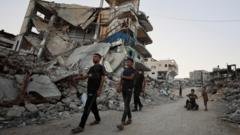
- Unprecedented Destruction: Over 80% of Gaza's infrastructure is damaged or destroyed, leaving 60 million tonnes of rubble and 1.9 million displaced people living in makeshift camps.
- Logistical Nightmares: Before rebuilding can start, teams must clear massive fields of unexploded ordnance and destroy hundreds of kilometers of underground tunnels.
The initiative, designed to roll out across 66 programs over a rapid six-month window, targets the absolute basics of survival: emergency housing, diesel power generation, and massive waste removal. But behind the shiny presentations and the high-profile attendees, a familiar, grim reality loomed over the proceedings. The money is not there. Not yet, anyway.
The Grand Ambition of the Board of Peace Trump Initiative
Established as the crown jewel of Donald Trump‘s broader 20-point peace initiative, the Board of Peace Trump created last year was supposed to represent a disruptive, business-minded approach to international conflict resolution. Instead of endless diplomatic communiqués, the board promised fast-paced, private-sector-style execution.
Yet, almost a year after Israel and Hamas agreed to a fragile, highly imperfect ceasefire, not a single brick of permanent reconstruction has been laid. The board’s own leadership was forced to acknowledge the massive chasm between diplomatic promises and actual bank balances. Of the $18 billion pledged by international donors, a meager $280 million has actually been transferred.
“The goal of today was really just to show you that we’re really fully committed to doing it,” conceded Jared Kushner, Trump’s son-in-law and a key member of the Gaza Executive Board. Kushner admitted the program faced “different delays on different things, for whatever reason,” offering a rare moment of candor in an otherwise highly choreographed rollout.
The scale of the challenge is hard to overstate. While the immediate six-month plan requires $2.45 billion, the long-term Gaza reconstruction cost is projected to reach an astronomical $71 billion over the next decade. It is a staggering sum that global donors are hesitant to write checks for without ironclad security guarantees.
The $71 Billion Math Problem: Pledges vs. Reality
To understand why the reconstruction effort is paralyzed, one must look at the balance sheet. The international community is wary of funding projects that could be reduced to rubble in the next outbreak of violence. This hesitation has created a severe liquidity crisis for the peace board.
| Funding Phase | Required Budget | Funds Secured / Delivered | Primary Focus Areas |
|---|---|---|---|
| Immediate Emergency Phase | $2.45 Billion | $280 Million | Temporary housing, diesel generators, waste management, ordnance clearance. |
| Mid-Term Recovery | $18.00 Billion (Pledged) | Pending Security Guarantees | Water infrastructure, schools, healthcare facilities, road networks. |
| 10-Year Total Reconstruction | $71.00 Billion (Estimated) | Unfunded | Permanent urban planning, economic zones, deep-water port integration. |
US Secretary of State Marco Rubio, speaking at a separate press conference, tried to put a positive spin on the fundraising deficit. He noted that “a number of countries have stepped forward” and that the board is actively “looking for more that will participate.” But without a clear path to stability, those pledges remain paper promises.
The Gaza Ceasefire Deadlock: The Disarmament Standoff
The primary roadblock to spending this money is not actually financial; it is political. The entire Gaza ceasefire deadlock hinges on a classic chicken-and-egg dilemma regarding security and sovereignty. Who blinks first?
Under the framework negotiated last year, Hamas agreed to return the remaining 48 hostages in exchange for Palestinian prisoners and agreed to hand over civil governance to a council of technocrats. In July, the group went a step further, accepting a phased disarmament plan on the condition that Israel withdraws its military forces from the 60% of Gaza it currently occupies.
Israeli Prime Minister Benjamin Netanyahu, however, has flatly rejected this sequence. Israel insists on the complete, verified disarmament of Hamas before a single soldier pulls back. For Hamas, surrendering their weapons before a withdrawal is tantamount to unconditional surrender. For Israel, withdrawing before disarmament invites a repeat of the October 7 attacks that triggered the war.
This geopolitical paralysis has left the 2.1 million residents of Gaza in a state of suspended animation. While the politicians argue in air-conditioned rooms in New York and Jerusalem, the situation on the ground continues to deteriorate.
Rubble, Tunnels, and Unexploded Bombs
Even if the political deadlock were resolved tomorrow, the physical reality of Gaza presents an unprecedented engineering nightmare. The war has left an estimated 80% of all structures in the territory damaged or destroyed. Over 60 million tonnes of rubble are piled across the strip—much of it contaminated with industrial toxins and human remains.
Michael Eisenberg, an Israeli-American member of the Board of Peace, laid out the daunting operational steps during an interview with the BBC. The process is not as simple as bringing in bulldozers and pouring concrete.
“Because it’s a war zone, you need to remove unexploded ordnance,” Eisenberg explained. “And then there are still hundreds of kilometres of tunnels underneath Gaza which need to be destroyed as well. Once that’s all done, Gazans can get to rebuilding again.”
This cleanup phase alone could take years. Meanwhile, more than 1.9 million people—nearly 90% of the population—remain displaced. Over 1.2 million of them are living in squalid tent cities with virtually no access to clean water, sanitation, or reliable electricity. It is a humanitarian catastrophe that is actively fueling the next cycle of radicalization.
A Fragile Peace on the Brink of Collapse
The current ceasefire, signed last October, has done little to bring real security. It is a peace in name only. Near-daily Israeli airstrikes continue to target suspected militant positions, and low-level skirmishes are common. </p
According to the Gaza health ministry, whose figures are verified and accepted by the United Nations, at least 1,408 Palestinians, including more than 300 children, have been killed in military actions since the ceasefire officially began. On the Israeli side, five soldiers and one civilian contractor have been killed in combat and operational accidents during the same period.
This persistent violence led Nickolay Mladenov, the Board of Peace’s high representative for Gaza, to issue a blistering critique of both Israeli military actions and Hamas’s continued insurgent tactics. Mladenov warned that the region is teetering on a knife-edge, stating that a total collapse of the ceasefire would represent “a point of no return” for Middle East peace diplomacy.
Can Business-Minded Diplomacy Succeed Where Politics Failed?
The Trump administration’s approach to the Middle East has always relied on economic leverage. The theory is simple: offer enough financial prosperity, and political grievances will melt away. The $2.45 billion recovery plan is the ultimate expression of this philosophy.</p
US envoy Steve Witkoff insisted that “real progress” has been made, pointing to the return of hostages and the existence of the ceasefire, however imperfect. “Humanitarian efforts have achieved historic results, with billions of dollars donated and pledged,” Witkoff argued in New York.
But critics point out that treating a deep-seated national and territorial conflict as a real estate development project ignores the emotional and historical realities of the region. A shiny new apartment building means very little to a population that has no freedom of movement, no sovereign state, and no guarantee that their new home won’t be targeted in the next military campaign.
The Board of Peace, which has since expanded its mandate to look at global conflicts, faces its ultimate test in Gaza. If it cannot convert its $18 billion in pledges into real, physical reconstruction, it risks becoming just another high-level talking shop—leaving the people of Gaza to survive in the ruins of a war that everyone claims they want to end.
<button type="button" onclick="this.parentElement.innerHTML='✓ Thank you, we will refine our analysis!‘” style=”background:#ffffff; border:1px solid #cbd5e1; border-radius:6px; padding:4px 12px; font-size:12px; cursor:pointer; color:#334155;”>👎 No
Latest Analytical Follow-up: For continuous developments on this subject, read our full investigation on Sabotage at Starlink Station in Poland Signals New Hybrid War.
