
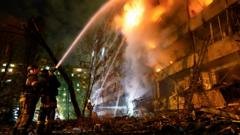
Russian Strikes Hit Kyiv Power Plant Amid Ceasefire Collapse
The night air above Ukraine’s capital tore open with the familiar, terrifying whistle of incoming ordnance. Seconds later, a deafening blast shuddered through the metropolitan core. Russian strikes hit Kyiv power plant facilities late Tuesday, dealing another devastating blow to an already battered municipal grid. President Volodymyr Zelensky confirmed that a critical energy installation supplying heat and electricity to thousands of families was directly targeted, alongside a nearby residential block where falling debris and blast waves claimed civilian lives.
A Russian ballistic missile strike hit the Darnytska CHP-4 power plant in Kyiv, destroying critical heating and electricity infrastructure. The attack occurred despite a recently announced US-brokered energy ceasefire, leaving two dead and over twenty injured in an adjacent residential building.<\/p>
- Infrastructure Devastation: The Darnytska CHP-4 facility, which supplies heat and electricity to hundreds of thousands of residents, sustained direct hits during a late-night ballistic missile barrage.
- Intelligence Gaps: Ukrainian President Volodymyr Zelensky criticized international partners for failing to provide early warnings regarding incoming ballistic trajectories.
- Ceasefire Fractured: The attack follows a tumultuous week that saw Donald Trump announce an energy ceasefire, which quickly dissolved amid persistent cross-border bombardments.
It is a stark, bloody reality check. Just days earlier, high-stakes diplomatic pronouncements from Washington suggested a temporary halt to energy sector targeting. Instead, explosions lit up the horizon for the second consecutive night, shattering any fragile illusions of a cooling conflict. Kyiv Mayor Vitali Klitschko reported a grim toll: two individuals killed and twenty-one wounded, with multiple victims fighting for survival in intensive care units.
The Shattered Silence of a Broken Accord
Diplomacy moves at a glacial pace, but war moves with ruthless velocity. Barely forty-eight hours had passed since US President Donald Trump declared that an energy ceasefire had been successfully brokered between Moscow and Kyiv. According to the White House, the temporary freeze was intended to de-escalate tensions and pave the way for broader political settlements. Yet, the battlefield wrote its own brutal terms almost immediately.
Zelensky did not mince words in his public addresses following the carnage. Pointing to the destruction of the Darnytska CHP-4 facility—commonly known as CHPP-4—the Ukrainian leader emphasized the profound asymmetry of the current engagement. Ukraine had signaled its willingness to abide by the energy freeze, he argued, while Russian forces systematically prioritized the total annihilation of municipal utilities.
“Ukraine supported an energy ceasefire. Russia is targeting yet another power plant and the lives of our people. This is absolutely unjust: when they are destroying our energy infrastructure, and Ukraine is not even receiving early warnings about ballistic missile launches.” — Volodymyr Zelensky, Ukrainian President
Industry insiders note that the psychological toll of these nocturnal raids often matches the physical devastation. When the lights go out and the heating fails in the dead of winter, the civilian population bears the brunt of the geopolitical standoff. According to reports compiled by outlets like Reuters, previous bombardments on this exact plant left over a thousand residential buildings, dozens of schools, and multiple medical institutions completely cut off from essential utilities.
Intelligence Sharing Under the Microscope
The timing of the strike has also ignited a firestorm of speculation regarding Western intelligence support. Following Monday night’s initial wave of missile attacks, rumors circulated through defense circles that Washington might have restricted Kyiv’s access to critical early-warning radar data and incoming tracking feeds.
The White House moved quickly to quash those whispers. President Trump addressed reporters earlier on Tuesday, flatly denying any deliberate withholding of military intelligence.
- Intelligence Access: The US administration maintains that critical tracking data continues to flow to Ukrainian defense operators.
- Ceasefire Ambiguity: Washington has acknowledged mutual violations, noting that Ukraine also struck various adversary sites in the days leading up to the announcement.
- Diplomatic Standoff: Both sides express a nominal desire for peace while remaining deadlocked on the tactical mechanisms required to achieve it.
When pressed directly on whether Moscow had fundamentally breached the newly minted agreement, Trump demurred. He suggested that both warring nations recognize the ultimate necessity of ending hostilities, even if neither side possesses a clear roadmap for how to cross that finish line.
Tactical Realities of the CHPP-4 Bombardment
To fully understand the gravity of Tuesday’s assault, one must examine the strategic footprint of the targeted facility. CHPP-4 is not merely an industrial building; it is a vital metabolic organ for eastern Kyiv. Operating complex combined heat and power systems requires precise engineering, specialized replacement parts, and uninterrupted structural integrity—all of which have become exceedingly rare commodities under continuous bombardment.
| Incident Timeline | Target Facility | Primary Impact |
|---|---|---|
| February 2025 | Darnytska CHP-4 | Severe structural damage; shut down heating for over 1,000 residential blocks. |
| Sunday Announcement | N/A | US President Donald Trump announces a proposed 60-day energy ceasefire. |
| Tuesday Night | Darnytska CHP-4 & Residential Block | Renewed ballistic missile strikes; 2 dead, 21 injured, critical power grid damage. |
Meanwhile, the diplomatic fallout extends far beyond Washington and Kyiv. Russian Foreign Minister Sergey Lavrov forcefully dismissed the concept of a prolonged respite, arguing that any temporary pause in fighting would simply allow European allies to flood Ukraine’s logistical supply lines with advanced weaponry.
As the smoke clears over the Darnytski district and municipal repair crews rush into the subterranean tunnels to patch severed steam lines, the overarching narrative remains grim. The gap between diplomatic optimism on the world stage and the thunderous reality on the ground has never felt wider. For the citizens bracing against the chill of a darkened apartment block, the war is not a theoretical debate over ceasefires—it is a minute-by-minute fight for survival.
<button type="button" onclick="this.parentElement.innerHTML='✓ Thank you, we will refine our analysis!‘” style=”background:#ffffff; border:1px solid #cbd5e1; border-radius:6px; padding:4px 12px; font-size:12px; cursor:pointer; color:#334155;”>👎 No
Latest Analytical Follow-up: For continuous developments on this subject, read our full investigation on Australia Michelin stars arrive in South Australia.
Latest Analytical Follow-up: For continuous developments on this subject, read our full investigation on Trump Waives Russia Sanctions Amid Deepening Ukraine Row.
