
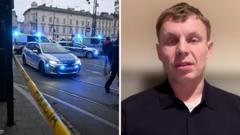
Krakow Shooting Victims: Hero Doctor’s Moral Stand
When gunfire shattered the weekend quiet near Krakow’s historic Main Market Square, saving Krakow shooting victims became a matter of seconds rather than minutes. The ancient cobblestones, typically filled with tourists and cafe diners, suddenly turned into a high-stakes trauma bay. Six people lost their lives, and 15 others suffered severe injuries in a horrific, unprovoked assault that has rattled Poland’s cultural capital.
During the tragic active shooter incident near Krakow's Main Market Square, off-duty surgeons including Professor Michal Pędziwiatr immediately rendered aid to Krakow shooting victims, wounded police officers, and the gunman. Their response highlights strict adherence to medical ethics and rapid active shooter emergency triage regardless of patient identity during violent mass casualties.<\/p>
- Immediate Civilian Intervention: Off-duty medical professionals stabilized critically injured patients minutes before municipal emergency crews arrived at the scene.
- Ethical Neutrality in Trauma Care: Medical teams applied trauma surgery ethics uniformly, treating wounded officers, bystanders, and the perpetrator without discrimination.
- Systemic Stress Test: The event forced local emergency response units to rapidly coordinate multi-agency logistics in historic urban infrastructure.
- Psychological Aftermath: First responders face profound psychological demands when transitioning instantly from personal leisure to high-stakes combat casualty care.
Yet, amidst the terror, human resilience surged forward. Professor Michal Pędziwiatr, a veteran surgeon dining nearby with a colleague, did not run for safety. He ran toward the muzzle flash. What followed was a masterclass in split-second medical judgment, professional detachment, and raw humanity.
Blood on the Cobblestones: Minutes of Chaos
The attack began without warning. A gunman opened fire indiscriminately, catching crowds off guard in one of Europe’s largest medieval town squares. Screams echoed against the Renaissance facade of the Cloth Hall. Panicking crowds sought cover behind restaurant tables and inside narrow alleyways.
Pędziwiatr and his fellow doctor recognized the distinct sound of high-caliber fire instantly. Within moments, instincts honed over decades in high-volume trauma centers took complete control. They did not wait for law enforcement to declare the zone fully secure.
“We rushed into the area and started our rescue,” Pędziwiatr recalled in a recent interview. The pair moved methodically from one fallen figure to the next. They improvised tourniquets using leather belts, applied direct pressure to arterial wounds, and cleared blocked airways with bare hands. Their immediate intervention stopped cataclysmic blood loss for several casualties who would have otherwise succumbed before professional paramedic rigs could navigate the narrow, crowded streets.
Caring for Krakow Shooting Victims: Radical Medical Ethics
As police tactical teams swarmed the square, heavy exchange of fire ensued. Two responding officers sustained severe injuries while neutralizing the threat. When the dust settled, the shooter lay immobilized on the ground alongside those he had targeted. This is where professional duty met profound moral complexity.
Without hesitation, Pędziwiatr treated the injured law enforcement officers—and then turned directly to stabilize the perpetrator. In the heat of violence, medical logic overrides personal emotion. Trauma care is binary: live or die, bleed out or stabilize.
“I treat all these people like they are victims,” Pędziwiatr stated simply, reflecting the unyielding code of medical ethics under fire. “When a patient is bleeding in front of you, you do not ask for their background, their motives, or their morality. You only see human tissue that requires immediate repair.”
This unwavering stance underscores the foundational principle of trauma surgery ethics. Medical professionals are trained to act without prejudice, even when facing individuals responsible for immense devastation. According to international protocols highlighted by Reuters health security reports, maintaining strict medical neutrality during mass casualty events is vital for preserving operational order and public trust.
Triage Under Extreme Conditions
Performing active shooter emergency triage outside the sterile environment of an operating room forces physicians to make brutal calculations. Resources are limited. Time is the ultimate enemy. Pędziwiatr and his colleague had to instantly categorize victims based on physiological viability:
- Immediate (Red Tag): Critical arterial bleeding, compromised airways, and tension pneumothorax requiring instantly life-saving intervention.
- Delayed (Yellow Tag): Serious fractures and deep lacerations with controlled bleeding.
- Minimal (Green Tag): Superficial wounds capable of self-care or delayed treatment.
- Expectant (Black Tag): Injuries inconsistent with life under available field conditions.
In this chaotic landscape, treating the shooter alongside his victims was not a political or moral judgment—it was a clinical mandate based purely on medical necessity.
Evaluating the Krakow Mass Shooting Response
Mass casualty events in historic urban centers present extreme logistical hurdles. Narrow pedestrian streets, restricted vehicle access, and dense crowds delay standard emergency apparatus. The improvised action taken by off-duty medical personnel bridged the critical lapse between initial panic and formal medical deployment.
Emergency infrastructure protocols across Europe are increasingly adapting to decentralized terror and active shooter scenarios. A look at operational metrics during street-level trauma incidents reveals the vital importance of immediate point-of-injury care:
| Operational Phase | Standard Municipal Protocol | Krakow Active Incident Reality | Strategic Impact |
|---|---|---|---|
| Initial Scene Triage | 4 to 8 minutes post-dispatch arrival | 0 to 2 minutes (Off-duty physicians on scene) | Prevented fatal hypovolemic shock in critical cases. |
| Hemorrhage Control | Paramedic equipment kits | Improvised field dressings & direct pressure | Stabilized major vascular injuries before transport. |
| Perpetrator Neutralization | Armed tactical unit perimeter breach | Immediate police engagement within public zone | Minimized further civilian casualties in open square. |
| Evacuation Routing | Designated medical corridors | Manual transport through historic pedestrian paths | Required rapid coordination across multiple agencies. |
The swift action executed during the Krakow mass shooting response highlights a growing reality in modern emergency planning: bystanders and off-duty specialists are often the true first responders.
The Psychological Burden on Medical Professionals
Trauma surgeons are accustomed to blood, surgical drains, and life-or-death decisions. However, encountering severe violence outside the controlled walls of a hospital setting introduces unique psychological strain. Transitioning from a quiet weekend meal to a bloody battleground within seconds leaves deep mental scars.
Psychiatric experts who study trauma recovery emphasize that treating perpetrators creates intense moral injury for caregivers. Reconciling professional duty with emotional revulsion requires massive mental discipline. Yet, surgeons like Pędziwiatr view their role as absolute.
When asked how he processed managing the life of the person who brought terror to his city, Pędziwiatr remained steadfast. To him, the human body on the operating table is an assembly of organs, blood vessels, and bone. Moral judgment belongs in a court of law; clinical judgment belongs at the bedside.
Broader Implications for Urban Safety and Medical Readiness
The tragic events in Krakow serve as a sobering reminder for global metropolitan areas. Security strategies must extend beyond physical policing to encompass rapid public health response mechanisms. Training healthcare personnel in civilian active-shooter response, encouraging public access to bleeding control kits, and establishing clear protocols for multi-agency communication are essential elements of modern municipal safety.
As Krakow mourns the six lives lost in this senseless tragedy, the courage shown by Professor Pędziwiatr and his medical colleague stands out as an enduring testament to professional integrity. Their actions saved lives, stabilized a catastrophic scene, and demonstrated that even in the darkest moments of public violence, human decency and medical ethics can remain unyielding.
<button type="button" onclick="this.parentElement.innerHTML='✓ Thank you, we will refine our analysis!‘” style=”background:#ffffff; border:1px solid #cbd5e1; border-radius:6px; padding:4px 12px; font-size:12px; cursor:pointer; color:#334155;”>👎 No
