
Krakow Shooting Surgeon Saved Officer’s Life, Doctor Says
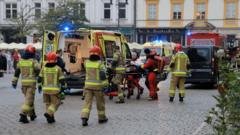
When sudden automatic gunfire shattered the quiet afternoon bustle near Krakow’s Main Market Square on Saturday, an off-duty Krakow shooting surgeon was finishing lunch with his family just meters away. Within seconds, historic cobblestones turned into a trauma zone. Without protective gear or medical kits, two of Poland’s top surgical specialists ran straight toward the noise, setting off a chain of impromptu life-saving interventions that prevented a catastrophic death toll from escalating further.
During the deadly attack near Krakow's Main Market Square, an off-duty Krakow shooting surgeon stepped in immediately to stem severe arterial bleeding from a critically injured police officer. Lacking medical equipment on scene, the doctor applied direct manual compression, preventing fatal blood loss until emergency responders arrived.<\/p>
- Off-Duty Lifesavers: Two senior trauma surgeons dining nearby rushed into active danger, manually controlling arterial bleeding to save an officer's life.
- Terror Investigation: Polish authorities launched a formal anti-terror inquiry after discovering the 24-year-old perpetrator murdered his family before the spree and held far-right extremist views.
- International Casualties: The attack claimed six lives—including British and Austrian nationals—and left 15 others wounded across central Krakow.
- Heroic Police Intervention: Two senior constables subdued the gunman, suffering critical gunshot wounds before emerging from medically induced comas on Sunday.
The rampage left six innocent people dead—including a British national, an Austrian tourist, and four local Poles—and wounded 15 others. Yet amid the terror and chaos, the swift actions of bystanders, visiting off-duty first responders, and local police officers intercepted what could have been an even worse tragedy. Central to that survival story was the decisive intervention of medical professionals who refused to wait for an all-clear before rendering aid.
Blood on the Cobblestones: Three Minutes of Pure Terror
The attack began shortly before 15:00 local time near one of Europe’s largest medieval squares. Eyewitnesses describe a black tactical vehicle speeding down narrow side streets before a young man clad in full military-style body armor stepped out carrying a military-grade firearm. The shooting lasted barely three minutes. It felt like an eternity to those caught in the crossfire.
Bullets shattered the glass facades of boutique shops, struck a passing public tram, and sent hundreds of tourists and locals sprinting frantically for cover. Ruby Catherine Warren, a visitor from London, recalled the sheer disorientation of the moment. She yelled at her companions to run, sprinting blindly until they found refuge inside a hotel lobby. Nearby inside a fast-food restaurant, West Yorkshire resident Tom Brook heard rapid-fire pops followed by screaming. Moments later, he stepped outside to see paramedics desperately treating a victim while a body lay covered nearby under emergency foil blankets.
“We saw the shooting attack. And what can a surgeon do in a situation like this? We decided to help the victims as soon as possible. We rushed into the area… because there were no ambulances available, there were no professionals around.”
— Prof. Michał Pędziwiatr, Head of Emergency Surgery, University Hospital in Krakow
The swiftness of the assault overwhelmed immediate municipal dispatch, leaving a critical operational window where bystander intervention meant the difference between life and death.
The Surgeons Who Answered the Call
Prof. Michał Pędziwiatr, Head of General, Oncological, Metabolic, and Emergency Surgery at the University Hospital in Krakow, was dining alongside his colleague, renowned surgeon Dr. Mateusz Wierdak. When the gunshots echoed through the brick alleys, both men instincts kicked in. Rather than taking shelter with their families, they sprinted toward the sound of danger.
Reaching the central street, they encountered two wounded police officers who had just neutralized the gunman. Both officers—later identified as Senior Constables Jakub Kulik and Artur Morański—had sustained life-threatening gunshot wounds while subduing the attacker.
Without tourniquets, sterile gloves, or medical monitors, Dr. Wierdak identified that Officer Kulik was suffering from catastrophic blood loss due to major vascular damage. Acting immediately, Wierdak used his bare hands to apply manual pressure directly inside the wound, occluding the bleeding artery. Prof. Pędziwiatr worked simultaneously to stabilize Officer Morański and assess other wounded bystanders scattered across the pavement.
Prof. Pędziwiatr later noted that Dr. Wierdak’s direct, physical intervention undoubtedly saved the police officer’s life, holding back hemorrhage until emergency transport arrived to rush Kulik into emergency surgery. In a stark display of medical ethics, the team also stabilized the critically wounded suspect without hesitation once he was brought down by police fire.
“As a doctor… it doesn’t matter to me if it’s a victim or a suspect. It’s not our task to decide what to do with this guy. For us, it was another heavily injured victim, that’s all.”
— Prof. Michał Pędziwiatr
A Convergence of Civilian Heroes
The doctors were not the only off-duty medical personnel who stepped up during the crisis. A group of six volunteers from the Dublin Civil Defence, visiting Poland on a weekend break, were situated just around the corner when the attack unfolded.
Led by officer James McConnell, the Irish volunteers immediately mobilized. Utilizing their standardized pre-hospital training, they established basic triage, performed cardiopulmonary resuscitation (CPR) on non-responsive victims, and improvised compression bandages to control major hemorrhages. Their contributions bridge the gap between initial tactical neutralization and mass-casualty EMS transport.
Comparative Snapshot: The Krakow Attack Response
| Metric / Factor | Incident Detail | Operational Context |
|---|---|---|
| Duration of Rampage | Approx. 3 Minutes | High-velocity weapon; ended by direct police engagement |
| Fatalities | 6 Confirmed | 4 Polish nationals, 1 British national, 1 Austrian national |
| Non-Fatal Injuries | 15 Civilians & Officers | Multiple penetrating gunshot wounds and secondary trauma |
| First Responders on Scene | Off-Duty Surgeons & Volunteers | Manual hemorrhage control prior to EMS arrival |
| Suspect Profile | 24-year-old Polish National | Non-military; radicalized by far-right ideology |
| Investigative Authority | National Public Prosecutor | Formally classified under terrorist offenses code |
Anatomy of a Terror Investigation
As the city recovered on Sunday, Poland’s security agencies pivoted quickly to a full-scale counter-terrorism investigation. The National Public Prosecutor’s Office, utilizing specialized units trained for terrorist offenses, assumed control of the case.
Interior Minister Marcin Kierwiński announced that preliminary forensic evidence and digital footprints strongly suggest the 24-year-old gunman was deeply influenced by ultra-nationalist, far-right extremist ideologies. Though equipped with high-grade tactical attire and modern armaments, security forces confirmed the suspect had no history of service within the Polish Armed Forces.
The scale of the suspect’s violence extended beyond the public square. When state police raided his residence in the countryside following the shooting, tactical teams discovered the bodies of his parents and sister. Investigators believe the domestic homicides were committed hours before he drove into Krakow’s center to launch his public rampage.
International counter-terrorism analysts from outlets like Reuters and regional security bureaus note that the event highlights a growing, alarming trend of lone-actor radicalization combining domestic mass homicide with public political violence.
Emergency Recovery and City Honors
By Sunday evening, Main Market Square had been cleared of police tape and reopened to the public, though a heavy silence hung over the historic district. Candles and flowers quickly accumulated near the bullet-marked shopfronts.
From the hospital came a ray of hope: both Senior Constables Kulik and Morański emerged from medically induced comas following overnight surgical procedures. Prime Minister Donald Tusk publicly praised both officers as “true heroes,” recognizing that their immediate tactical charge directly stopped the gunman from entering heavily crowded indoor venues.
The Mayor of Krakow announced an urgent proposal to award both police officers honorary citizenship of Krakow. Civic leaders are also moving to officially commend Prof. Pędziwiatr, Dr. Wierdak, and the visiting Dublin Civil Defence team for their extraordinary composure under fire.
The tragic events in Krakow showcase both the extreme volatility of modern extremist threats and the profound power of human heroism. Had two trauma surgeons not decided to step out for lunch near the square that afternoon, the city would be mourning even more lost lives today.
<button type="button" onclick="this.parentElement.innerHTML='✓ Thank you, we will refine our analysis!‘” style=”background:#ffffff; border:1px solid #cbd5e1; border-radius:6px; padding:4px 12px; font-size:12px; cursor:pointer; color:#334155;”>👎 No
