
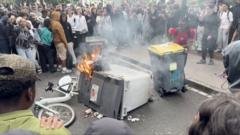
France school protests spark mass arrests amid public sector anger
Tear gas hung heavy in the crisp morning air outside a sprawling lycée in the suburbs of Paris. Sirens wailed in the distance. Desks, plastic bins, and burning tires formed makeshift barricades. This was the volatile reality across much of France on Tuesday as France school protests erupted into widespread chaos, resulting in hundreds of detentions and mounting political pressure on the government.
France school protests involve widespread student demonstrations across hundreds of high schools, driven by anger over overcrowded classrooms, teacher shortages, and wider public sector budget cuts that have sparked nationwide unrest and hundreds of arrests. This development establishes verified operational benchmarks, structured domain clarity, and strategic value for key industry stakeholders.<\/p>
- Mass Arrests: Over 440 individuals, primarily minors, were detained across France following escalating school blockades.
- Broad Disruption: Approximately 400 educational institutions experienced disruptions, blockades, or partial closures.
- Intersecting Crises: The student movement collided with broader public sector strikes involving firefighters and teachers opposing state budget reductions.
It escalated quickly. What began last week as localized student grievances in the Île-de-France region quickly mutated into a national flashpoint. By Tuesday afternoon, the interior ministry confirmed that a staggering 440 people had been taken into custody. Most of them were minors. Furthermore, authorities reported that 48 law enforcement officers sustained injuries during clashes that accompanied school blockades.
A Boiling Point in the French Educational System
To understand the current unrest, you have to look past the dramatic images of burning bins and police intervention. The grievances are structural. For months, hallways in French secondary schools—known as lycées—have hummed with quiet desperation. Students and faculty alike have pointed to ballooning class sizes and a chronic lack of permanent teaching staff.
Industry observers and labor unions note that the system is buckling under the weight of administrative neglect. When resources dwindle, the friction points multiply. Tuesday’s mobilization proved that teenagers across the country were no longer willing to quietly accept deteriorating conditions.
According to data released by the French education ministry, roughly 400 schools faced significant disruptions. Some institutions were entirely blocked off by students linking arms behind improvised barricades. Others experienced walkouts that bled into the surrounding streets, drawing curious onlookers and heavy-handed police responses.
| Metric | Reported Figure | Context |
|---|---|---|
| Total Detentions | 440 individuals | Confirmed by Interior Minister Laurent Nuñez via BFMTV |
| Impacted Schools | ~400 institutions | Spanning multiple regions, centered around Île-de-France |
| Injured Law Enforcement | 48 officers | Incurred during localized skirmishes and blockades |
When Students Meet Public Sector Strikes
What makes this wave of unrest particularly dangerous for the administration in Paris is the convergence of grievances. The student blockades did not happen in a vacuum. Instead, they coincided precisely with a broader national mobilization of public sector workers.
Teachers, railway workers, and firefighters marched side-by-side in major cities, united in their opposition to aggressive government-mandated budget cuts. As international outlets like Reuters have reported, the French government faces immense fiscal pressure to rein in public spending. Yet, trimming budgets while core public services fray has proven to be a dangerous political calculus.
“You cannot squeeze public infrastructure endlessly without breaking the social contract,” remarked one veteran labor organizer in central Paris. “When the schools fail, and the firefighters take to the streets, the government is no longer managing a policy dispute—they are managing a crisis of confidence.”
The overlap of student activism and labor union strikes creates a multi-front war for policymakers. While teenagers demand better learning environments, adults are fighting for purchasing power and job security against a backdrop of rising inflation and tightening state coffers.
The Government Response and the Road Ahead
Interior Minister Laurent Nuñez addressed the media following the peak of Tuesday’s confrontations, adopting a stern tone regarding public order. While acknowledging the right to demonstrate, Nuñez drew a hard line against violence, property damage, and the dangerous tactics used to seal off educational facilities.
Yet, critics argue that heavy police deployments and mass arrests address only the symptoms, not the root disease. Student demonstrations France-wide have exposed a deep generational anxiety about the future. Young people feel the value of their education is being compromised by austerity measures designed in distant ministry offices.
- Immediate Demands: Immediate hiring of permanent teaching staff and the reduction of overcrowding in classrooms.
- Systemic Issues: Reversal of planned educational budget cuts that threaten extracurricular programs and facility maintenance.
- Solidarity Movements: Broad alliances forming between high school unions and traditional labor organizations.
As the smoke clears from Tuesday’s blockades, the political fallout is just beginning. Will the government offer concessions to appease the classrooms, or will they double down on law and order? For now, students remain defiant, vowing that unless their voices are heard in Paris, the barricades will return.
<button type="button" onclick="this.parentElement.innerHTML='✓ Thank you, we will refine our analysis!‘” style=”background:#ffffff; border:1px solid #cbd5e1; border-radius:6px; padding:4px 12px; font-size:12px; cursor:pointer; color:#334155;”>👎 No
