
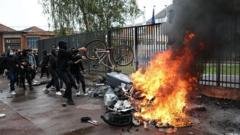
France Student Protests Escalate: Over 400 Detained
The smell of burning plastic and tear gas hung heavy over the boulevards of Paris this Tuesday. What began as localized, sporadic walkouts has rapidly transformed into a nationwide crisis. The ongoing France student protests have escalated dramatically, culminating in the detention of more than 400 people—the vast majority of them minors. High schools across the country are now battlegrounds for a generation that feels abandoned by the state.
The latest France student protests have escalated due to systemic issues in the national education system, including severe teacher shortages and overcrowded classrooms. High school students across the country have blockaded hundreds of lycées, resulting in clashes with police, over 400 detentions, and dozens of injuries among both demonstrators and law enforcement officers.<\/p>
- Mass Detentions: Over 400 individuals, predominantly minors, were taken into custody on Tuesday as demonstrations spread across French high schools.
- Systemic Grievances: Students are protesting overcrowded classrooms, averaging 34 pupils per class, alongside a chronic shortage of qualified teachers.
- Widespread Disruption: The French education ministry confirmed that at least 400 schools nationwide were impacted by blockades and demonstrations.
- Broader Social Unrest: The student actions coincided with a massive national strike involving over 200,000 civil servants, teachers, and healthcare workers.
For days, teenagers have erected makeshift barricades outside their schools, using wheelie bins, metal fences, and wooden pallets to halt classes. The movement, which initially flared up in the working-class suburbs of the Île-de-France region, has now spread to major cities like Lille, Lyon, and Marseille. According to the French education ministry, at least 400 schools have been disrupted by these intense blockades.
‘We are not here to smash things up for fun,’ explained a 16-year-old student blockading her school in Lille. ‘We are here because the system is completely broken. There are 34 of us in a single classroom. It is impossible to learn, and our teachers are completely burned out.’
This sentiment is echoing across the country, highlighting a deep-seated frustration with the state of public services in France. The government, however, is viewing the situation through a lens of public order, warning that the line between democratic protest and outright lawlessness has been crossed.
The Boiling Point: Inside the French Education System Crisis
To understand the ferocity of these protests, one must look closely at the structural decay of the French education system crisis. For years, successive governments have attempted to reform the secondary education sector, often resulting in budget cuts, staff reductions, and administrative bottlenecks. The current wave of anger is the direct result of these compounding pressures.
Classroom sizes have swelled to levels that educators describe as unmanageable. In many urban lycées, it is now common to find 35 or more students crammed into rooms designed for 25. This overcrowding is compounded by a chronic shortage of teachers. Due to low starting salaries and increasingly difficult working conditions, the French state has struggled to recruit new educators, leaving thousands of classrooms without permanent teachers for months at a time.
The situation has created an environment of mutual exhaustion. Students feel they are receiving a sub-standard education, while teachers are pushed to their psychological limits. The current protests are not merely a reaction to policy; they are a cry for help from inside a collapsing institution.
The Anatomy of the Lycée Blockades in Paris and Beyond
The tactical heart of this movement lies in the lycée blockades Paris has witnessed over the past week. These blockades are highly organized, often coordinated via social media platforms like TikTok and Telegram. Students gather in the early hours of the morning, long before school administrators arrive, to secure the entrances with heavy chain links and piles of refuse.
While many of these demonstrations begin peacefully, tension inevitably rises when police arrive to clear the blockades. On Tuesday, scenes of chaos played out across the country. In several Parisian neighborhoods, groups of youths clashed with riot police, throwing glass bottles and fireworks. Officers responded with baton charges and repeated volleys of tear gas, dispersing crowds of teenagers into narrow side streets.
The physical toll of Tuesday’s clashes is stark. Officials confirmed that at least 48 law enforcement officers were injured during the demonstrations. In addition, at least ten teachers and dozens of students required medical attention for injuries sustained during the melees or from the inhalation of tear gas. The scale of the unrest has shocked a public accustomed to social mobilization but rarely to this level of intensity among school-aged children.
A Hardline Stance: The Police Response to French Protests
The severity of the law enforcement crackdown has sparked intense political debate. Critics from the left-wing opposition have accused the government of using excessive force against minors, pointing to videos of tear gas being deployed directly outside school gates. The police response to French protests has become a lightning rod for controversy, raising questions about the limits of state authority when dealing with teenagers.
Ryad Rani, president of the Union Syndicale Lycéenne, which represents high school students, did not mince his words when addressing the media. He accused the government of choosing ‘repression over dialogue’ and using heavy-handed tactics to silence legitimate grievances. ‘These are children asking for books and teachers, and they are being met with batons and handcuffs,’ Rani told reporters.
However, Paris Police Chief Laurent Nuñez defended the actions of his officers. Speaking to BFMTV, Nuñez insisted that the police response had been ‘carried out in an extremely proportionate manner’ given the level of violence directed at law enforcement. He confirmed that of the 440 people detained on Tuesday, approximately two-thirds were placed in formal police custody, reflecting the serious nature of the charges, which include arson, property damage, and violence against public officials.
To provide a clearer picture of how the current unrest compares to historical student movements in France, the table below outlines key metrics from recent major mobilizations:
| Year / Movement | Primary Grievance | Estimated Schools Affected | Average Daily Detentions | Government Response |
|---|---|---|---|---|
| 2018 (Parcoursup Protests) | University admission reforms | Approx. 300 lycées | 150 – 200 | Partial policy adjustments, police intervention |
| 2023 (Pension Reform Solidarity) | Retirement age increase | Approx. 150 lycées | 80 – 100 | Strict policing, minor concessions |
| Current (Education Crisis) | Overcrowding & teacher shortages | Over 400 lycées | 400+ (Peak Tuesday) | High-level condemnation, widespread detentions |
The Convergence of Anger: A National Strike in France
The student rebellion does not exist in a vacuum. It has coincided with a massive national strike France is currently weathering, organized by a coalition of public sector unions. On Tuesday, over 200,000 civil servants, hospital staff, and primary school teachers marched through major cities to protest against low wages, high inflation, and deteriorating working conditions.
This convergence of student anger and labor unrest represents a significant threat to the administration of Prime Minister Sébastien Lecornu. While the adult-led union marches were largely peaceful, the chaotic energy of the high school blockades has injected an unpredictable element into the broader social movement. There is a growing fear within the government that the two movements could merge, creating a unified front of social opposition that would be incredibly difficult to contain.
According to Reuters reporting, the French government is desperate to prevent a repeat of the 2018 ‘Yellow Vest’ crisis, which paralyzed the country for months. By taking a hard line against the student blockades early on, ministers hope to deter more moderate students from joining the fray and prevent the protests from gaining further momentum.
Political High Stakes: Lecornu’s Warning and the Path Forward
The political rhetoric surrounding the protests has reached a fever pitch. Prime Minister Sébastien Lecornu issued a stern warning to the public, labeling any further escalation of the school blockades as ‘irresponsible.’ Taking to social media, Lecornu pointed to the use of fireworks and deliberate acts of arson near school buildings, stating that ‘nothing justifies endangering students, staff, or police officers.’
Education Minister Édouard Geffray echoed these sentiments, emphasizing that while the right to protest is a fundamental democratic freedom, it cannot be used as a shield for violence and vandalism. He warned that those calling for an extension of the blockades are actively endangering the lives of students and public employees.
Yet, for many observers, the government’s focus on law and order fails to address the root cause of the crisis. As noted in a recent Bloomberg analysis, unless the French state commits to significant, long-term financial investment in public education, temporary police crackdowns will do little to soothe the underlying anger of a generation that feels its future is being compromised.
As night fell over Paris, the barricades were cleared, but the tension remained palpable. With student unions calling for continued mobilization and public sector workers planning further strikes, France’s winter of discontent shows no signs of thawing. The coming days will test not only the resilience of the French education system but also the political survival of a government caught between the demands of its youth and the maintenance of public order.
<button type="button" onclick="this.parentElement.innerHTML='✓ Thank you, we will refine our analysis!‘” style=”background:#ffffff; border:1px solid #cbd5e1; border-radius:6px; padding:4px 12px; font-size:12px; cursor:pointer; color:#334155;”>👎 No
