
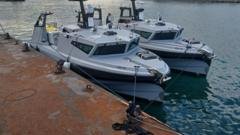
Robot vessels transform dangerous maritime mine hunting at sea
Traversing the Strait of Hormuz remains one of the most perilous trips a commercial vessel can take. Despite active patrols and assistance from the US Navy, merchant ships continue to face asymmetric threats from the air and beneath the surface. To transit these troubled waters, shipping companies require absolute agreement between captains and crews to absorb the severe risks, alongside exorbitant war risk insurance policies.
Robot vessels are autonomous or uncrewed marine craft equipped with advanced sonar, AI-driven data processing, and remote monitoring systems. They locate, track, and neutralize sea mines in hazardous areas like the Strait of Hormuz, drastically reducing human casualties and operational risks for global navies.<\/p>
- Autonomous Removal: Robot vessels take human sailors out of the direct line of fire during high-risk maritime mine hunting operations.
- Economic Warfare: Sea mines remain an inexpensive yet devastating tool to disrupt global tanker fleets and paralyze commercial shipping lanes.
- Cognitive Architecture: Future naval success relies on integrating uncrewed platforms as dynamic applications within a distributed force network.
- Psychological Impact: Beyond physical destruction, the sheer uncertainty of hidden ordnance creates immense fear that autonomous systems are designed to mitigate.
Underneath the surface, silent hazards lurk. Modern sea mines rest quietly on the seabed, designed to detonate when they detect acoustic or magnetic signatures from a passing hull. Others rise through shallow waters, float freely, or are actively powered toward targets. As maritime experts frequently point out, the underlying technology is neither complex nor expensive, yet the mere psychological threat of a mined shipping lane is enough to completely paralyze a global tanker fleet.
Finding these hidden underwater explosives has traditionally fallen to specialist mine-hunting vessels carrying large crews of roughly 80 sailors. Today, however, naval forces are pivoting rapidly. To keep humans entirely out of harm’s way, an increasing share of the workload is handled by robot vessels monitored remotely from secure shore stations.
The Evolution of Maritime Mine Hunting
For decades, navies have experimented with autonomous underwater technology. During the 2003 Iraq war, the US Navy deployed a torpedo-shaped robot known as the Remus 100 to map the seabed. Pinging the murky depths with sonar down to around 100 feet, these early machines spared human divers from navigating treacherous underwater environments.
The latest geopolitical flashpoints in the Gulf are testing vastly more capable platforms. While major military powers remain tight-lipped about their full inventory, high-profile incidents have pulled the curtain back on modern naval drone technology. Iranian forces notably hauled an uncrewed US autonomous submarine out of the waters of the Strait of Hormuz, sparking intense international interest. Although the Pentagon downplayed the device as an older, non-classified unit, the strategic advantage was obvious: no sailors were captured, interrogated, or imperilled.
When an uncrewed vessel falls into hostile hands, the risk of data leakage is a primary concern. Yet, modern military engineers have built-in safeguards. Computer drives can be wiped or thoroughly destroyed remotely through various failsafes before adversaries can reverse-engineer sensitive hardware.
Inside the Tech: How Robot Surface Vessels Operate
Global defense contractors are capitalizing on this urgent operational shift. Collaboration between European defense giants like Thales, the Royal Navy, and France’s Marine Nationale has yielded sophisticated robotic motor launches capable of sustained autonomous operations.
The Thales uncrewed surface vehicle is heavily packed with advanced sensors programmed to detect underwater threats via sonar adapted from commercial oil and gas exploration. These craft typically tow a five-meter rectangular towed array that sweeps the seabed with high-resolution imaging. An onboard artificial intelligence engine then refines this 3D data, isolating anomalies that match the profiles of modern, stealth-engineered sea mines.
Key Advantages of Autonomous Marine Systems
- Reduced Personnel Requirements: Missions that once demanded 80-person crews can now be managed by as few as 20 operators working in rotating shifts on land.
- Rapid Global Deployment: Containerized control centers and lightweight hulls allow these systems to be airlifted into crisis zones quickly.
- Lower Operational Costs: Autonomous platforms are significantly cheaper to build, fuel, and maintain than traditional multi-role minehunters.
To provide a clear picture of how these autonomous systems stack up against traditional manned vessels, consider the following structural comparison:
| Operational Metric | Traditional Minehunters | Robot Vessels (USVs / UUVs) |
|---|---|---|
| Crew Size Onboard | 60 to 90 sailors | Zero personnel (Remote command) |
| Deployment Speed | Limited by transit speed of large hulls | Air-transportable / Containerized |
| Risk to Human Life | High (Direct exposure to blast zones) | Negligible (Hardware loss only) |
| Data Processing | Mostly post-mission analysis | Real-time AI edge analysis |
The Future of Hybrid Navies and Distributed Forces
Navigating the complex realities of modern naval warfare requires more than just dropping isolated gadgets into the ocean. Steve Prest, an associate fellow at the RUSI defence think tank and the Royal Navy’s first fleet robotics officer appointed in 2014, emphasizes that hardware is only part of the equation.
“There is a bunch of ways to look for a mine using robot boats or robot subs, and while you can’t prove the negative, that no mines are there, you can reduce the risk. We’ll see more use of autonomy but also the missions and capability will expand, and AI will be analysing data from those vessels on the spot.” — Steve Prest, RUSI
The Royal Navy’s recent conceptual pivot toward a hybrid navy involves blending autonomous drones seamlessly with conventional warships. However, industry veterans caution that this vision will stall if fleets fail to operate as a unified, distributed force. Uncrewed systems should not be viewed as standalone operating systems; rather, they function best as vital applications running on a broader, cognitive naval architecture.
Despite these technological leaps forward, human perception remains the ultimate bottleneck in high-risk zones like the Strait of Hormuz. Marine insurers at Lloyd’s of London note that the psychological impact of unseen threats weighs heavily on commercial shipping markets. While military authorities may declare maritime routes largely cleared, fear of the unknown remains the most potent weapon in asymmetric naval warfare. By shifting the burden of exploration onto expendable machinery, modern navies are finally finding a viable way to confront and conquer that fear.
<button type="button" onclick="this.parentElement.innerHTML='✓ Thank you, we will refine our analysis!‘” style=”background:#ffffff; border:1px solid #cbd5e1; border-radius:6px; padding:4px 12px; font-size:12px; cursor:pointer; color:#334155;”>👎 No
Latest Analytical Follow-up: For continuous developments on this subject, read our full investigation on Inside the AI Library Books Scandal Rocking Indian Publishing.
