
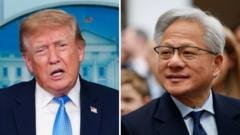
Jensen Huang FBI Investigation Sparks Semiconductor Crisis
A seismic shift rattled the semiconductor industry this week after Washington confirmed the launch of a high-profile Jensen Huang FBI investigation. The probe centers on the Nvidia chief executive’s personal relationship with an alleged operative of a Chinese espionage campaign. Wall Street’s reaction was immediate and brutal. Investors panicked. Within hours of trading on Monday, nearly $250 billion in equity value dissolved into thin air as Nvidia shares crashed by 4%.
The **Jensen Huang FBI investigation** centres on allegations that Nvidia's chief executive was targeted in a Chinese intelligence operation involving Alice Huang, an executive at Singapore-based Megaspeed. Following warnings from Secretary of State Marco Rubio, federal authorities and Nvidia's board are reviewing potential national security vulnerabilities and corporate exposure.<\/p>
- Federal Inquiry Launched: The White House confirmed an ongoing FBI semiconductor security probe regarding Nvidia CEO Jensen Huang and an alleged Chinese intelligence operative.
- Severe Market Impact: Wall Street reacted swiftly, erasing roughly $250 billion from Nvidia's market capitalization in a single trading session.
- Singapore Supply Chain Link: Intelligence reports focus on Megaspeed, a Singaporean entity where suspect Alice Huang managed operations, raising questions about third-party chip distribution.
- Capitol Hill Summons: Congressional leaders have requested Huang's presence at a closed-door briefing to detail corporate espionage protocols and IP defense.
Silicon Valley has weathered executive scandals before. But this is different. It sits directly at the volatile intersection of global espionage, military-grade hardware, and the high-stakes race for global AI dominance. The company powering the modern technological revolution now finds its founder under federal scrutiny.
The Memo That Shook Washington
The story broke into the open when President Donald Trump fielded questions outside the White House, confirming that federal law enforcement was reviewing the executive’s conduct. However, intelligence signals had been blinking red for months. According to intelligence disclosures originally reported by The New York Times, Secretary of State Marco Rubio had dispatched a classified memorandum to senior administration figures detailing concerns over Huang’s personal interactions with a woman known within intelligence circles as Alice Huang, or Huang Le.
She was no ordinary corporate executive. Alice Huang held the position of managing director at Megaspeed, a high-profile Singaporean enterprise heavily involved in procuring and distributing advanced microprocessors across Asian markets. Federal investigators suspect her of operating as a state-backed asset for Beijing.
“I asked him that question: ‘Did you have any idea she was a spy?’ He said ‘I had no idea she was a spy’—and I really believe him,” Trump told reporters on the White House lawn, adding that the executive was “suffering greatly” under the weight of the allegations.
While the President expressed personal confidence in the chief executive’s integrity, official Washington is taking zero chances. Intelligence agencies consider the threat of corporate extraction of trade secrets through interpersonal leverage to be at an all-time high.
Inside the Jensen Huang FBI Investigation: Tech, Spies, and Silicon
The scope of the FBI semiconductor security probe extends far beyond standard personal background checks. Federal agents are meticulously tracing communications, travel itineraries, meeting logs, and commercial handoffs involving Megaspeed Alice Huang and Nvidia’s executive suite. The strategic objective? Determining whether classified product roadmaps, underlying mathematical frameworks, or supply chain routing protocols were leaked.
Nvidia moved quickly to limit the fallout. The board of directors commissioned an independent forensic investigation led by external legal counsel. Their early stance remains defensive yet definitive: no internal data appears compromised.
- Zero Evidence of Data Leakage: Internal audits currently indicate that Nvidia’s core source code, architecture designs, and proprietary CUDA software stacks remain uncompromised.
- Supply Chain Routing Scrutiny: Investigators are reviewing secondary hardware transfers to ensure advance processing clusters were not diverted.
- Personal Misconduct Acknowledgment: Huang publicly acknowledged marital unfaithfulness, issuing a public apology to his family while pledging full transparency to federal authorities.
Beijing was swift to issue a blunt denial. China’s Foreign Ministry categorized the allegations as “entirely groundless, speculative and intended to smear and malign China,” accusing Washington of weaponizing national security to suppress legitimate enterprise.
The Singapore Conduit: Megaspeed’s Role Under the Lens
Understanding why federal agents reacted with such urgency requires looking at Singapore’s position in global logistics. As Western authorities clamped down with stringent AI chip export controls, neutral logistical hubs like Singapore became major transit points for high-performance computing hardware. Intelligence analysts monitor these transshipment channels constantly to prevent illicit transfers into mainland China.
Megaspeed operated inside this high-pressure trade environment. As managing director, Alice Huang oversaw operations that put her in proximity to the silicon powering the world’s leading language models and neural networks.
Comparative Breakdown of Corporate and National Security Variables
| Assessment Dimension | Nvidia Official Position | U.S. Intelligence Perspective | Market Realities |
|---|---|---|---|
| Intellectual Property Security | No proprietary secrets or hardware blueprints breached. | High risk of social engineering and non-technical intelligence gathering. | $250B loss reflects deep institutional anxiety over operational continuity. |
| Hardware Logistics | All international deliveries strictly adhere to export law. | Scrutinizing third-party buyers like Megaspeed for shadow diversions. | Resellers face tightening global compliance frameworks. |
| Executive Status | Huang remains in active leadership while cooperating. | Subject to ongoing FBI inquiry and congressional scrutiny. | Institutional shareholders demand clear contingency governance plans. |
Market analysts at major brokerages note that even if no technical IP changed hands, the perception of access is dangerous. In the world of high-stakes computing, personal access to a chief executive often provides invaluable context regarding company strategy, supply chain pain points, and diplomatic leverage points.
Export Controls and the Battle Over the H200
This scandal arrives at a fragile moment for Nvidia’s commercial strategy. For years, Huang argued forcefully against broad-based technological blockades. His premise was pragmatic: forcing China out of the U.S. technology ecosystem would simply accelerate Beijing’s push to build indigenous semiconductor capability. He maintained that global technology standards should remain anchored in American innovation.
That stance created friction with national security hawks in Washington. The debate reached a peak over the H200 accelerator—Nvidia’s high-powered graphics processing unit built explicitly for large-scale enterprise artificial intelligence applications. The administration initially blocked the export of H200 units to Chinese clients over fears of military dual-use application.
However, early this year, Washington adjusted its stance, allowing conditional sales under rigorous end-user verification protocols. That policy shift now faces intense political backlash. Lawmakers across both major parties are asking whether corporate lobbying influenced national export policy at a time when executive leadership was exposed to potential foreign espionage operations.
Capitol Hill Prepares the Subpoenas
The legislative branch is moving quickly to claim oversight of the matter. Bipartisan leadership across key House and Senate security committees sent formal correspondence requesting Huang’s presence at a closed-door briefing next week. The letter was explicit in its scope:
“The committees seek a formal briefing on Nvidia’s security protocols against foreign adversary espionage and your interactions with a publicly reported People’s Republic of China intelligence asset.”
Appearing before Capitol Hill under these conditions carries tremendous risk for any chief executive. Congressional investigators possess broad latitude, and testimony given under oath will be cross-referenced directly against materials gathered by the FBI.
- Review of Counter-Espionage Training: Lawmakers want proof that executive staff underwent mandated counter-intelligence training standard for firms handling dual-use technology.
- Audit of Communication Channels: Committee staff are demanding logs of non-standard communication channels used during trips to Southeast Asia and East Asia.
- Verification of Export Compliance: Counsel will scrutinize every hardware shipment facilitated through Megaspeed during Alice Huang’s tenure.
Whether Huang appears voluntarily or relies on corporate legal representation remains an open question. Legal experts suggest that while voluntary cooperation demonstrates goodwill, it opens the chief executive to intense questioning regarding his personal conduct and administrative oversights.
Market Volatility and the Cost of Executive Exposure
For Wall Street, the single-day 4% stock tumble was not merely a reaction to tabloid headlines. It reflected deep-seated structural fear. Nvidia is not just another technology firm; it is the fundamental engine driving global market capitalization gains across the technology sector. Its chips power everything from cloud infrastructure at tech giants to defense-sector machine learning systems.
As detailed by financial reporting from Bloomberg, institutional investors are increasingly calculating political and security risk directly into technology stock valuations. When an executive who synthesizes the roles of chief innovator, global salesman, and corporate visionary becomes embroiled in a national security probe, the entire corporate enterprise suffers a risk premium discount.
Nvidia’s board faces a difficult balancing act. It must reassure institutional investors that corporate governance remains rock-solid, while simultaneously supporting a founder whose technical vision turned a modest graphics card maker into a multi-trillion-dollar titan.
What Comes Next for Silicon Valley’s Flagship Firm?
The days ahead will test Nvidia’s operational resilience. The FBI investigation will proceed on its own timeline, independent of corporate press releases or market cycles. Federal investigators will complete their forensic work, analyze digital records, and determine whether any criminal statutes or national security laws were violated.
Meanwhile, the geopolitical rift between Washington and Beijing continues to widen. The semiconductor industry no longer operates in a purely commercial sandbox. Every chip, every design file, and every high-level executive relationship is now viewed through the lens of national defense and geopolitical survival.
For Jensen Huang, the personal and professional stakes could not be higher. He faces the daunting task of steadying a global market leader while navigating a federal security investigation, an impending congressional interrogation, and the fallout of a deeply personal corporate scandal. Silicon Valley is watching closely, fully aware that the outcome could fundamentally alter how tech leaders navigate international business, security disclosures, and the geopolitical battle for AI supremacy.
<button type="button" onclick="this.parentElement.innerHTML='✓ Thank you, we will refine our analysis!‘” style=”background:#ffffff; border:1px solid #cbd5e1; border-radius:6px; padding:4px 12px; font-size:12px; cursor:pointer; color:#334155;”>👎 No
Latest Analytical Follow-up: For continuous developments on this subject, read our full investigation on Nvidia Shares Tumble Amid Founder Espionage Probe.
Latest Analytical Follow-up: For continuous developments on this subject, read our full investigation on Jensen Huang Resigns from Nvidia Amid Shocking Scandal.
