
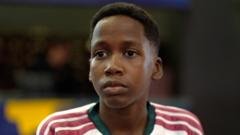
Vinícius Jr Sudan message brings hope to war-injured boy
In a darkened living room in Cairo, a 13-year-old boy sits mesmerized by the ambient glow of a mobile screen. His eyes, wide and unblinking, reflect the image of global football royalty. The screen flickers, and Real Madrid winger Vinícius Júnior begins speaking directly to him in warm Arabic: “Zaher, marhaba.”
Real Madrid winger Vinícius Júnior delivered a heartfelt video message and match invitation to Zaher, a 13-year-old Sudanese boy who lost both legs during a 2024 Khartoum drone strike. Following months of crowdsourced rehabilitation in Cairo, the young survivor received words of solidarity and hope amidst Sudan's ongoing humanitarian crisis.<\/p>
- Personal Gesture: Vinícius Júnior sent a custom video message in Arabic inviting 13-year-old Zaher to attend a Real Madrid match in Spain.
- Severe Trauma: Zaher lost both legs during a 2024 drone strike in Khartoum while selling street food alongside his mother.
- Crowdfunded Miracle: A UK-based lawyer mobilized a £45,000 campaign, navigating immense bureaucratic hurdles to bring Zaher to Cairo for prosthetics and physical therapy.
- Humanitarian Emergency: UNICEF estimates over 17 million children require urgent assistance in Sudan, with thousands killed or maimed since fighting broke out in April 2023.
For Zaher, those two words bridge a vast chasm between the horrors of battlefield trauma and the dizzying height of European football. The emotional reverberations of the Vinícius Jr Sudan message have reached far beyond that small apartment in Egypt, turning a quiet child’s horrific loss into a rallying cry for millions caught in one of the world’s most devastating, yet overlooked, conflicts.
The Morning the World Shattered in Khartoum
To understand Zaher’s transformation, one must return to the scorching streets of Khartoum in early 2024. Sudan had already been plunged into catastrophic violence following the April 2023 outbreak of hostilities between the Sudanese Armed Forces (SAF) and the paramilitary Rapid Support Forces (RSF). War had swallowed the capital whole. Shelling was constant. Food was scarce.
Zaher and his mother, Habibah, were trapped. Lacking the funds to flee the city, they turned to selling lentils on dusty street corners just to secure a single meal a day. It was honest, desperate work. Then came the drone.
Without warning, an aerial strike hit their immediate vicinity. A deafening roar. A flash of fire. Shrapnel tore through the market stalls. When Habibah regained her senses through the choking smoke, her young son was lying beside her, drowning in his own blood.
“I looked at him and he was bleeding everywhere,” Habibah recalled, her voice cracking with the memory. “He would wake up in shock and ask, ‘Why did you let them cut off my legs?’ I had no answer for him. None.”
Both of Zaher’s legs were severely shattered, necessitating bilateral amputations high above the knee. In a crumbling city where hospitals were routinely bombarded or looted, basic medical supplies were practically non-existent. For months, Zaher navigated the rubble of his destroyed neighborhood in a makeshift wheelchair, rolling past blackened vehicles and artillery hulls. When he attempted to play his beloved sport with neighborhood boys, he had to drag himself across the jagged ground on his knees, risking fatal bacterial infections every time.
Grassroots Hope: The £45,000 Bridge Out of Darkness
Zaher’s plight might have remained another silent tragedy among thousands if not for international media coverage. When footage of the quiet, withdrawn boy maneuvering through the ruins reached global audiences, it struck a deep nerve. Among those watching was Dena Latif, a UK-based lawyer of Sudanese descent.
Determined not to let Zaher become a forgotten statistic of the Sudan civil war child victims crisis, Latif launched a targeted crowdfunding effort. Within weeks, the campaign raised over £45,000 ($60,000). Yet money was only half the battle.
Getting a child out of a war zone without official documentation is a logistical nightmare. Zaher’s home had been leveled, destroying his birth certificate. Neither he nor his mother possessed valid passports. It took months of delicate legal maneuvering, diplomatic persistence, and cross-border coordination to secure transit permits across the Egyptian border.
When Zaher finally landed in Cairo, an entire network of care was waiting. Doctors, physiotherapists, and mental health clinicians gathered to rebuild a boy broken by high-intensity warfare.
- Surgical Reconstruction: Addressing bone spurring and scar tissue from the original emergency amputations.
- Prosthetic Integration: Custom-fitting state-of-the-art carbon-fiber prosthetic limbs designed for growing adolescents.
- Psychological Therapy: Intensive trauma counseling to alleviate acute post-traumatic stress disorder (PTSD).
- Physical Rehabilitation: Daily strength conditioning and gait training over six grueling months.
“When he arrived, he was profoundly withdrawn,” says Dr. Bintelmuna Eltayeb, a specialist involved in his rehabilitation. “Getting even a slight smile was nearly impossible. His emotional recovery had to move hand in hand with his physical healing.”
“You Deserve Happiness”: A Star’s Message of Solidarity
As Zaher’s mobility returned, so did his personality. He began joking with medical staff, practicing trick passes in clinic hallways, and revealing his burning dream: to walk again and watch his idol, Vinícius Júnior, play for Real Madrid. Word of Zaher’s recovery eventually reached the Brazilian superstar in Madrid.
Known not only for his electrifying speed on the wing but also for his vocal advocacy against racial injustice and systemic inequality, Vinícius Jr agreed to send a direct message to the boy. The resulting video clip proved to be a watershed moment in Zaher’s recovery.
“I was made aware of your story. I know how difficult the last few months must have been for you,” Vinícius told Zaher in the video. “You are a hard-working black man. I really hope you will make good use of your new prosthetic legs, that you return to playing football, and that you find happiness. You deserve it.”
Then came the ultimate surprise: a formal Real Madrid match invite. Vinícius personally invited Zaher and his mother to Spain to attend a match at the Santiago Bernabéu Stadium as his personal guests.
Overwhelmed by emotion, Zaher briefly sprinted out of the living room on his new legs, returning moments later proudly wearing a brand-new Vinícius Jr jersey. “Tell Vinícius I love him,” Zaher beamed. “His message has given me strength I didn’t know I had.”
Humanitarian Toll: Children in the Crosshairs of War
While Zaher’s story provides a rare beacon of light, international relief agencies emphasize that his experience represents an exceptionally rare outcome in a ongoing humanitarian tragedy. Sudan’s infrastructure has largely collapsed, leaving tens of thousands of amputees without access to basic care, let alone advanced prosthetics.
Data compiled by the UN Children’s Fund (UNICEF) outlines an alarming collapse of basic child protections across the region:
Sudan Conflict: A Stark Comparison of Impact
| Humanitarian Metric | Pre-Conflict Baseline (2022) | Current Conflict Status (2025/2026) |
|---|---|---|
| Children Needing Immediate Aid | Approx. 7.5 Million | Over 17.0 Million |
| Verified Child Casualties | Isolated regional disputes | 4,300+ verified (Vastly underreported) |
| Population Facing Acute Famine | Local food insecurity | 41% experiencing severe food crisis |
| Functional Health Facilities | ~75% operational nationwide | Under 20% functional in combat zones |
Diplomats and human rights observers warn that targeted strikes on civilian infrastructure have created a generation of youth without identity documents, formal schooling, or basic healthcare access. Human rights groups continue to document widespread violations by both the SAF and RSF, including the deliberate shelling of hospitals and residential quarters.
Return to a Fragile Homeland
Equipped with his new legs, a vibrant personality, and renewed purpose, Zaher has recently returned to Khartoum alongside his mother. The city remains a ghost of its former self. Though military lines have shifted and the army has reclaimed parts of the capital, entire blocks lie charred and looted.
For Habibah, returning home brings a mix of comfort and terror. “I feel like the whole world cheered for Zaher,” she says softly. “But as a mother, I look around Khartoum and I worry. Will he be safe? Will he get his education? What about the other children who have no prosthetics, no support, no voice?”
Zaher, however, looks ahead with unshakeable determination. He dreams of becoming an airline pilot one day, soaring far above the battered streets where he once lost his legs. Until then, he practices walking every morning, adjusting to his changing height, and holding onto a promise made by a football icon thousands of miles away.
<button type="button" onclick="this.parentElement.innerHTML='✓ Thank you, we will refine our analysis!‘” style=”background:#ffffff; border:1px solid #cbd5e1; border-radius:6px; padding:4px 12px; font-size:12px; cursor:pointer; color:#334155;”>👎 No
