
Ukraine Peace Talks Flexibility Signals New Abu Dhabi Shift
On the eve of the fifth anniversary of Russia’s invasion, whispers of quiet compromise are finally surfacing from backchannel corridors. American diplomats report unprecedented hints of Ukraine peace talks flexibility behind closed doors in the United Arab Emirates. Yet, on the ground, the war continues its brutal cadence. A devastating strike on a village in Zaporizhzhia left at least 40 dead last week, offering a tragic reminder of the gulf between diplomat speak in Abu Dhabi luxury hotels and the bloody realities of the Ukrainian front lines.
Recent signals of Ukraine peace talks flexibility in Abu Dhabi suggest behind-the-scenes movement on eastern territorial concessions and postwar security guarantees. While public demands over the Donetsk region remain rigid, US-backed trilateral negotiations are attempting to reconcile frontline control with long-term security architecture for Kyiv and Moscow.<\/p>
- Private Compromise vs Public Rigidness: While Moscow and Kyiv maintain maximalist positions publicly, US envoys report subtle shifts behind closed doors regarding eastern Ukraine.
- The Donetsk Sticking Point: Control over the Donetsk region remains the main operational hurdle, with Kyiv insisting on freezing the contact line and Moscow demanding full territorial surrender.
- Security Architecture First: Negotiators acknowledge that territorial compromises cannot be finalized without establishing enforceable postwar security guarantees for both nations.
- European Marginalization: EU leaders and NATO members express growing anxiety over being excluded from Washington-led mediation efforts in Abu Dhabi.
Delegations from Moscow, Kyiv, and Washington have assembled in the Gulf state for their first trilateral meeting since a failed February summit in Geneva. That previous effort collapsed when regional war broke out in the Middle East, drawing Washington’s focus elsewhere. Now, with the Trump administration desperate for a diplomatic victory, negotiators are taking another crack at ending Europe’s deadliest conflict since 1945.
Behind the Scenes in Abu Dhabi: Realism or Recklessness?
Publicly, neither side has softened its posture by an inch. Moscow still demands total Ukrainian withdrawal from Donetsk, a region now largely under Russian occupation. Kyiv refuses to cede an inch of territory it still holds, insisting that freezing the current contact line is non-negotiable for national survival. Yet senior American officials insist that off-camera exchanges tell a different story.
“They will not solve the Donetsk issue and the territorial issue until they know what the security architecture is going to be after the war,” a senior US diplomat disclosed on condition of anonymity. “And keep in mind, we’re not going to be able to finalize one without the other.”
Washington’s negotiating team is led by peace envoy Steve Witkoff and Jared Kushner, the former president’s son-in-law who has increasingly stepped into high-profile international brokering roles. Kushner took to X to frame the strategy: “An important part of this process is encouraging all parties to begin thinking seriously about what comes after the war.” He cautioned, however, that the Gulf meeting is meant primarily to generate momentum rather than deliver an immediate breakthrough.
“While Putin has a war machine up and running, he has no incentive to negotiate. Trump wants a quick deal at the expense of Ukraine, which will certainly be rejected by Kyiv.” — Oleksandr Merezhko, Chair of the Ukrainian Foreign Affairs Parliamentary Committee
That perspective is widely shared across Kyiv’s political establishment. Skepticism runs deep regarding Washington’s push for rapid concessions. Ukrainian lawmakers point out that recent American moves—such as quietly entering deals to purchase Russian diesel—send mixed signals, undercutting economic pressure on the Kremlin just as peace envoys demand compliance.
The Donetsk Sticking Point: Strategic Fortress vs Political Trophies
To understand why the talks keep stalling, one must look closely at the maps of eastern Ukraine. The contested region of Donetsk is not merely a symbolic territorial prize; it represents the core of Ukraine’s eastern defensive grid. Over ten years, Ukrainian engineers built a dense network of fortified positions, fortified trenches, and interconnected logistics hubs known colloquially as the Donetsk fortress belt.
If Kyiv surrenders the remaining uncaptured segments of Donetsk, it loses its most formidable defensive barrier, leaving open plains vulnerable to future armor thrusts toward the Dnipro River. For Moscow, securing the entire administrative boundary of Donetsk is essential to claiming victory for its domestic audience.
According to reports from Reuters, American envoys are attempting to bridge this divide by introducing interim administrative concepts, demilitarized buffer zones, and monitored lines of separation. But operational realities make such arrangements notoriously fragile without ironclad enforcement mechanisms.
Current Strategic Stances at the Negotiating Table
| Stakeholder | Primary Territorial Position | Security Demands | Preferred Format |
|---|---|---|---|
| Ukraine (Kyiv) | Freeze current contact line; retain Donetsk defensive positions | Enforceable Western security guarantees; path to NATO/EU | Multilateral with full European inclusion |
| Russia (Moscow) | Full Ukrainian withdrawal from Donetsk, Luhansk, Zaporizhzhia, Kherson | Permanent Ukrainian neutrality; NATO rollback in Eastern Europe | Bilateral US-Russia or restricted trilateral |
| United States (Washington) | Pragmatic line-of-contact compromise; phased territorial talks | New regional security framework; crisis hotlines; NATO-Russia Council reactivation | Trilateral transitioning to wider multilateral talks |
| European Union (Brussels) | Restoration of international borders; non-recognition of illegal annexations | Continental security integration; collective defense posture | Full seat at the main negotiating table |
The Mystery of the Postwar Security Architecture
Beyond land, the true battleground in Abu Dhabi centers on the elusive concept of postwar security architecture. What does it actually look like? For Kyiv, any durable peace requires explicit guarantees of armed intervention by Western allies if Russia attacks again. Without binding defense commitments, Ukrainian officials view any ceasefire as a mere operational pause for the Kremlin to rearm.
Moscow’s definition of security is the exact polar opposite. Kremlin officials view any Western military presence in Ukraine as an existential threat. They continue to push for a complete rollback of NATO infrastructure to its pre-1997 borders—a condition that Eastern European allies consider entirely out of the question.
To break this stalemate, American officials are pitching intermediate measures. These include:
- Direct Crisis Hotlines: High-level military-to-military communications links between Washington, Moscow, and Kyiv to prevent accidental escalation.
- De-escalation Protocols: Reciprocal limits on troop concentrations along designated border zones.
- Reactivation of the NATO-Russia Council: Resuscitating the security dialogue body that has lain dormant since the 2022 invasion.
These proposals might sound practical in white-paper policy memos, but European diplomats worry they leave fundamental aggression unpunished while giving Moscow effective veto power over European defense planning.
Europe’s Anxiety: Locked Out of Their Own Security
European leaders are watching the Abu Dhabi summit with growing alarm. Having provided tens of billions of euros in financial aid, military hardware, and humanitarian support, the European Union finds itself largely sidelined in peace talks driven by Washington.
European Commission President Ursula von der Leyen delivered a blunt reminder on Monday, insisting that NATO allies and EU member states must be integral participants in any “meaningful discussions about Europe’s security architecture.”
President Volodymyr Zelensky has repeatedly echoed that demand. Kyiv understands that while American support is crucial for firepower, long-term economic integration and political backing depend entirely on Europe. Excluding Brussels risks creating a peace framework that Europe refuses to fund or guarantee.
US negotiators claim they intend to broaden the talks into a multilateral format once basic parameters are established. “Hopefully we’ll get the Russians on board,” one US negotiator remarked, while dryly noting that “the Russians have a bad taste in their mouth with the Europeans.”
Diplomacy Under Fire: The Reality on the Ground
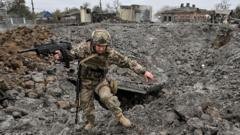
While negotiators in suit jackets debate maps in air-conditioned Abu Dhabi suites, the war’s grinding kinetic reality grinds on. Russia’s campaign targeting Ukrainian grid infrastructure continues around the clock. Over the past 48 hours alone, drone and missile strikes disrupted power for hundreds of thousands of civilians and wounded dozens across central and eastern regions.
Military analysts at Bloomberg Intelligence suggest that Moscow’s intensified bombardment ahead of diplomats meeting is deliberate. It is classic coercive leverage: inflict maximum discomfort on civilians to force Kyiv’s delegation toward concessions at the table.
The composition of the delegations reflects the gravity—and hostility—of the encounter. Moscow sent Kremlin aide Vladimir Medinsky, spy chief Igor Kostyukov, and Army General Yury Zhigarlovsky. Kyiv deployed seasoned combat and intelligence leaders, including Foreign Intelligence Chief Rustem Umerov, Presidential Chief of Staff Kyrylo Budanov, and senior lawmaker Davyd Arakhamiya.
These are hardened figures who know each other’s tactics well. Neither group is prone to starry-eyed optimism. If subtle Ukraine peace talks flexibility is indeed emerging in Abu Dhabi, it will be tested not by press releases or tweets, but by whether weapons fall silent along the icy trenches of Donetsk.
<button type="button" onclick="this.parentElement.innerHTML='✓ Thank you, we will refine our analysis!‘” style=”background:#ffffff; border:1px solid #cbd5e1; border-radius:6px; padding:4px 12px; font-size:12px; cursor:pointer; color:#334155;”>👎 No
