
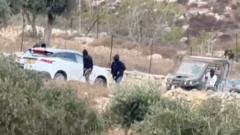
European Diplomats Attacked in West Bank Settler Raid
Tension in the occupied West Bank reached a dangerous breaking point this week when European diplomats attacked by masked vigilantes were forced to flee the historic village of Taybeh. What was designed as a routine diplomatic fact-finding mission turned into a violent melee, laying bare the staggering collapse of law and order in the rural Palestinian countryside. The incident has sent shockwaves through Brussels, Paris, and Washington, exposing deep fractures within Israel’s political establishment and prompting unprecedented calls for international intervention.
European diplomats were attacked in the West Bank when masked Israeli settlers ambushed an official delegation visiting the Palestinian village of Taybeh. The assailants smashed diplomatic vehicle windows, assaulted French Mayor Bernard Baudoux with iron bars, and threw stones, sparking international condemnation and demands for targeted European Union sanctions.<\/p>
- Diplomatic Delegation Ambushed: Representatives from Belgium, France, Poland, and the Catholic Church came under physical attack by masked Israeli settlers in Taybeh.
- French Official Severely Injured: Bernard Baudoux, mayor of Aulnoye-Aymeries, was beaten with iron bars and kicked during the confrontation.
- Targeting of Press & Observers: The incident occurred less than 24 hours after Washington Post photojournalist Heidi Levine was injured in a separate settler assault.
- Diplomatic Rift Deepens: Belgium led calls for strict EU sanctions, while US Ambassador Mike Huckabee labeled the assault a 'despicable act of terror'.
The delegation—comprising official representatives from Belgium, France, Poland, and the Catholic Church—had traveled to Taybeh, a predominantly Christian Palestinian village situated northeast of Ramallah. Their objective was straightforward: monitor the heightened security risks facing local farmers during the annual West Bank olive harvest, an economic lifeline routinely disrupted by radical ideological groups. Instead, the envoys became the targets of a brazen daylight ambush.
The Ambush at Taybeh: Iron Bars and Shattered Glass
According to eye-witness accounts and field logs gathered by diplomatic staff, the convoy was confronted on the periphery of the village by dozens of young men wearing face covers. Within minutes, verbal hostility escalated into physical violent action. Attackers hurled heavy stones at diplomatic vehicles, shattering the rear windshield of a Belgian consular car.
The physical assault hit French political dignitary Bernard Baudoux, the visiting mayor of Aulnoye-Aymeries in northern France, with particular violence. Baudoux, who was wearing his official French tricolor sash at the time, was swarmed by assailants before he could retreat into a vehicle.
“It is the gratuitous nature of the violence that stuns me,” Baudoux stated during a hospital evaluation, detailing how assailants struck him repeatedly with iron pipes and kicked him while he lay on the ground. “They arrived completely enraged. The whole world needs to know what is happening here. For me, I will return to my country and recover. Those who continue to suffer the most are the people who live here every single day.”
Footage circulated across social media channels corroborated key elements of the attack. One video captured a dazed European official slumped against the side of an SUV while bystanders shouted for medical aid. Local Palestinian residents who rushed to assist the diplomats were also pelted with rocks before the assailants withdrew into nearby hilltop outposts.
Diplomatic Fury in Brussels and Paris
The response from European capitals was swift and severe. Belgium’s Foreign Minister Maxime Prevot released an unsparing statement, making clear that the targeting of sovereign representatives crosses a non-negotiable red line under international conventions.
“Palestinians face this violence every day. Settlers also target journalists reporting on it and diplomats. Harvesting olives, reporting the news, or carrying out diplomatic duties should never put anyone at risk of attack,” Prevot emphasized. “As the occupying power, Israeli authorities must protect Palestinians, ensure the safety of diplomats and journalists, and bring those responsible to justice. Impunity for violent settlers must end.”
Prevot confirmed that Belgium is actively mobilizing support for targeted European Union sanctions against individual perpetrators and the legal or financial networks underpinning extremist outposts. Observers from Reuters regional updates suggest that the incident could catalyze a long-delayed consensus among EU member states to enforce travel bans and asset freezes on radical figures in the territory.
A Fractured Response in Jerusalem
Inside Israel, the attack provoked a striking disconnect between different branches of government and military authorities, revealing acute political anxiety over the international legal implications.
The IDF and Foreign Ministry Acknowledge Severe Violence
The Israel Defense Forces (IDF) issued a formal statement strongly condemning what it explicitly characterized as a “severe act of violence” carried out by “Israeli rioters.” Military officials noted that a preliminary inquiry confirmed no IDF troops were present on the immediate scene during the ambush, promising a thorough military-police investigation.
Israeli Foreign Minister Gideon Sa’ar also moved to limit the diplomatic damage, holding emergency calls with European ambassadors. Sa’ar offered a strong public condemnation of the rioters, though he added a layer of procedural criticism. “Without detracting from the severity of the incident, it is unfortunate that the visit was not coordinated with the IDF in advance,” Sa’ar stated. “Such coordination could have helped safeguard the visitors’ security.”
Netanyahu’s Office Casts Doubt
Conversely, the Prime Minister’s Office (PMO) under Benjamin Netanyahu adopted an entirely different stance, actively seeking to minimize the events and challenging the credibility of the reports. In a public statement that raised eyebrows across foreign embassies, the PMO urged “caution before drawing conclusions,” suggesting that media coverage was driven by bad faith actors.
- Smear Campaign Allegations: The PMO suggested the incident reports were embedded within a “coordinated campaign to smear Israel and the Jewish residents of Judea and Samaria.”
- Evidence Dismissal: Officials asserted that social media footage “does not establish the complete sequence of events or individual responsibility.”
- Focus on Coordination: Government communications stressed that unannounced visits into high-friction zones complicate ground security operations.
This messaging strategy highlights the domestic pressures facing Netanyahu’s coalition government, which relies heavily on the political backing of pro-settler political factions. According to market and geopolitical analysts tracking Middle Eastern stability at Bloomberg financial geopolitics coverage, the political friction within Jerusalem threatens to further isolate Israel’s security establishment from its traditional Western intelligence partners.
Escalating Pattern: Journalists and Observers Under Fire
The attack on the European delegation was not an isolated flare-up. Less than 24 hours prior, a separate assault unfolded in a nearby agricultural village, targeting international media and local farm workers. Among those injured was Heidi Levine, a veteran American photojournalist working for the Washington Post, who required medical treatment after being struck during a confrontation with armed settlers.
The targeting of a prominent US journalist sparked an unusually direct response from Washington, signaling growing frustration within the American political establishment over ungoverned violence in the West Bank.
“This was a despicable act of terror carried out by masked cowards,” declared US Ambassador to Israel Mike Huckabee, a traditionally staunch defender of Israeli policy. Huckabee demanded that the assailants face “prosecution to the fullest extent of the law.” Meanwhile, US Secretary of State Marco Rubio characterized the attack on Levine as “disturbing” and noted that the imagery emerging from the West Bank was “not a good look” for regional stability efforts.
The shared outrage from both Brussels and Washington marks a critical shift. For years, diplomatic missions operated under an unwritten assumption of diplomatic immunity on the ground. The physical beatings of high-profile foreign officials like Bernard Baudoux in Taybeh indicate that extremist factions feel increasingly emboldened to challenge sovereign foreign personnel with total disregard for international consequences.
Comparative Breakdown: Incidents, Actors, and Diplomatic Responses
To understand the scope of the escalating crisis during the agricultural season, consider the structural details outlining the recent incidents:
| Metric / Element | Taybeh Diplomatic Incident | Agricultural Zone Media Attack |
|---|---|---|
| Primary Targets | European Envoys (Belgium, France, Poland, Vatican) | International Press & Local Farmers |
| Key Victims Identified | Bernard Baudoux (French Mayor, Aulnoye-Aymeries) | Heidi Levine (Washington Post Photojournalist) |
| Nature of Physical Assault | Stones, iron bars, physical beatings, vehicular damage | Direct stone-throwing, physical intimidation |
| Primary US Reaction | Ambassador Huckabee: “Despicable act of terror” | Sec. State Rubio: “Disturbing, not a good look” |
| Primary EU Action | Formal push for EU-wide sanctions by Belgium | Emergency media safety petitions filed |
| Official IDF Position | Condemned as “severe act of violence” | Under active military police investigation |
Economic and Human Toll on the Olive Harvest
At the center of this geopolitical storm lies a quiet, devastating reality for local Palestinian communities. The West Bank olive harvest is far more than a cultural tradition; it represents up to 15 percent of the agricultural economy in rural zones. For tens of thousands of families, the oil produced during these autumn weeks dictates their annual financial survival.
Human rights monitors report that systematic land access restrictions, combined with violent intimidation, have rendered large swathes of grove land inaccessible. Whole families are routinely forced to abandon their crops under threat of physical harm or property destruction.
- Harvest Disruption: Farmers lose critical harvest windows due to safety fears, leading to spoiled crops and severe economic hardship.
- Property Damage: Thousands of ancient olive trees have been vandalized, burned, or uprooted across rural districts.
- Systemic Deterrence: Violent clashes near civil observer posts discourage third-party human rights groups from documenting abuses.
When external observers—whether foreign diplomats, non-governmental organizations, or international photojournalists—are targeted, the protective shield around local agricultural workers collapses entirely. The assault on the French mayor and Belgian diplomatic staff proves that even official diplomatic credentials no longer guarantee safe passage in disputed rural areas.
The Road Ahead: Legal Accountability or Diplomatic Collapse?
The events in Taybeh have forced a dramatic recalculation in Western capitals regarding West Bank security dynamics. The days of treating violent acts by non-state actors as minor localized disputes appear to be over. As European foreign ministers prepare for upcoming council meetings in Brussels, the pressure to transition from verbal condemnation to actionable punitive measures is intense.
If Israel’s law enforcement infrastructure fails to arrest, prosecute, and convict those responsible for the beatings in Taybeh, the European Union will face immense pressure to institute broad-spectrum sanctions targeting non-state extremist networks. The physical scars borne by Bernard Baudoux and the smashed windows of Belgian diplomatic cars are no longer mere news headlines—they are severe geopolitical liabilities that could redefine diplomatic relations across the Middle East for years to come.
<button type="button" onclick="this.parentElement.innerHTML='✓ Thank you, we will refine our analysis!‘” style=”background:#ffffff; border:1px solid #cbd5e1; border-radius:6px; padding:4px 12px; font-size:12px; cursor:pointer; color:#334155;”>👎 No
