
France presidential election student protests manipulation
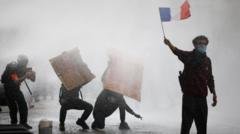
The French passion for protest is legendary in Europe. Over the last few years, we have regularly witnessed farmers angry about costly regulations lobbing manure at local mayoral offices, while masked youths periodically hurl homemade grenades at riot police in disadvantaged city suburbs. For over three weeks now, thousands of students have barricaded entry to high schools and taken their grievances to the streets. This Saturday, hundreds of new demonstrations have been announced across France.
Student protests in France have become a flashpoint ahead of the upcoming presidential election, with Prime Minister Sébastien Lecornu accusing the radical left of weaponising high school demonstrations for electoral advantage. Meanwhile, mounting public debt, generational divides, and historical traditions of civil unrest continue to fuel widespread societal friction.<\/p>
- Political Weaponization: Prime Minister Sébastien Lecornu has publicly accused hard-left figures like Jean-Luc Mélenchon of exploiting high school blockades for electoral gain.
- Deepening Economic Strain: France grapples with soaring public debt, ranking among the highest public expenditure rates in the OECD at roughly 57% of GDP.
- Historical Paragons: The current mobilization echoes the legendary May 1968 student-worker alliances, reflecting a deep-seated French tradition of utilizing street protests for systemic change.
Students are expected to be joined by workers’ unions and key figures from the so-called “yellow vest” movement. France’s prime minister, Sébastien Lecornu, suggested this week that student anger was being manipulated as politics heats up ahead of next year’s France presidential election. The gilets jaunes demonstrated against cost-of-living hikes for over a year from 2018—becoming one of the longest-lived protest movements in French history.
The Echoes of Past Unrest
Jérôme Rodrigues, a prominent gilets jaunes activist, has used Instagram to encourage people to join Saturday’s demonstrations. The protests should give a voice to those who want to live decently, no longer have to count every cent, and no longer have to choose between eating and driving, he said in a video.
Anger has no political party. An empty fridge has no political party.
So what is going on in the EU’s second largest economy? Social unrest, government borrowing costs at eye-watering highs, a deeply divided French parliament, and an apparent revolving door of exasperated French prime ministers—six prime ministers over the last five years—all claiming to want to reduce their country’s public debt. Is France at breaking point, and what does this all mean for the eurozone currency the French are such a huge part of?
“You can’t compare France to the Greece debt crisis of 2012 or Argentina in 2001. And the financial markets know it,” economist Anne-Laure Delatte told me. She is a CNRS Tenured Researcher at the Economics Department of Paris Dauphine University; a well-known face in debates on French media on the parlous state of the country’s public debt.
“The markets recognised already in 2024 that we would have a budgetary problem after snap elections left parliament deeply divided between three opposing political blocs, but they also realise France is a big country with the ability to raise taxes if necessary.”
Comparing Economic Realities
Delatte suggests the current climate mirrors the United Kingdom in 2023 under Liz Truss, noting that while painful, fiscal adjustments remain entirely within the nation’s technical toolkit. Yet, imagine the public reaction if taxes were to increase or welfare budgets decreased further.
France’s national motto is liberté, égalité, fraternité, but that is certainly not the sense you get on seething streets and in viral social media posts. Radical-left LFI leader Jean-Luc Mélenchon has been accused of exploiting the student protests ahead of next year’s elections.
I met 17-year-olds Maxime, Madeleine, and Elodie this week, perched on big green dustbins that have been used to block the entrance to their high school. They told me things were bad enough here in the 3rd district of Paris, with holes in classroom walls and a dearth of teaching staff, but the teenagers were more than aware that the situation was far worse in their capital city’s disadvantaged suburbs.
Key Socio-Economic Indicators
| Metric | France | EU Average |
|---|---|---|
| Public Expenditure (% GDP) | ~57% | ~49% |
| Prime Ministers in 5 Years | 6 | Varies |
| Youth Unemployment | Elevated | Moderate |
“France likes to speak of égalité,” they told me, “but the reality is the poor here are prejudiced against, while the rich benefit.” None of them will be old enough to vote next spring, but they questioned whether the changing face of politicians in power made all that much difference anyway.
The Ghosts of 1968
They are part of a defiant French tradition. Cultural icon Victor Hugo, the 19th-century author of Les Misérables, proclaimed: “Si vous n’êtes pas contents, manifestez, criez, hurlez, mais ne subissez pas.”
Amongst crowds of protesting students walking through Paris on Thursday, I came across a number of mums with placards reading: “Mums in solidarity.” Gwen, 37, said she and other mothers were taking it in turns every morning to coordinate between students and police at their local school lock-in. This came after mounting accusations of police brutality during protests earlier this month in which hundreds were injured and a 15-year-old boy in the town of Lens lost a hand. France’s interior minister has since suspended the use of stun grenades by police at high school demonstrations.
At Thursday’s demo, I also came across 17-year-old Lola and her mother, Sandrine, sharing a placard that said revolution was the most beautiful expression of humanity. “My mum took to the streets in ’68,” Lola said proudly. “Now it’s my turn. No point in waiting for the presidential election. We want change now.”
Student protests in Paris in May 1968 are the stuff of legend. Demands for better education inspired workers to join the marches, turning into the biggest general strike in French history. Now, though, with six months to go before an already fraught election cycle, accusations fly that the hard left is weaponising student frustration.
“Members of France Insoumise are instrumentalising the high school movement for their electoral advantage,” said Sébastien Lecornu on Wednesday, accusing them of encouraging protests while dodging accountability for resulting violence. But “Mélenchon for President!” remains a common chant in the streets.
Whether any new president can break the financial impasse remains doubtful. With public expenditure sitting at roughly 57% of GDP, French citizens expect a heavy return on their high tax burden. Ultimately, as political fatigue grows, the path forward for the republic demands structural and constitutional reflection that goes far beyond the ballot box.
<button type="button" onclick="this.parentElement.innerHTML='✓ Thank you, we will refine our analysis!‘” style=”background:#ffffff; border:1px solid #cbd5e1; border-radius:6px; padding:4px 12px; font-size:12px; cursor:pointer; color:#334155;”>👎 No
Latest Analytical Follow-up: For continuous developments on this subject, read our full investigation on The Tragic Reality Facing Canada’s Rescued Belugas.
