
Six Flags Rollercoaster Death: Inside the Fatal Fall
A catastrophic incident at a marquee theme park has reignited critical debates surrounding ride mechanics and rider security. The recent Six Flags rollercoaster death of 42-year-old Hassan Jihad Ibn Kariem at Six Flags Over Georgia has shocked thrill-seekers nationwide, leaving investigators to determine how a passenger could be violently ejected from one of North America’s tallest steel attractions. What was meant to be an ordinary summer afternoon in Austell, Georgia, dissolved into chaos shortly before 4:00 PM on Monday, leaving park guests reeling and safety regulators scrambling for answers.
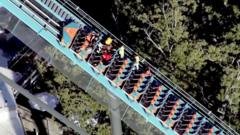
The recent Six Flags rollercoaster death occurred on the Goliath ride at Six Flags Over Georgia, where 42-year-old Hassan Jihad Ibn Kariem was fatally ejected at speeds reaching 70 mph. Preliminary investigations center on mechanical restraint integrity, passenger securing procedures, and ride operator protocols, prompting precautionary closures across North American parks.<\/p>
- Tragic Ejection: 42-year-old educator Hassan Jihad Ibn Kariem died after being thrown from the Goliath hypercoaster at Six Flags Over Georgia.
- Precautionary Fleet Halt: Six Flags suspended operations on nine attractions across North America as engineers examine restraint lock mechanisms.
- Disturbing Witness Accounts: Eyewitnesses reported seeing an empty seat return to the dispatch hub with an unlatched lap restraint and traumatized, injured passengers.
- Oversight Deficits: The incident renews debate over the federal loophole exempting fixed-site amusement parks from Consumer Product Safety Commission (CPSC) oversight.
Cobb County police officers already stationed at the venue responded alongside paramedics, discovering Kariem deceased beneath the colossal steel structure of the Goliath coaster. Preliminary statements from law enforcement indicate that Kariem was dislodged mid-circuit, striking other riders before falling to the ground below. In the immediate aftermath, corporate leadership at Six Flags Entertainment Corporation ordered the precautionary shutdown of nine similar attractions across the United States and Canada, signaling that investigators are not taking mechanical integrity for granted.
The Terminal Plunge on Goliath: What Witnesses Actually Saw
Goliath is no modest attraction. Engineered by legendary Swiss coaster designers Bolliger & Mabillard (B&M) and opened to the public in 2006, the ride towers 200 feet into the air. It features a terrifying 170-foot drop, speeds touching 70 miles per hour, and sustained positive and negative gravitational forces designed to produce intense feelings of weightlessness. To experience Goliath is to trade gravity for raw velocity. But that trade-off hinges entirely on the infallibility of a single mechanical interface: the passenger restraint.
Eyewitnesses standing in the queue line recounted moments of sheer disbelief that gave way to mass hysteria. Nick Mendenhall, an eyewitness positioned nearby, watched the disaster unfold in real time. “It was just super, super bizarre, traumatic,” Mendenhall recounted. “I mean, it took me a couple of seconds to process what was going on. I can’t believe that I just saw that.” According to his account, Kariem left his seat mid-drop, struck a trailing train cart, and plummeted beneath the tracks.
When the train returned to the brake run and rolled into the loading station, the scene turned visceral. Connor Thompson, who was waiting to board, observed frantic patrons screaming for emergency dispatchers. Thompson noticed that one seat sat vacant, its safety restraint noticeably unlatched. Another guest, CiCi Nelson, reported seeing an empty seat alongside a female rider drenched in blood, presumably injured when Kariem was violently cast backward. Park souvenir kiosks reportedly captured automatic ride photos of the sequence, assets that have since been cordoned off by local detectives.
“Everyone was kind of confused at first, and then there was someone who was yelling, ‘Call 911! Someone fell out!’ At first it was almost like I didn’t believe it because I thought that was impossible.” — Connor Thompson, Eyewitness
Hassan Kariem: A Double Cancer Survivor and Dedicated Mentor
Beyond the horrific technical choreography of the incident lies a profound human loss. Hassan Jihad Ibn Kariem was an anchor within his local community. A resident of nearby Atlanta, Kariem spent more than twelve years shaping young minds at Wesley International Academy, an acclaimed public charter school where he served as an IT manager, computer science instructor, and competitive robotics coach.
Colleagues and students described Kariem as an endlessly patient educator who poured his free time into inspiring inner-city youth through STEM education. Outside the classroom, he was an avid tinkerer who spent weekends building bespoke items with 3D printers and laser cutters, watching anime, and spending time with his family. His survival story was already one of incredible resilience. According to family members, Kariem had triumphed over cancer twice—entering his most recent remission in 2018—and had miraculously walked away from a severe vehicle collision involving his 10-year-old daughter just three weeks prior to Monday’s incident.
“Mr. Kariem was deeply loved and respected, and his absence will be felt throughout our school community,” Wesley International Academy administrators wrote in a statement. “His love for Wesley, dedication to our students, and commitment to our school community were evident in everything he did.” That a man who survived prolonged battles with mortal illness should lose his life on an afternoon outing has cast a dark shadow over Atlanta’s academic ecosystem.
The Engineering Breakdown: Clamshell Restraints Under Scrutiny
Whenever an ejection occurs on a mega-coaster, mechanical engineers inevitably scrutinize the secondary and primary locking assemblies. Goliath uses B&M’s proprietary T-bar “clamshell” restraint. Unlike over-the-shoulder harnesses that clamp a rider’s upper torso against the seatback, the clamshell comes down over the lap, resting snugly against the upper thighs and pelvis. It offers riders a liberating sense of upper-body freedom, which heightens the thrill of negative G-forces.
From an engineering perspective, B&M trains are widely viewed by industry analysts as the gold standard of theme park safety. The restraints operate on redundant hydraulic cylinders backed by mechanical ratchets. For a clamshell to release at peak velocity, several catastrophic anomalies must align:
- Hydraulic Seal Failure: A total loss of fluid pressure inside the dual-cylinder unit, though rare, could theoretically eliminate holding force if backup mechanical pawls fail to engage.
- Improper Dispatch Verification: Ride operators are trained to physically tug and verify the locked status of every restraint before clearing the train for launch. Failure to identify a partially latched bar can prove fatal.
- Rider Dimension Mismatch: If a patron’s physical proportions prevent the ratcheting mechanism from clearing the minimum required lock point, extreme airtime forces can cause the rider to slip free even if the lap bar stays rigid.
- Sensor Bypass or Control Error: The ride’s programmable logic controller (PLC) is programmed to prevent train dispatch if any proximity sensor detects a restraint sitting outside the safe latch margin.
Federal records compiled by investigative bodies, often referenced in reports by major business outlets like Reuters, emphasize that modern steel coasters rely on computer-monitored interlocks specifically designed to eliminate operator error. If Goliath’s PLC allowed a train to cycle while a restraint remained unlatched, investigators will have to evaluate not merely a physical failure, but a total breakdown of software fail-safes.
A History of High-Profile Theme Park Fatalities
While amusement rides statistically remain among the safest entertainment venues in the developed world, history reveals that catastrophic failures, when they occur, leave lingering industry-wide scars. Six Flags Over Georgia has itself witnessed tragedies across its decades of operation, recording seven previous fatalities stemming from medical emergencies, restricted-zone incursions, and related mishaps.
Nationwide, ejection cases are rare but not unprecedented. In analyzing prior events, forensic engineers find recurring themes of improper restraint fit, operational fatigue, and maintenance oversights. The table below details notable ejection incidents over the past two decades across North American facilities.
| Year | Amusement Facility | Attraction Involved | Primary Factor | Regulatory & Legal Outcome |
|---|---|---|---|---|
| 2011 | Six Flags Darien Lake (NY) | Ride of Steel | Ejection of double-amputee veteran; improper rider screening | State citations, confidential civil settlement, strict rider guidelines |
| 2013 | Six Flags Over Texas (TX) | New Texas Giant | Restraint mechanical margin failure relative to rider girth | Redesigned restraint sensors, operator retraining, extensive settlement |
| 2021 | Adventureland (IA) | Raging River | Raft inversion; structural and mechanical inflation issues | OSHA investigations, state fines, permanent ride modifications |
| 2022 | ICON Park (FL) | Orlando FreeFall | Manual manipulation of safety sensors to fit larger patrons | Attraction demolished, operator criminal charges, state safety overhaul |
| Current | Six Flags Over Georgia (GA) | Goliath | Under active multi-agency technical investigation | Nine regional rides temporarily shuttered; ongoing state review |
Regulatory Realities: Who Polices the Thrill Industry?
The tragedy highlights a glaring contradiction in American consumer protection law: the so-called “Roller Coaster Loophole.” In 1981, Congress amended the Consumer Product Safety Act, stripping the Consumer Product Safety Commission (CPSC) of oversight authority regarding fixed-site theme park rides. While mobile carnival attractions that travel across state lines remain subject to federal scrutiny, permanent installations like Goliath answer exclusively to a fractured patchwork of state, municipal, and private insurance inspectors.
In Georgia, oversight duties fall to the Office of Insurance and Safety Fire Commissioner. The department enforces compliance codes, reviews routine maintenance logs, and licenses commercial attractions. However, as trade publications and economic platforms like Bloomberg have long pointed out, state regulatory agencies frequently lack the specialized forensic engineering personnel required to conduct independent metallurgical or software audits. Consequently, parks rely heavily on third-party inspection firms and internal maintenance staff.
Following Kariem’s death, state inspectors from the Insurance and Safety Fire Commissioner’s office arrived on site alongside independent forensic investigators. Their mandate is exhaustive: extract the black-box operational telemetry from Goliath’s control system, verify whether safety trip sensors were functioning, inspect hydraulic pressure logs from train maintenance earlier that morning, and cross-reference CCTV footage tracking staff performance during the dispatch sequence.
The Ripple Effect: Six Flags Under Mounting Pressure
For Six Flags Entertainment Corporation, the financial and reputational stakes could hardly be higher. The operator, which recently underwent a mega-merger with Cedar Fair to form an amusement juggernaut controlling dozens of theme parks, water parks, and resorts across the continent, is managing multiple safety-related legal battles. Just months ago, the company closed its celebrated X2 coaster at Six Flags Magic Mountain in California after more than 100 individuals alleged they had suffered traumatic brain injuries from severe vibrations and unmitigated G-forces.
Suspending nine marquee rides across various regional parks indicates that corporate leadership recognizes the catastrophic implications of a systemic flaw. If forensic teams discover a manufacturer-level metallurgy defect, a component flaw in the hydraulic assemblies, or a vulnerability in B&M’s control software, the operational fallout will extend far beyond Georgia. Theme parks throughout Europe, Asia, and South America operating identical B&M hypercoasters will be forced to modify hardware, install supplemental seatbelts, or suspend high-earning attractions indefinitely.
Safety analysts point to the 2013 New Texas Giant litigation as an instructive precedent. In that case, 52-year-old Rosa Ayala-Gaona was ejected from a hybrid coaster after her restraint failed to properly secure her torso. The resulting litigation forced park operators to introduce seatbelts that physically lock into the lap bar mechanism, creating a redundant physical tether independent of hydraulic pressure. Goliath on the other hand, relies primarily on the form-fitting clamshell bar. Whether investigators recommend the mandatory installation of secondary harness belts remains a central point of discussion.
Where the Investigation Goes From Here
Cobb County Police have sealed off the ride perimeter as a crime scene while mechanical specialists conduct physical tear-downs. The official inquiry will advance along three distinct tracks:
- Biomechanical Reconstruction: Medical examiners and kinematic engineers will calculate the exact G-forces sustained during the drop to determine how much kinetic energy was exerted against Kariem’s lap bar at the point of release.
- Component Stress Testing: Goliath’s train will be disassembled. Every hydraulic cylinder, latch tooth, hinge pin, and weld seam on the car in question will undergo non-destructive ultrasonic and magnetic particle testing.
- Human Factors Review: Investigators will review operational logs to establish shift lengths, training histories, and fatigue levels of the ride attendants responsible for checking Kariem’s seat before dispatch.
Theme parks exist on a razor’s edge between the illusion of mortal peril and the absolute guarantee of physical safety. Guests surrender bodily control to steel tracks and computer algorithms, trusting implicitly that engineering fail-safes will bring them home. When that social compact breaks, the thrill evaporates, leaving behind only the cold reality of physics and grief.
Outside Wesley International Academy, students have begun leaving flowers, hand-drawn cards, and small robotic parts in tribute to an educator who helped them reach for the future. Inside the park, Goliath sits silent against the Atlanta skyline, frozen in place as engineers work methodically to discover why the steel giant failed Hassan Kariem.
<button type="button" onclick="this.parentElement.innerHTML='✓ Thank you, we will refine our analysis!‘” style=”background:#ffffff; border:1px solid #cbd5e1; border-radius:6px; padding:4px 12px; font-size:12px; cursor:pointer; color:#334155;”>👎 No
